Thyroid & Labs
Hashimoto's: what is actually happening
By Daniela Hess · Great Energy · June 27, 2026

Hashimoto's thyroiditis is an Autoimmune condition. That one sentence is the most important thing to understand about it, and it is also the thing most conventional thyroid care leaves out. Hold onto it, because everything else here grows from it.
The large majority of hypothyroidism in the United States is Hashimoto's, which is the immune system mounting a defense against the thyroid gland. The thyroid underperforms because the immune system is acting on thyroid tissue. There is nothing inherently wrong with the gland itself.
If you are new here, understanding Hashimoto's as an immune condition is the doorway into the Autoimmune Recovery Method (ARM), a complete approach to moving an Autoimmune condition 'Toward Remission'. Because everything in Hashimoto's starts with the immune system, the clearest place to ground yourself first is 'Autoimmunity Explained: What the Immune System Is Doing and Why'. This overview is one room in that larger house.
And I want to be careful with the word 'attack', because of where it lands. Your immune system is not malicious and it has not betrayed you. It is a devoted, exhausted protector working from crossed signals, mounting a real and loyal defense against a target it has misidentified. Mistaken identity, not malice. The gland is the casualty, not the culprit.
Treating only the thyroid with medication addresses the consequence, not the cause. The medication matters, and it is often necessary. It is just not the whole story, and being handed only the medication is why so many women keep feeling unwell long after their dose is 'optimized'.
Why it takes so long to diagnose
The average time from when the Autoimmune attack begins to a formal Hashimoto's diagnosis is roughly 10 years. Read that again. 10 years.
Here is why the gap is so wide. Most conventional practitioners screen the thyroid with a single number, TSH, thyroid stimulating hormone, and they do not test for thyroid antibodies until that number rises outside the normal range.
But TSH only measures how hard your pituitary is shouting at a gland that has stopped keeping up. It does not measure the immune attack at all, and it does not move until the gland is already significantly damaged.
So you can be in the early stages of Hashimoto's, with your immune system actively attacking thyroid tissue and producing real symptoms, the fatigue, the cold hands, the hair in the drain, the fog, while every one of your labs reads as 'normal'.
The test that would catch it, a simple antibody panel, is simply not the test most people are given. You were not slow to notice. You were testing the wrong window.
By the time my own years of fatigue, hair shedding, brain fog, and weight changes arrived, I had spent decades supporting students and clients through both the spiritual and the physical sides of well-being. I held a Master's in Health Education and was trained in Ayurvedic wellness. I knew how to read research.
And I still spent years being told my labs were 'normal' while I felt like a stranger in my own body.
None of that made the symptoms less real. What it made was the search for answers far longer than it needed to be. If it happened to me, with all of that training behind me, and if you have been wondering whether you somehow could have caught this sooner, please set that down. You were navigating a system that tests too late.
The diagnosis that finally came was Hashimoto's and hypothyroidism. The practitioner who found it ran a full thyroid panel: TSH, free T3, free T4, and both antibodies. That panel, which is covered by insurance, can reveal what is happening a decade before TSH shifts on its own. I lay out every marker and why it matters in 'The Full Thyroid Panel: Getting the Complete Picture'.
If no one has ordered that panel for you, ask for it. Ask by name. You are allowed to ask, and you are allowed to keep asking until someone listens.
It progresses in stages
Researchers describe Hashimoto's moving through 5 stages over its course. In the earliest stages, the genetics and the immune cell changes are present, but thyroid hormone levels still look normal on labs.
Antibodies may or may not show up in blood. Roughly 10 to 20 percent of people with confirmed Hashimoto's never have elevated antibodies, which is why a thyroid ultrasound is sometimes more informative than blood work alone. The absence of antibodies is not the absence of disease.
By the time the thyroid hormones change on labs, the disease has usually been progressing for years. Most people are diagnosed at stage 4, when TSH is elevated and hormone levels have dropped, which is to say, most people are caught late.
Stage 2, when antibodies are first elevated and the gland is actively inflamed, is actually the most powerful moment for intervention. That is when the root cause work, food, gut, nutrients, toxins, infections, can do its most meaningful work, before significant tissue is lost.
Wherever you are in this progression, you are not too late to work the process. Earlier gives you more leverage. Later still gives you real ground to stand on.
Why antibody numbers mislead
Here is something that surprises most people, and it is worth understanding so a single number never runs your week: your antibody level does not tell you how bad things are. Antibodies tag tissue. The immune system decides how aggressively to attack.
Someone with low antibody numbers can be in an active flare. Someone with very high antibodies can feel relatively well. The marker and the misery do not move in lockstep.
A word here on what a flare actually is, because the term gets used loosely. A flare is a period when the immune attack and the inflammation ramp up, and the symptoms surge with it: deeper fatigue, more fog, aching, the sense of having slid backward. It is the fire flaring higher for a while, often in response to a trigger, a poor stretch of sleep, a stressful season, a food, an infection.
Flares pass. Knowing what they are takes some of their power, because a bad week is not a verdict on the whole journey.
What this means in practice is straightforward. If your antibodies are high, that is worth knowing, and it is not worth panicking over. If they are low or normal, that does not mean the Autoimmunity is not active.
And when you start an AIP protocol and your antibodies rise in the first weeks, that is often a sign the recovering immune system is producing more markers. It can mean things are working, not worsening.
Hold your numbers lightly. They are one data point, not the verdict on how you are doing. The verdict lives in how you feel, the trend over time, and the whole of your body, not in a single line on a page.
Why the gut is central to all of it
Hashimoto's and gut health are deeply linked, and the link is structural, not poetic. The gut and the thyroid develop from the same embryonic tissue, so the body has handled them as kin from the very beginning.
Here is the mechanism in plain terms. The lining of your gut is a single cell thick, held together by gatekeepers called tight junctions. When that gate is compromised, what we call intestinal permeability or leaky gut, partially digested food proteins slip into the bloodstream where they were never meant to be.
The immune system meets them there, treats them as intruders, and learns to attack them.
The trouble is that some of those food proteins look, molecularly, like your own tissue. Gluten is the clearest example: its protein structure closely resembles thyroid tissue, so closely that the immune system, in attacking the gluten, attacks your thyroid along with it. This case of mistaken identity has a name, molecular mimicry, and it is one of the main reasons gluten comes out first in this work, as I explain in 'Gluten and Hashimoto's: Why the Elimination Matters Even When Celiac Tests Are Negative'.
For an Autoimmune body the food work goes further than gluten-free, to grain-free and dairy-free, because the whole grain class and dairy proteins keep that same fire stoked, and I make the full case in 'Grain-Free, Not Just Gluten-Free, and Why Dairy Comes Out Too'.
I give molecular mimicry its own full treatment in 'Molecular Mimicry: How One Protein Teaches the Immune System to Attack Another', because the mechanism deserves the room. For now, hold the short version: a gut that is in repair is a thyroid that is being protected.
This is the logic behind ARM and behind the diet work in Key 2, Gut & Nourishment. The food changes are clearing the immune triggers and creating the conditions for gut and thyroid healing at the same time. This is not arbitrary elimination, and it is not punishment. What comes off your plate has a reason. The reason is you.
What Remission looks like
Hashimoto's is a manageable condition, not a curable one. I want to be honest with you about that, because false promises help no one. And here is the truth that sits right beside it: Remission, a genuine quieting of immune activity, with reduced symptoms and often reduced antibodies, is achievable and real.
I live and thrive with Hashimoto's, and I am moving toward Remission, not away from it. Getting there means working the root causes: food sensitivities, gut integrity, nutrient depletions, toxin burden, infections, blood sugar, and stress. Those root causes are the backbone of ARM's 6 Keys of Action Toward Remission.
Medication is part of the picture for most people, especially by stage 4. It is meeting your body where it is while the deeper work happens. There is no virtue in suffering without it.
Pause here for a moment before you move on. Breathe into the front of your throat, where the thyroid sits, and let the breath go all the way down into your belly. That deep, diaphragmatic breath tells your nervous system it is safe, and the whole body softens a little. Your body really is struggling, and you have not been imagining any of it. And there is a great deal you can do.
There is also a quiet, steady voice in you that brought you this far, the one reading these words right now. Sometimes it seems to speak from your head, sometimes your heart, sometimes from the still space between your thoughts. It is the part of you that keeps championing for you, even on the days you cannot quite champion for yourself, the kind voice that always guides you toward harmony and balance. The Sufi poets Rumi and Hafiz called it the Friend.
Begin to notice it, and trust it. You are in the right place, and this work is where things can change. I say more about why this inner work belongs in your healing in 'The Inner Work Is Not Soft: Why Mindset and Connection Are Part of Recovery'.
---
Questions people ask
What is Hashimoto's disease?+
Why does it take so long to diagnose Hashimoto's?+
What labs are needed to diagnose Hashimoto's?+
Does a high thyroid antibody number mean my Hashimoto's is worse?+
Can Hashimoto's be cured?+
Why is gut health linked to Hashimoto's?+
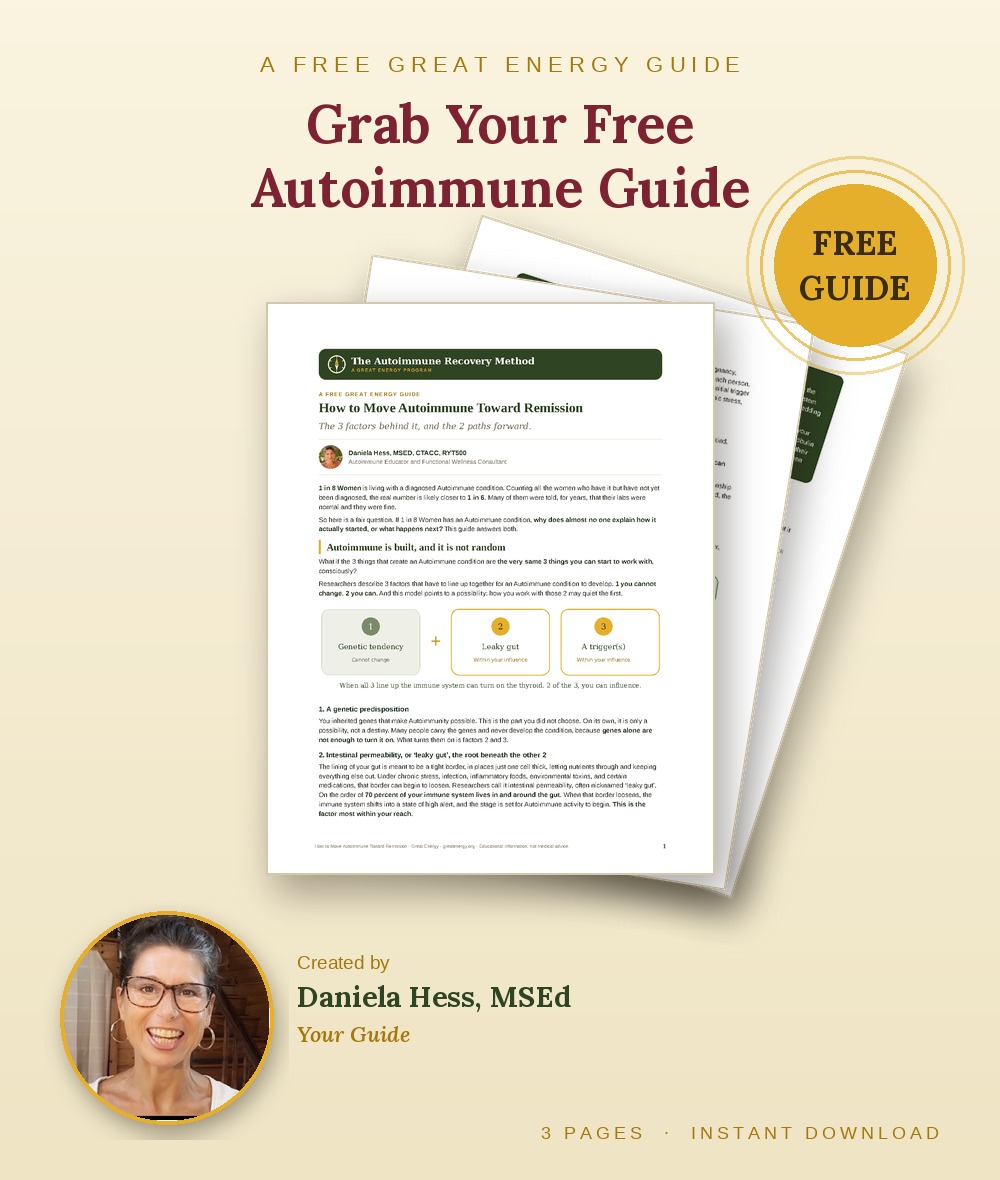
How to Move Autoimmune Toward Remission
The 3 factors behind an Autoimmune condition and the 2 paths forward, free, straight to your inbox.
No spam. Unsubscribe anytime.
Your guide is on its way. You can also open it now (PDF).
Prefer to work together directly? Daniela offers a 1-on-1 labs review and functional wellness session for women with an Autoimmune diagnosis.
See how to work with DanielaRelated reading
Thyroid medication guide: understanding your options Thyroid & LabsTSH: what the number means and doesn't mean Thyroid & LabsThe full thyroid panel: getting the complete picture Thyroid & LabsRemission IS Possible Start HereWhat your thyroid does, and what changes when it does not work Thyroid & Labs
About the author
Daniela Hess, MSEd, is the co-founder of Great Energy and the founder of the Autoimmune Recovery Method. She is an Autoimmune Educator and Coach, a Functional Wellness Consultant, and a certified AIP coach. She lives and thrives with Hashimoto’s and hypothyroidism, and she teaches the science and the Soul of moving an autoimmune condition toward Remission. She is not a licensed medical provider and does not diagnose, treat, or prescribe. Everything here is for education, not medical advice.
With Great Energy & Great Love,
Daniela
From the glossary
Words in this article you can look up. Tap or click a term to learn what it means.
AntibodyBlood sugarFlareFree T3Free T4GlutenHashimoto's thyroiditisHypothyroidismImmune systemInflammationMolecular mimicryRemissionThyroid antibodiesTight junctions