Gut & Immune
Leaky gut: what it is and why it matters for autoimmunity
By Daniela Hess · Great Energy · June 30, 2026

It really takes something to be here. To change how you eat, to learn a whole new vocabulary, to pay attention to a body that, for some of you, has not felt like a reliable place to live in years.
Having an Autoimmune condition is a crash course in learning and education, and that takes something. It is worth acknowledging before we go a step further.
And understanding what is actually happening underneath, in your gut, is worth that effort, because this is not fringe wellness territory. In the medical literature it is called 'intestinal permeability', and there are thousands of peer-reviewed studies on it. 'Leaky gut' is the kitchen-table name for it, and the science underneath that name is serious.
It is a significant and common contributing mechanism in all Autoimmune conditions, from Hashimoto's to hypothyroidism and on to others like celiac, rheumatoid arthritis, and inflammatory bowel disease.
It is the second of the 3 necessary factors, the more permeable gut barrier, and it feeds straight into the third, because a leaky gut is part of how the triggering load gets in. Understanding it helps you understand why this work matters.
If you are new here, leaky gut is one piece of the Autoimmune Recovery Method (ARM), a complete approach to moving an Autoimmune condition 'Toward Remission'. The gut barrier is one of the 3 factors the whole method is built around, and the big picture is laid out in 'The 3 Factors Behind Every Autoimmune Condition'. This article zooms in on that one factor, the gut wall, so the rest of ARM has a foundation to build on.
What is supposed to happen
Here is the scale of it first, because it is hard to believe. The lining of your small intestine is a single cell thick. One layer of cells stands between the contents of your gut, the half-digested food and the trillions of bacteria, and your bloodstream. That is all.
And that single layer is designed to be selectively permeable, and the word selectively is the whole point. Tiny structures called tight junctions stitch those cells together and act as gatekeepers, regulating what passes through, letting digested nutrients in and keeping everything else out.
When those tight junctions are working properly, the immune system that patrols the gut does its job quietly. Food gets broken down, nutrients get absorbed, and bacteria and undigested proteins stay where they belong. A healthy gut wall is a discerning door, opening just enough, just for the right things, never simply sealed shut.
What goes wrong
When the tight junctions are compromised, the gate stops closing properly, and larger particles slip through that are not supposed to be there. Food proteins. Bacterial fragments. Lipopolysaccharides, or LPS, which are pieces of the outer membrane of bacteria and powerful triggers of inflammation.
What pries those junctions open is worth understanding plainly, because much of it is reachable. There is gluten, and this one is mechanical and specific: gliadin, the protein in gluten, triggers the release of a signaling molecule called zonulin, and zonulin is the body's own key for unlocking the tight junctions.
When zonulin floods the system, the gate is told to open. In most people it reseals; in those who are genetically susceptible or already inflamed, it stays propped open too long.
And it is not only gluten. Grains more broadly, including the non-gluten ones, carry compounds that can irritate and inflame the gut lining, which is part of why ARM goes grain-free, not only gluten-free. I lay out that fuller case in 'Grain-Free, Not Just Gluten-Free, and Why Dairy Comes Out Too'.
There is a second piece to the grain story. Once the gut is already leaky, grain proteins are among the particles that slip through the open gate into the bloodstream, where the immune system meets them and reacts. So grains can be both a cause of the leak and, once it is open, one of the things floating through it.
Beyond gluten there are other inflammatory foods, medications like NSAIDs, regular alcohol, chronic stress that keeps the body in a state poorly suited to digestion and repair, dysbiosis where the balance of gut bacteria has tipped, infections and overgrowths such as Candida or parasites or SIBO, and the low-grade chronic inflammation these things feed. They overlap and reinforce each other, which is part of why this can feel hard to untangle on your own.
The immune system finds these particles in the bloodstream, where they were never meant to be, and treats them as invaders. It mounts an inflammatory response, the right response to the wrong location.
And because some of those food proteins, particularly gluten, have a molecular structure that closely resembles human tissue, thyroid tissue, nervous system tissue, that loyal defense can begin landing on the body's own cells along with the food protein. This case of mistaken identity, called molecular mimicry, is a key mechanism behind most Autoimmune conditions, the same family that includes Hashimoto's and hypothyroidism alongside others like multiple sclerosis, lupus, and type 1 diabetes.
It is the immune system chasing a real threat and landing, by molecular resemblance, on you. I unpack exactly how this happens in 'Molecular Mimicry: How One Protein Teaches the Immune System to Attack Another'.
Hold this clearly, because the usual language lands hard on women: your immune system is not malicious and it has not betrayed you. It is a devoted, exhausted protector working from crossed signals, mounting a real and loyal defense against a target it has misidentified. Mistaken identity, not malice.
The leaky brain connection
The same process that damages the gut lining tends to damage the blood-brain barrier. They are structurally similar, they use similar tight junction proteins, and they are regulated by similar systems, almost like two gates built by the same hands.
Many people with intestinal permeability also have increased brain permeability, which shows up as brain fog, mood changes, cognitive difficulty, and heightened sensitivity to environmental factors. This is part of why Hashimoto's often produces symptoms that look more like depression or cognitive decline than a classic thyroid problem.
The fog is not separate from the gut. It is often the gut, showing up in the head. I go further into this two-way street in 'The Gut-Brain-Immune Axis: Why Gut Health Is Brain Health'.
I want to say this plainly, because most people are never told it: cognitive issues are directly related to poor gut health. If you have spent time wondering whether the fog and the fatigue are REAL, they are. The body is telling the truth. You are not losing your mind, and you are not lazy. And the place to address them reaches well beyond the head, all the way down into the gut.
What leaky gut is not
Leaky gut is not a nutrient deficiency that a supplement fixes. Gut-healing nutrients (L-glutamine, collagen, zinc carnosine, deglycyrrhizinated licorice) can calm gut inflammation and support repair. But they address the symptom of permeability, not the cause.
When the cause is a food that keeps triggering immune inflammation, the gut cannot complete its repair as long as that food is still in the picture. This is the primary reason diet precedes everything else in ARM, and why the shift away from processed food matters so much, the case I make in 'For the Love of Whole Foods: The Shift from Processed to Real'.
There is something else worth addressing here. Removing the foods that drive inflammation is necessary, but it is only half the work. As I tell the women I work with, 'What we eliminate stops the damage, but removing foods is not enough. What we DO eat is what feeds the microbiome and fuels the body.'
Along with an end to the injury, the gut needs to be fed, with nutrient density and variety, so the lining can rebuild and the good bacteria can do their work. Stopping the harm and feeding the repair are two different jobs, and your gut needs both.
Leaky gut is also not a single condition with a single fix. Some people resolve it relatively quickly with dietary changes and gut-healing support. Others have underlying drivers (chronic infections, mold exposure, active Autoimmune inflammation, persistently unstable blood sugar) that need more specific attention before the gut can hold its repair.
If you are one of the people for whom this is taking longer, it simply means your body has more to tend to first. It is information about what it still needs.
Leaky gut and Autoimmunity: the honest picture
Fixing intestinal permeability will not cure an Autoimmune condition, whether that is Hashimoto's, hypothyroidism, or one of the others like psoriasis, rheumatoid arthritis, or lupus, because Autoimmune conditions are not curable, and I will not pretend otherwise. What it does is something genuinely worth your effort: it removes a major ongoing driver of immune activation.
When the gut is less permeable, the immune system receives fewer inflammatory signals, flares tend to be less frequent and less severe, and the condition becomes more manageable. That is REAL and meaningful, even though it is not a cure. Quieting a fire is worth doing even when you cannot remove the match.
This is also why, in everything I teach, the gut comes first. Nothing in the body works in a vacuum, it is all connected, and the gut sits underneath the rest of it. Hormones, mood, energy, the way you tolerate food, the way your immune system behaves: all of it is shaped by what is happening in your gut.
The order of healing looks different for everyone, and over time you may need to address other contributing factors too. But the one constant is that everything builds on gut healing. Start there, and you are working on the foundation under all the rest.
The goal ARM is working toward is Remission: a state where the immune system is quiet, symptoms are low, and you are living with a condition rather than being lived by it. I explain why this distinction is actually good news in 'Remission, Not Cure: Why This Distinction Matters, and Why It Is Actually Good News'. Each thing you do to support your gut is a contribution toward that. It adds up, even on the days it does not feel like it.
So breathe in deep, exhale long, and let your shoulders come down from your ears. Be patient with the timeline, and be patient with yourself. You do not have to figure this out alone.
And notice the quiet, steady voice that brought you this far, the one reading right now. Sometimes it seems to speak from your head, sometimes your heart, sometimes from the space between your thoughts. It is the part of you that keeps championing for you, even on the days you cannot quite champion for yourself, the kind voice that always guides you back toward harmony and balance.
The Sufi poets Rumi and Hafiz called it the Friend. Trust it. And know that tending this voice is not separate from the physical work, and it is woven all through the Autoimmune Recovery Method, as I explain in 'The Inner Work Is Not Soft: Why Mindset and Connection Are Part of Recovery'.
Note from the first pass (please weigh in)
- Source said leaky gut 'sits at the center of most Autoimmune conditions'; softened to 'a common contributing mechanism' per the Datis Kharrazian 3-factor guardrail.
---
Questions people ask
Is leaky gut real, or is it a wellness fad?+
What actually happens in a leaky gut?+
Can leaky gut cause Autoimmune disease?+
Why does leaky gut cause brain fog?+
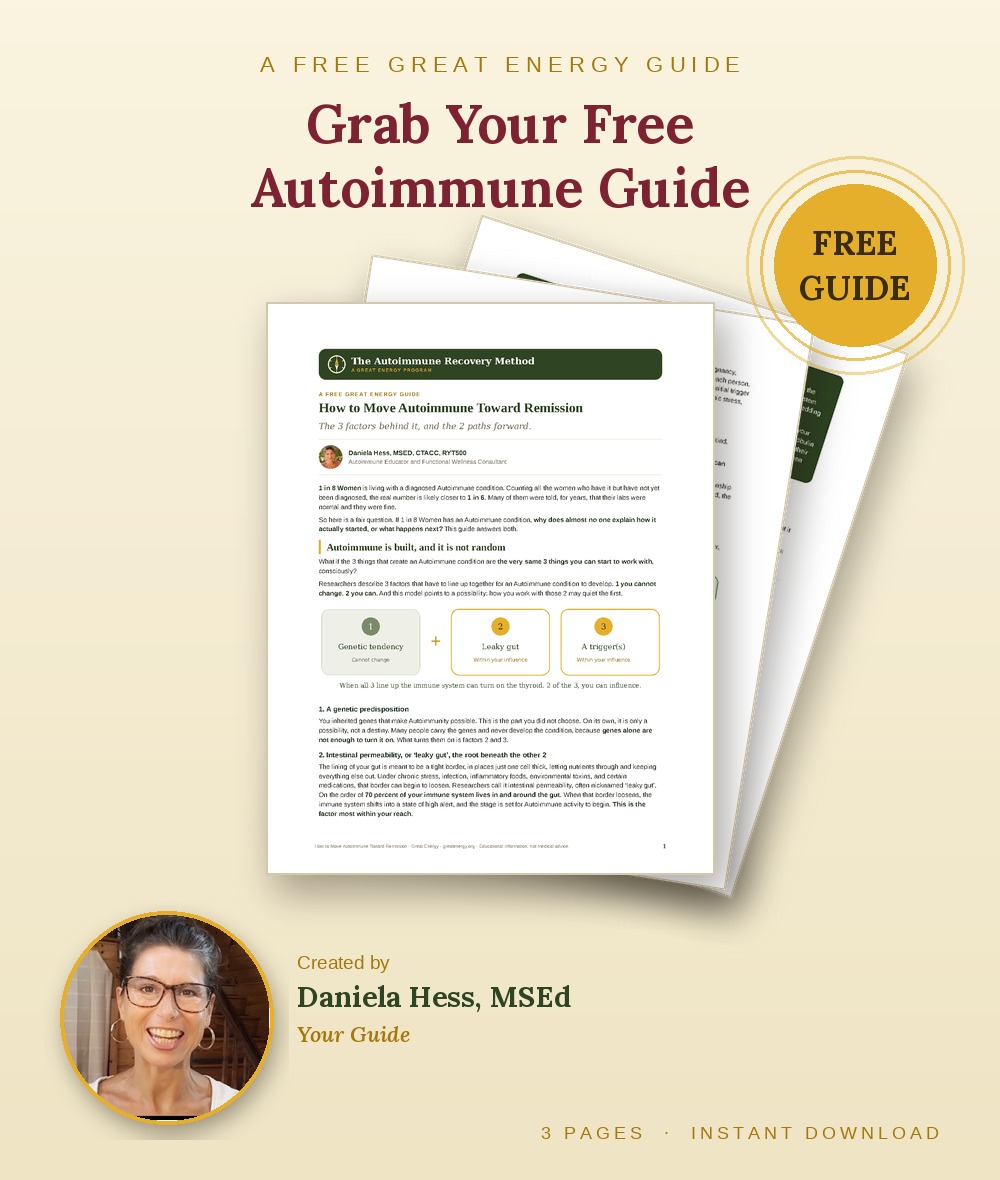
How to Move Autoimmune Toward Remission
The 3 factors behind an Autoimmune condition and the 2 paths forward, free, straight to your inbox.
No spam. Unsubscribe anytime.
Your guide is on its way. You can also open it now (PDF).
Prefer to work together directly? Daniela offers a 1-on-1 labs review and functional wellness session for women with an Autoimmune diagnosis.
See how to work with DanielaRelated reading
Intestinal permeability and autoimmunity: the gate that should be closed Gut & ImmuneHow AIP works on the gut Gut & ImmuneInflammation: the difference between acute and chronic Gut & ImmuneAutoimmunity explained: what the immune system is doing and why Gut & ImmunePolyautoimmunity: why one autoimmune condition often becomes more than one Gut & Immune
About the author
Daniela Hess, MSEd, is the co-founder of Great Energy and the founder of the Autoimmune Recovery Method. She is an Autoimmune Educator and Coach, a Functional Wellness Consultant, and a certified AIP coach. She lives and thrives with Hashimoto’s and hypothyroidism, and she teaches the science and the Soul of moving an autoimmune condition toward Remission. She is not a licensed medical provider and does not diagnose, treat, or prescribe. Everything here is for education, not medical advice.
With Great Energy & Great Love,
Daniela
From the glossary
Words in this article you can look up. Tap or click a term to learn what it means.
Blood sugarBlood-brain barrierHypothyroidismImmune systemInflammationL-glutamineLeaky brainMicrobiomeMolecular mimicryMultiple sclerosisNutrient densityRheumatoid arthritisTight junctionsType 1 diabetes