Start Here
The 3 factors behind every Autoimmune condition
By Daniela Hess · Great Energy · June 27, 2026

Let me show you how this actually works, plainly. Once you see it, your body stops being a mystery and starts making sense. It is responding to conditions, and most of those conditions you can touch.
These 3 factors are the foundation of the Autoimmune Recovery Method (ARM), a complete approach to moving an Autoimmune condition 'Toward Remission'. Understand them, and everything else in the Autoimmune Recovery Method falls into place.
Researchers who study Autoimmunity, one of my favorites being Datis Kharrazian, describe a model where an Autoimmune condition usually needs 3 things to line up together. Not 1. THREE.
Sit with that for a moment, because it may be the most hopeful sentence in this whole protocol. A condition that needs 3 things to line up is a condition you can meet in more than one place.
Factor 1: a genetic susceptibility
The first factor is a genetic susceptibility. You inherited a particular tendency, a set of genes that makes a certain kind of immune confusion more likely. Maybe Hashimoto's runs in your family, or psoriasis, or rheumatoid arthritis, or lupus, or type 1 diabetes, or something no one ever named out loud.
This is the factor people fixate on, because it can feel like a sentence handed down at birth. It is not. Think of it this way: your genes may load the gun, but they do not pull the trigger. A tendency is not a destiny. A gene that can be expressed can also stay quiet for a whole lifetime, depending on what is happening around it and inside it.
This is the one factor you cannot change, and it is also the one that does the least on its own. It needs the other 2 to speak up. Which is exactly where your leverage lives.
Factor 2: the gut barrier
The second factor is the gut barrier, and I want you to really see this one, because it is more delicate than most people imagine. The lining of your gut, the wall that decides what gets into your bloodstream and what stays out, is a single cell thick. One cell.
A barrier as fine as that, holding back the whole outside world you take in as food, is a small miracle, and it is also easily disturbed.
When that lining is healthy, it is selective: it lets nourishment through and keeps the rest where it belongs. When it becomes more permeable, what you may have heard called intestinal permeability or 'leaky gut', the spaces between those cells loosen, and things slip through that were never meant to cross.
This appears to be a common contributing mechanism in many Autoimmune conditions. I am saying 'appears' on purpose. This is a proposed, well-studied pathway, not a verdict stamped on your particular body.
So what loosens that one-cell wall in the first place? More than most people are ever told. Gluten is the most studied. The gliadin protein in gluten signals the gut to release zonulin, a molecule that opens the tight junctions between those cells, the very seams meant to stay closed, in nearly everyone who eats it.
Dairy is another common agitator, both as an inflammatory food and because its proteins can provoke the immune system in sensitive people. Beyond those 2, the usual inflammatory foods stir the same pot: refined sugar, industrial seed oils, alcohol, and the long list of processed foods built from them, which is why the move away from processed food matters so much, a shift I make the case for in 'For the Love of Whole Foods: The Shift from Processed to Real'.
And it is not only food. Chronic stress that keeps the body out of rest and repair, frequent anti-inflammatory medications, infections, an imbalance in the gut bacteria, and too little stomach acid to break food down well all loosen that wall too.
You will notice that most of these are also factor 3 triggers. That is not a coincidence. The triggers and the gut barrier are deeply entangled, each one feeding the other, which is also why working on them together is so powerful.
Factor 3: the triggers
The third factor is the triggers, and this is the longest list of the 3, because so many different things can tip a susceptible body over. I will list them more fully than most resources do, so you can find yourself somewhere in here.
There are the infections: viruses like Epstein-Barr, bacteria, parasites, an overgrowth of Candida. There is mold, and the load of environmental toxins most of us carry. There is chronic stress, the kind that never fully switches off.
There are the big emotional events, a sudden shock, a heartbreak, a loss, a season of grief that the body keeps holding long after the mind has tried to move on. There is poor sleep, stretched thin over years. There are hormonal shifts, which is part of why so many of us first feel this in Perimenopause. And there are certain foods.
Not all of these are yours. Some of them are. Part of this protocol is finding out which, with patience and without blame.
Where your power lives
Now here is the part that hands you your power back, so read it slowly, with me.
YOU cannot change factor 1. Your genes are your genes, and you can stop blaming yourself for them tonight. Factors 2 and 3 are the ones that turn the volume up or down on factor 1. The gut barrier and the triggers are the dial.
When the gut is inflamed and the triggers are stacking up, the volume goes up, and your genetic tendency gets expressed as symptoms. Settle the gut, ease the triggers, and the volume can come down. The tendency is still there. It is just quieter.
That is the whole logic of the Autoimmune Protocol. It works directly on factor 2, calming the gut and giving that one-cell lining the conditions it needs to repair. And it is also how you begin to meet factor 3, because the food you remove and then reintroduce is one of the biggest trigger categories there is.
The food is the doorway into both. The deeper, non-food triggers of factor 3, we come to in their own time.
I want to be honest about what this asks of you, because the third factor is where the real, ongoing work lives. Your triggers are not a list you find once and then never have to think about again. They are a discovery you keep making.
Some triggers are food, and you will meet those in reintroduction, one at a time, on purpose. Some triggers are not food at all, and those ask for a different kind of attention: the quality of your relationships, the rhythm of your days, your sleep, the thoughts you live inside, the stress you have called 'normal' for too long.
We will go into all of it, gently, in the work ahead. For now I just want you to know it is coming, and that food is only the beginning.
This is why I keep saying you have to keep discovering, day after day. It is not because the protocol is endless. It is because you are a living system, not a fixed one. The same food can sit differently in a calm week than in a brutal one.
And here is what I most want you to take from this: your body is brilliant. It is communicating with you all the time, in sensation, in energy, in symptoms, in the way you sleep and digest and feel. None of that is random. It is a language, and it is always telling the truth. Your work is to slow down enough to listen, and to learn what your body is actually saying.
When a flare comes
First, let me say plainly what a flare even is, because the word gets used a lot and explained rarely. A flare is your symptoms rising again after a quieter stretch, your body turning the volume back up for a while. It looks different for every woman and every condition.
It might be a wave of fatigue that flattens you for a day or 3. It might be joints that ache or swell, brain fog that thickens, digestion that turns unsettled, skin that breaks out or flushes, headaches, a dip in mood, a shorter fuse, a new sensitivity to foods or smells or light that was not there last week. For some women it is 1 clear signal. For others it is a whole cluster arriving together.
None of it means you are back at the beginning. We have a whole article devoted to flares and how to tend them, so here I only want to give you the very first move.
When a symptom flares, notice the old question that rises first: 'what did I do wrong'. That question keeps you small and afraid, and it teaches you nothing. Reach for curiosity instead. Before you analyze a single thing, take one slow breath into your belly, a long exhale, and let your body feel that it is not in trouble with you. That diaphragmatic breath is a direct signal of safety to your nervous system, and it helps it settle.
Then, gently, ask what changed. What did you eat. How did you sleep. What did you carry this week. This is where a simple food and symptom journal earns its keep, and we have one ready for you to use, because the patterns that are invisible day to day often become obvious on the page.
When a flare comes, you are being handed information about your own 3 factors, and that is exactly the information this protocol is built to help you read.
What Autoimmunity really is
One more thing, because it matters and almost everyone misses it. You will often hear an Autoimmune condition described as 'the body attacking itself'. I want to retire that phrase with you, because I have felt the quiet shame it can carry, even in some spiritual circles, where a woman is left believing this is somehow her fault, or a sign that she is at war with herself. It is not.
Here is a truer picture. Your immune system is a devoted protector. It has been standing watch for years, often without rest, working from signals that got crossed somewhere along the way.
Picture it like this. A food protein, gluten is the classic one, slips through that one-cell gut wall where the zonulin-opened seams have loosened. Out in the bloodstream, that gluten protein happens to look remarkably like your own thyroid tissue.
The protector, doing exactly the job it was built for, cannot tell the 2 apart, so it moves against both, the gluten and the thyroid that resembles it. Researchers call that resemblance molecular mimicry.
Dairy can play the same trick in some people. It is a case of mistaken identity, not malice. Not self-hatred. Not punishment.
So this is not a body at war with itself. It is a loyal, exhausted guard, doing its job too well, with confused information.
Our work together is to clear the confusion: settle the gut, ease the triggers, and give that guard enough rest and enough accurate information to tell friend from foe again. As the conditions change, the immune system has a real chance to grow calmer.
3 factors. 1 you cannot change, and 2 you can. The next pages are about exactly how we move the 2 you can.
Questions people ask
What are the 3 factors that cause Autoimmune disease?+
Is Autoimmune disease genetic or hereditary?+
What is leaky gut and how is it connected to Autoimmune disease?+
Does gluten cause leaky gut?+
What triggers an Autoimmune flare?+
Does the immune system really attack itself in Autoimmune disease?+
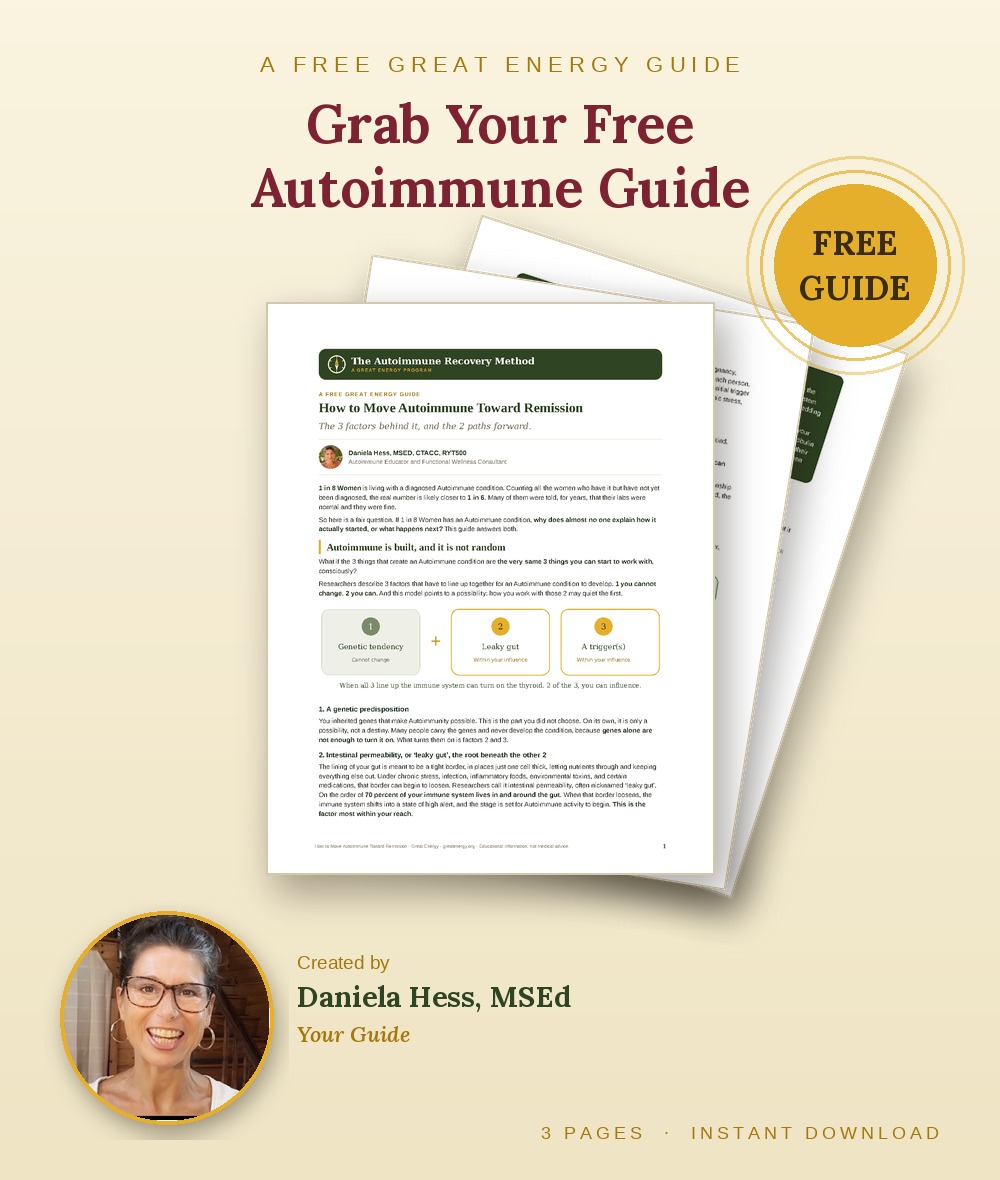
How to Move Autoimmune Toward Remission
The 3 factors behind an Autoimmune condition and the 2 paths forward, free, straight to your inbox.
No spam. Unsubscribe anytime.
Your guide is on its way. You can also open it now (PDF).
Prefer to work together directly? Daniela offers a 1-on-1 labs review and functional wellness session for women with an Autoimmune diagnosis.
See how to work with DanielaRelated reading
Meet Your Guide, Daniela Hess, the Founder and Creator of the Autoimmune Recovery Method Start HereThe Autoimmune Diseases: What Autoimmunity Really Is, and Why It Lands Where It Does Start HereWhy women carry the Autoimmune burden Start HereRemission IS Possible Start HereThe ARM Map: The Whole Method, Start to Finish Start Here
About the author
Daniela Hess, MSEd, is the co-founder of Great Energy and the founder of the Autoimmune Recovery Method. She is an Autoimmune Educator and Coach, a Functional Wellness Consultant, and a certified AIP coach. She lives and thrives with Hashimoto’s and hypothyroidism, and she teaches the science and the Soul of moving an autoimmune condition toward Remission. She is not a licensed medical provider and does not diagnose, treat, or prescribe. Everything here is for education, not medical advice.
With Great Energy & Great Love,
Daniela
From the glossary
Words in this article you can look up. Tap or click a term to learn what it means.
CandidaGliadinImmune systemIndustrial seed oilsMolecular mimicryPerimenopausePsoriasisReintroductionRemissionRheumatoid arthritisThyroidTight junctionsType 1 diabetesZonulin