Start Here
Why women carry the Autoimmune burden
By Daniela Hess · Great Energy · July 3, 2026

Roughly 80 percent of all Autoimmune conditions affect women. Approximately 1 in 6 women has an Autoimmune condition, and many do not know it yet.
That is not a coincidence, and it is not because women's bodies are more fragile. It is because women's bodies run a more complex, more reactive immune system, and medicine has been slow, in some cases centuries slow, to actually study it. This is one piece of why the Autoimmune Recovery Method (ARM), a complete approach to moving an Autoimmune condition 'Toward Remission', exists at all.
The X chromosome
Women carry 2 X chromosomes. Men carry 1. The X chromosome carries a large number of immune-regulating genes, and 2 copies means a more reactive immune system overall, more protective against infection, and more prone to turning on itself.
Estrogen
Estrogen directly amplifies immune activity. It is part of why women mount stronger immune responses than men do, and part of why the immune system can become overactivated, especially during the hormonal shifts of Perimenopause, postpartum, and pregnancy.
The gut
Women's gut microbiomes are more vulnerable to disruption from stress, hormonal shifts, antibiotics, and diet. Since roughly 70 percent of the immune system lives in the gut, a disrupted gut is often where Autoimmunity begins. Remember, 3 things have to come together for an Autoimmune condition to take hold: a genetic predisposition, an impaired, permeable gut lining, and a trigger, often chronic stress that compounds, a viral infection, mold, or Lyme, to name only a few. I lay this out in full in 'The 3 Factors Behind Every Autoimmune Condition'.
Pregnancy and fetal microchimerism
During pregnancy, fetal cells cross into the mother's body and can remain there for decades, a phenomenon called fetal microchimerism. Researchers have found these fetal cells far more often in Hashimoto's thyroid tissue than in healthy thyroid tissue, though the exact role they play, whether they help trigger the immune confusion or simply show up alongside it, is still being studied. It is one plausible piece of why Hashimoto's so often emerges or worsens after pregnancy, not a single, settled cause.
Trauma
Women experience higher rates of the specific trauma types, sexual trauma, domestic violence, and relational childhood adversity, that carry the strongest documented links to later Autoimmune onset. Because estrogen sensitizes the stress response system, women's bodies amplify the biological impact of that stress more than men's bodies do. Chronic, low-grade cortisol dysregulation, not one dramatic event but the slow, grinding kind, is one of the most powerful drivers of immune dysregulation we know of.
A medical system that is under-investigating women
Here is where it gets harder to hear, and I want to say it plainly. In my own practice, I see this pattern again and again: a woman is put on an antidepressant or an anti-anxiety medication without ever having her sex hormones, ferritin, testosterone, or full thyroid panel checked. And even when those labs are run, they are almost never interpreted through Functional Medicine optimal ranges, only through conventional 'normal' ranges built on a sick population.
What gets missed and why
You can have a TSH that a conventional doctor calls normal and still feel exhausted, anxious, depressed, and like you are losing your mind. Depression and anxiety are real, and they deserve real treatment. And for some women, what looks identical to depression and anxiety on the surface is actually an undiagnosed physiology problem underneath it, treated as purely psychological because no one ever checked.
Here is what that can look like in practice:
- Hypothyroidism and low ferritin can mimic anxiety and depression
- Low sex hormones, estrogen, progesterone, and testosterone, can mimic depression
- Low adrenal function and cortisol dysregulation can mimic anxiety, fatigue, and depression
None of these show up on a psychiatric intake form. They show up on a lab requisition, if anyone thinks to write one. The hormonal layer underneath all of this, and what Perimenopause does to it, is the subject of my Midlife and Perimenopause work at The Midlife Mentor.
The labs that get skipped
The hardest part
CDC data confirms that suicide rates for women peak in Midlife, between ages 45 and 64, higher than any other stage of a woman's life. What I am about to say next is my own view, not a clinician's, and I want to be precise about that: it is not a proven, settled statistic, it is a pattern I have watched closely and cannot unsee. In my opinion, a meaningful number of those women are carrying undiagnosed or undertreated Autoimmune conditions, alongside micronutrient deficiencies, low ferritin, low B12, low vitamin D, or suboptimal thyroid function, conditions that can create symptoms clinically indistinguishable from anxiety and depression. Too often, a woman is offered a prescription before she is ever offered the lab order that might explain what is actually happening in her body.
This is not only a 'mental health crisis'. It is a medical crisis being mislabeled, and it deserves to be investigated as one.
What actually changes this
Women are being under-investigated, under-interpreted, and over-medicated. This is a massive medical system problem, and it is also one that can change, one lab order, one informed conversation, one woman at a time.
If any part of this sounds like your own story, here are the questions to bring to your next appointment, read against Functional Medicine optimal ranges, not just the conventional 'normal' range:
- A full thyroid panel: TSH, free T3, free T4, reverse T3, and thyroid antibodies, not just TSH alone. I break this down fully in 'Your Thyroid Labs Cheat Sheet'.
- A full iron panel, including ferritin
- Sex hormones
- Vitamin D
- Vitamin B12
- Zinc
- Selenium
- Copper
- Your regular CBC, whatever markers measure inflammation, and anything else on your mind that is not unreasonable to ask for
You are not asking for too much. You are asking for the workup your body has been due for years.
And once those labs are drawn, how they get read matters as much as whether they get ordered. Here is the difference that matters most: conventional 'normal' ranges are built from a sick population, an average of people who are already ill, so they only flag you once you are sick enough to match that average. Functional Medicine 'optimal' ranges work the other way. They ask what a thriving body actually looks like, and they let you catch the drift toward dysfunction years before it turns into a diagnosis. One waits to treat you until you are sick. The other gets ahead of it, so you can actually thrive, not just avoid falling further behind. Ask specifically for your labs to be read against optimal ranges, not simply told they fall inside 'normal'.
If today has been hard, or harder than hard, reach a crisis line or a trusted person first, before anything else in this article. You do not need the right words for that, only the willingness to say something.
Once you are safe and steady enough to think about next steps, if you recognize yourself in the pattern this article describes, tell a doctor or a therapist plainly: 'I think there might be something physical going on underneath this, and I do not want to sort it out alone.' That single sentence can open the right door, a lab order, a referral, or simply someone willing to look further than a prescription pad. You are not imagining this, and you are not alone in it. Millions of women are living this exact pattern right now, and this article exists so that a few more of you get looked at closely, instead of just labeled.
Questions people ask
Why are women more likely to get Autoimmune diseases than men?+
Can hormones trigger Autoimmune disease?+
Can pregnancy trigger or worsen Hashimoto's?+
Can undiagnosed thyroid problems be mistaken for anxiety or depression?+
What labs should I ask for if I think something Autoimmune is going on?+
Can trauma or chronic stress cause Autoimmune disease?+
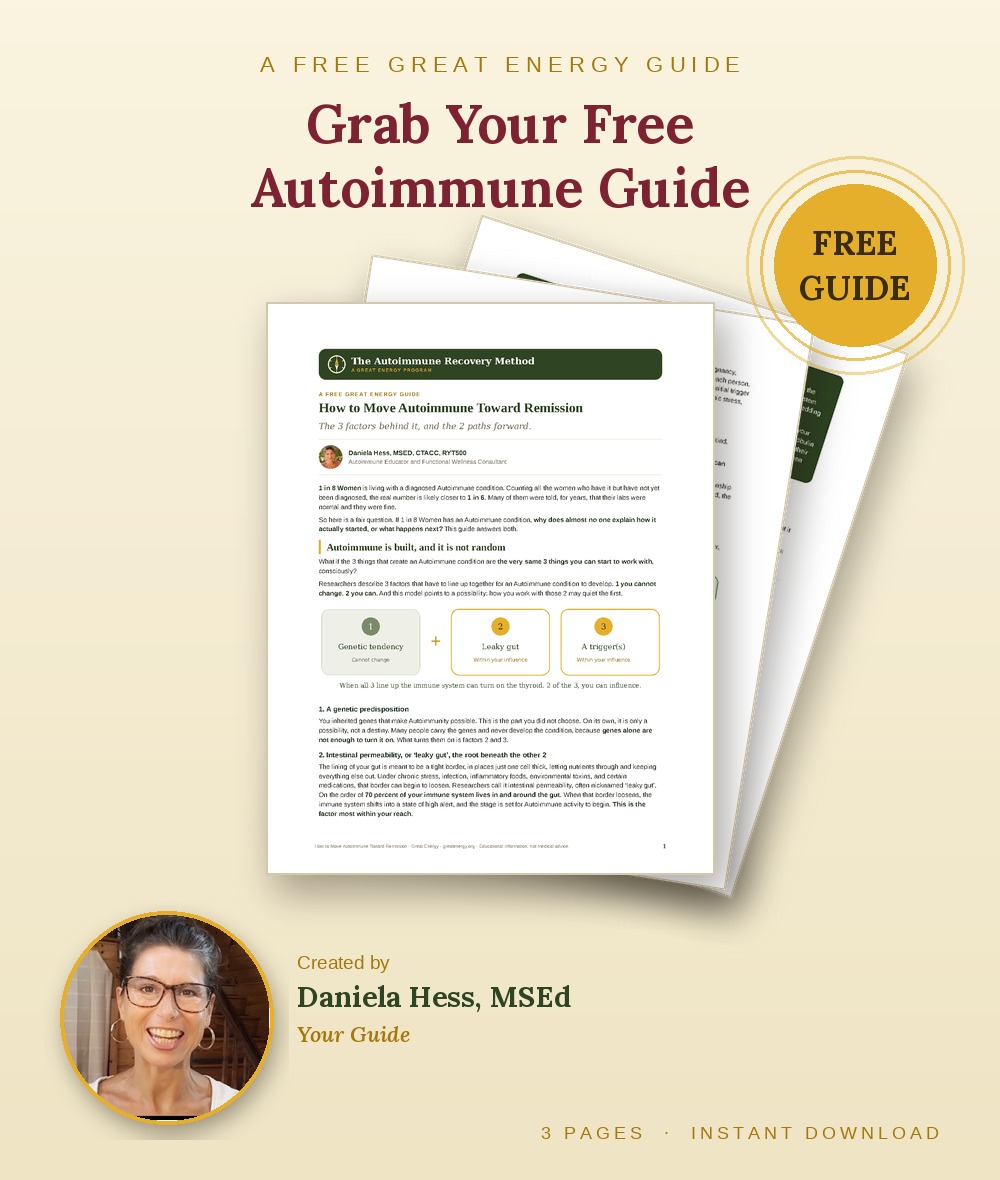
How to Move Autoimmune Toward Remission
The 3 factors behind an Autoimmune condition and the 2 paths forward, free, straight to your inbox.
No spam. Unsubscribe anytime.
Your guide is on its way. You can also open it now (PDF).
Prefer to work together directly? Daniela offers a 1-on-1 labs review and functional wellness session for women with an Autoimmune diagnosis.
See how to work with DanielaRelated reading
Remission IS Possible Start HereYou are not alone in this Start HereAutoimmunity explained: what the immune system is doing and why Gut & ImmuneMeet Your Guide, Daniela Hess, the Founder and Creator of the Autoimmune Recovery Method Start HereThe 3 factors behind every Autoimmune condition Start Here
About the author
Daniela Hess, MSEd, is the co-founder of Great Energy and the founder of the Autoimmune Recovery Method. She is an Autoimmune Educator and Coach, a Functional Wellness Consultant, and a certified AIP coach. She lives and thrives with Hashimoto’s and hypothyroidism, and she teaches the science and the Soul of moving an autoimmune condition toward Remission. She is not a licensed medical provider and does not diagnose, treat, or prescribe. Everything here is for education, not medical advice.
With Great Energy & Great Love,
Daniela
From the glossary
Words in this article you can look up. Tap or click a term to learn what it means.
CortisolEstrogenFerritinHypothyroidismImmune dysregulationImmune systemInflammationPerimenopauseProgesteroneRemissionTestosteroneThyroid antibodiesVitamin B12Vitamin D