Thyroid & Labs
Your thyroid labs: a cheat sheet to bring to your doctor
By Daniela Hess · Great Energy · June 30, 2026

This is a quick reference to help you understand your own thyroid labs and make better sense of them, so you can walk into your appointment with clearer questions. It is education, not medical advice, and not me acting as your doctor. Your prescriber makes every medication decision, and how you feel always counts alongside the numbers. And hold the rule underneath all of it: normal is not the same as optimal.
This sits alongside the fuller picture in 'The Full Thyroid Panel: Getting the Complete Picture' and the woodworking shop image in 'What Your Thyroid Does, and What Changes When It Does Not Work'.
If the numbers feel like a lot, that is alright. Take a slow breath into your belly, and let your belly expand. This diaphragmatic breathing genuinely helps to calm the nervous system. You are simply learning to read your own body.
The optimal targets to aim for
Read these against the printed range on your own report, because labs differ. 'Upper third' and 'upper half' just mean toward the top of whatever range your report shows.
- TSH: about 0.5 to 1.0, a calm, low number. If you take a medication that contains T3, a TSH below 0.5 is normal and expected, so a low TSH by itself is not a red flag.
- Free T4: the upper half of the range.
- Free T3: the upper third of the range. This is the one most tied to how you feel.
- Reverse T3: near the bottom of the range, a common rule of thumb is under 15.
- Free T3 to Reverse T3 ratio: above 20.
- TPO antibodies (TPOAb) and thyroglobulin antibodies (TgAb): as low as possible. Remission looks like TPOAb under 9 and TgAb under 1.
What your results may point to
This shows how the pattern of your numbers points toward a conversation. It is not a set of instructions, and nothing here is a reason to change a medication on your own. Bring it to the person who prescribes for you, and let them make the call from your whole picture.
- If Free T4 is low, toward the bottom or lower-middle of the range, there may not be enough raw material. This points to a conversation about your T4 (levothyroxine, or a cleaner option like Tirosint).
- If Free T4 looks good but Free T3 is low, you have the raw material and are not turning it into the active hormone. This points to a conversation about conversion: lowering stress, and covering the nutrients it needs, such as selenium, zinc, and iron, and sometimes about whether T3 (liothyronine) belongs in the picture.
- If Reverse T3 is high, around 15 or above, and the ratio is low, around 20 or below, too much is being wasted, usually driven by stress. This points to a conversation about calming the stress drivers, and sometimes about whether the balance of T4 and T3 in your treatment is worth revisiting with your prescriber.
- If TSH is above your optimal zone with low Free T3 and Free T4, and you feel tired, that is the undermedicated picture. This points to a conversation about more thyroid support.
- If Free T3 and Free T4 are running high and you feel wired or have palpitations, that may be too much, and points to a conversation about easing back. One reminder: if you are on a T3 medication, a low TSH on its own does not mean too much. It is the Free T3, the Free T4, and how you feel that tell the real story.
The one-line version to keep in your pocket
- Low Free T4 points to a T4 conversation.
- Low Free T3 with adequate Free T4 points to a T3 and conversion conversation.
- High Reverse T3 points to a stress and conversion conversation, and sometimes to revisiting the T4 and T3 balance with your prescriber.
Before you leave the lab
Make sure the panel included all 6: TSH, Free T4, Free T3, Reverse T3, TPO antibodies (TPOAb), and thyroglobulin antibodies (TgAb). Ask for a copy of your results, and bring the actual numbers to your appointment.
You are allowed to ask for the full panel, and you are allowed to ask again. Understanding your own numbers is not stepping on your doctor's toes. It is showing up to the conversation as a real partner in your own care.
---
Questions people ask
Is an optimal TSH level different from a normal TSH level?+
What thyroid labs should I ask my doctor for?+
What does it mean if Free T4 is normal but Free T3 is low?+
What does high Reverse T3 mean?+
What TPO antibody level indicates Autoimmune thyroid Remission?+
Can a low TSH mean I'm on too much thyroid medication?+
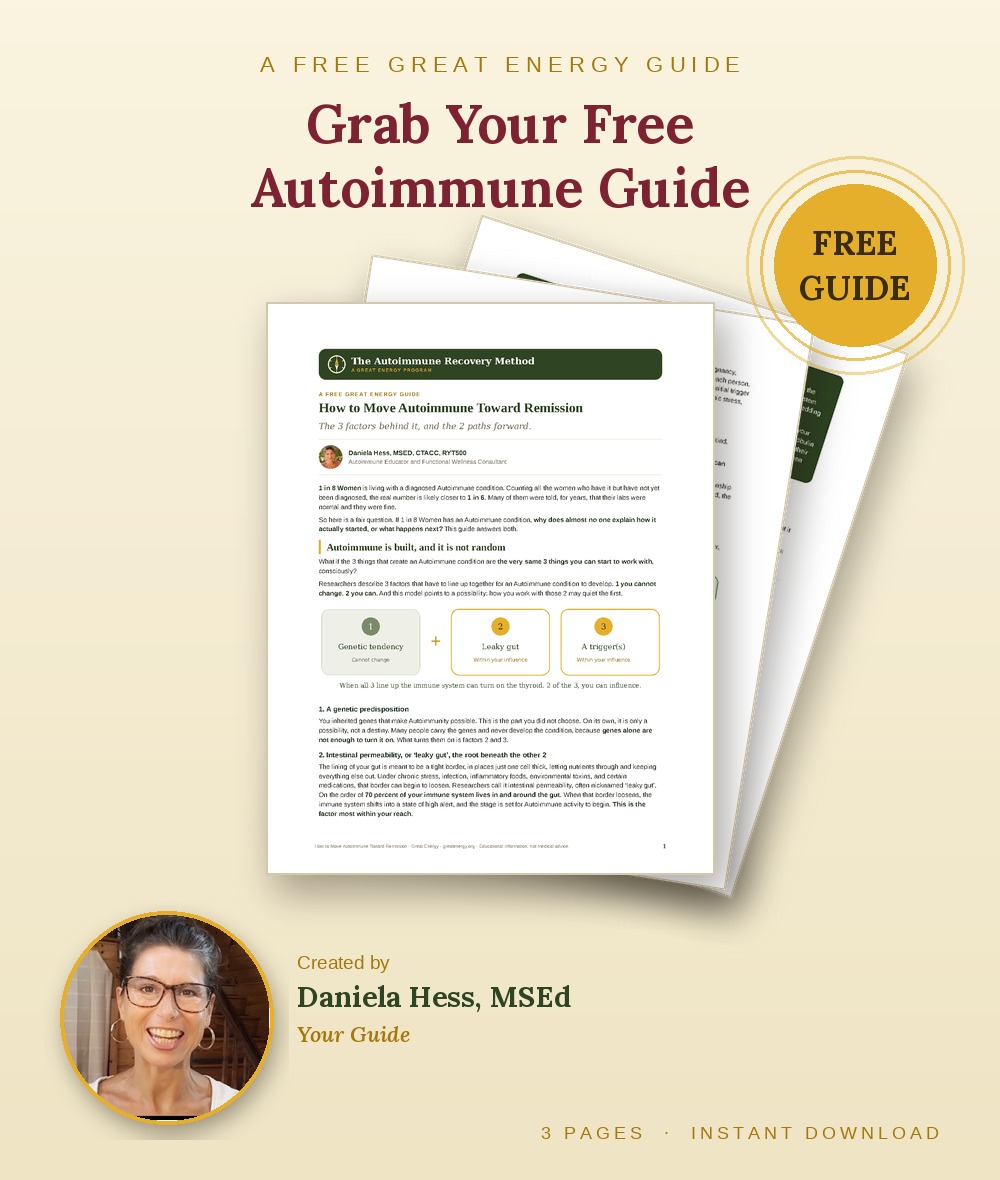
How to Move Autoimmune Toward Remission
The 3 factors behind an Autoimmune condition and the 2 paths forward, free, straight to your inbox.
No spam. Unsubscribe anytime.
Your guide is on its way. You can also open it now (PDF).
Prefer to work together directly? Daniela offers a 1-on-1 labs review and functional wellness session for women with an Autoimmune diagnosis.
See how to work with DanielaRelated reading
Hashimoto's: what is actually happening Thyroid & LabsWhat your thyroid does, and what changes when it does not work Thyroid & LabsWhy T4 to T3 conversion is the piece most thyroid care misses Thyroid & LabsThyroid medication guide: understanding your options Thyroid & LabsTSH: what the number means and doesn't mean Thyroid & Labs
About the author
Daniela Hess, MSEd, is the co-founder of Great Energy and the founder of the Autoimmune Recovery Method. She is an Autoimmune Educator and Coach, a Functional Wellness Consultant, and a certified AIP coach. She lives and thrives with Hashimoto’s and hypothyroidism, and she teaches the science and the Soul of moving an autoimmune condition toward Remission. She is not a licensed medical provider and does not diagnose, treat, or prescribe. Everything here is for education, not medical advice.
With Great Energy & Great Love,
Daniela
From the glossary
Words in this article you can look up. Tap or click a term to learn what it means.
Free T3Free T4LevothyroxineLiothyronineRemissionSeleniumThyroglobulin antibodies (TgAb)ThyroidZinc