Endocrine system
Addison's disease (autoimmune adrenalitis)
Addison's disease affects the adrenal glands, which sit atop the kidneys. The immune system is thought to gradually destroy the outer layer of the adrenal gland, the adrenal cortex, mediated in large part by antibodies against the enzyme 21-hydroxylase. This progressively reduces the gland's ability to produce cortisol and often aldosterone, the hormones that help regulate energy, blood pressure, and the body's stress response. Autoimmunity is understood to be the leading cause of Addison's disease in industrialized countries, and research describes a preclinical phase, sometimes lasting years, in which autoantibodies and mild hormone shifts are present before symptoms appear.
Addison's disease is considered rare. One commonly cited estimate for the United States and Western Europe puts prevalence at roughly 1 in 20,000 people, and separate Norwegian registry data has reported a higher regional figure of around 144 per million, and it is generally described as more common in women.
Common signs
deep fatigue, muscle weakness, weight loss and low appetite, low blood pressure and dizziness on standing, salt cravings, nausea, and darkening of the skin. Symptoms often build slowly and can flare under stress.
This is a plain-language summary for orientation, not a diagnosis. Mechanisms are described as current understanding, not settled fact. Work with your own clinician for your care.
Questions people ask
Can Addison's disease be cured?+
What is the life expectancy of a person with Addison's disease?+
Is Addison's disease genetic?+
In a doctor’s words
“At the end of the day, this is something that people can manage.”
Maria G. Vogiatzi, MD, Medical Director, Adrenal and Puberty Center, Children's Hospital of Philadelphia (CHOP)
Read more at Children's Hospital of Philadelphia (Patient Story: Grayson's Story) ↗
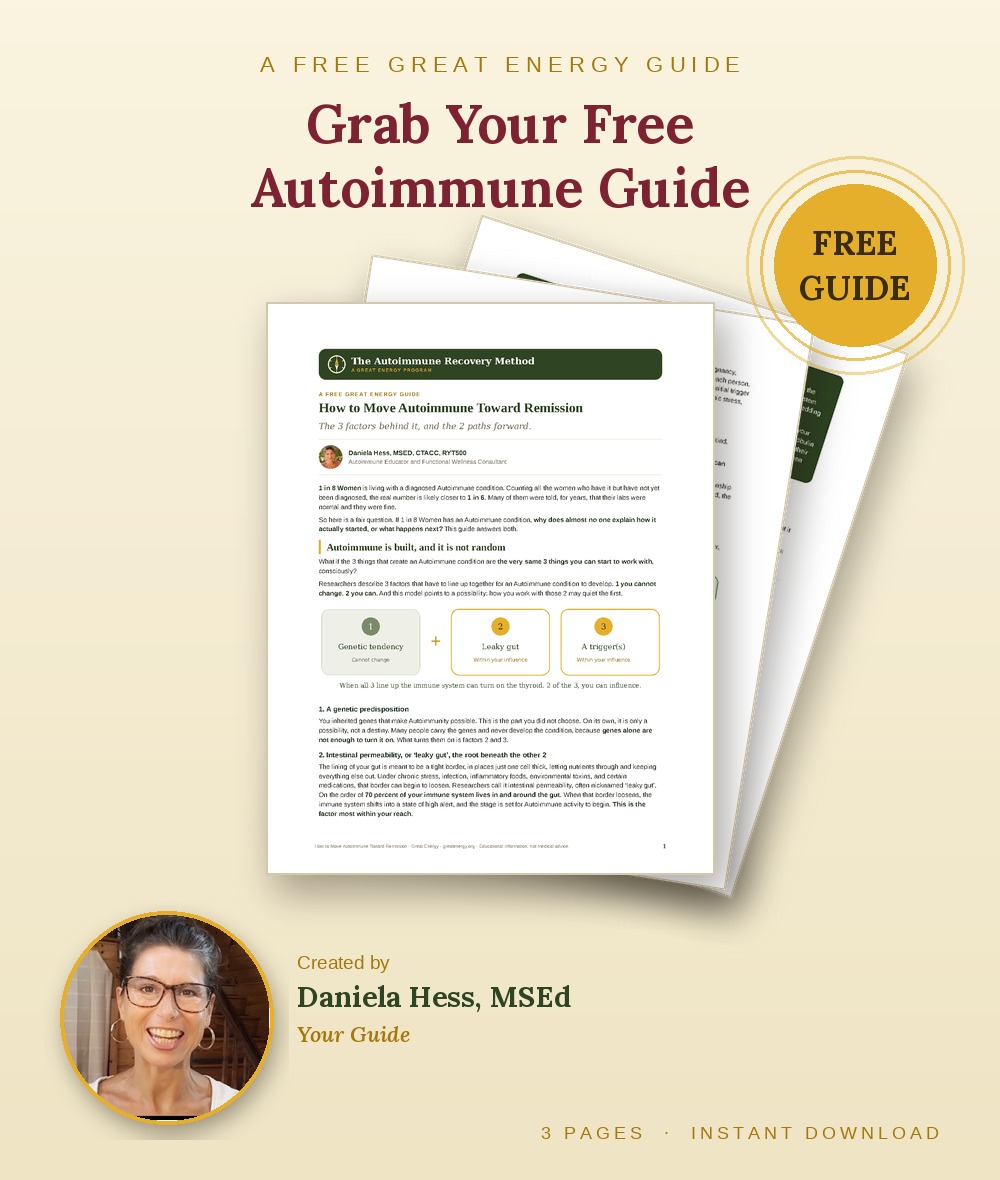
How to Move Autoimmune Toward Remission
The 3 factors behind an Autoimmune condition and the 2 paths forward, free, straight to your inbox.
No spam. Unsubscribe anytime.
Your guide is on its way. You can also open it now (PDF).

Articles from Daniela
Daniela Hess, MSEd, is a co-founder of Great Energy and an Autoimmune Educator and Functional Wellness Consultant who lives and thrives with Hashimoto’s. She is not a licensed medical provider.
AIP recipes to try
A place to start in the kitchen while you work on this with your own clinician: