Joints, muscles, and connective tissue
Adult-onset Still's disease (AOSD)
Adult-onset Still's disease is a rare systemic inflammatory condition, considered part of the autoinflammatory and autoimmune spectrum, that produces spiking fevers, an evanescent salmon-colored rash, and joint inflammation, often alongside an elevated white blood cell count. Current understanding describes its pathogenesis as involving genetic background and infectious triggers that activate macrophages and neutrophils, with cytokines including interleukin-1, interleukin-6, interleukin-18, and TNF-alpha driving the inflammatory episodes.
Because it is uncommon, solid prevalence figures are limited and estimates vary between reports, so a precise figure is not given here. The disease can follow a single self-limited episode, a relapsing pattern, or a persistent joint-centered course, and macrophage activation syndrome, a severe complication, is reported in up to 15 percent of cases.
Common signs
Spiking daily fevers, a salmon-colored rash that often comes and goes with the fever, joint and muscle pain, and sore throat. Fatigue and a general unwell feeling are common during flares, and some people develop ongoing arthritis.
This is a plain-language summary for orientation, not a diagnosis. Mechanisms are described as current understanding, not settled fact. Work with your own clinician for your care.
Questions people ask
What are the symptoms of adult-onset Still's disease?+
Does adult-onset Still's disease go away, or does it keep coming back?+
Is adult-onset Still's disease dangerous?+
In a doctor’s words
“The new biologic therapies (IL-1 and IL-6 blockers) offer hope for better management of the disease in the future.”
Anca D. Askanase, MD, MPH, Director, Columbia University Lupus Center, New York
Read more at Healthgrades, "Still's Disease: 6 Things Doctors Want You to Know" ↗
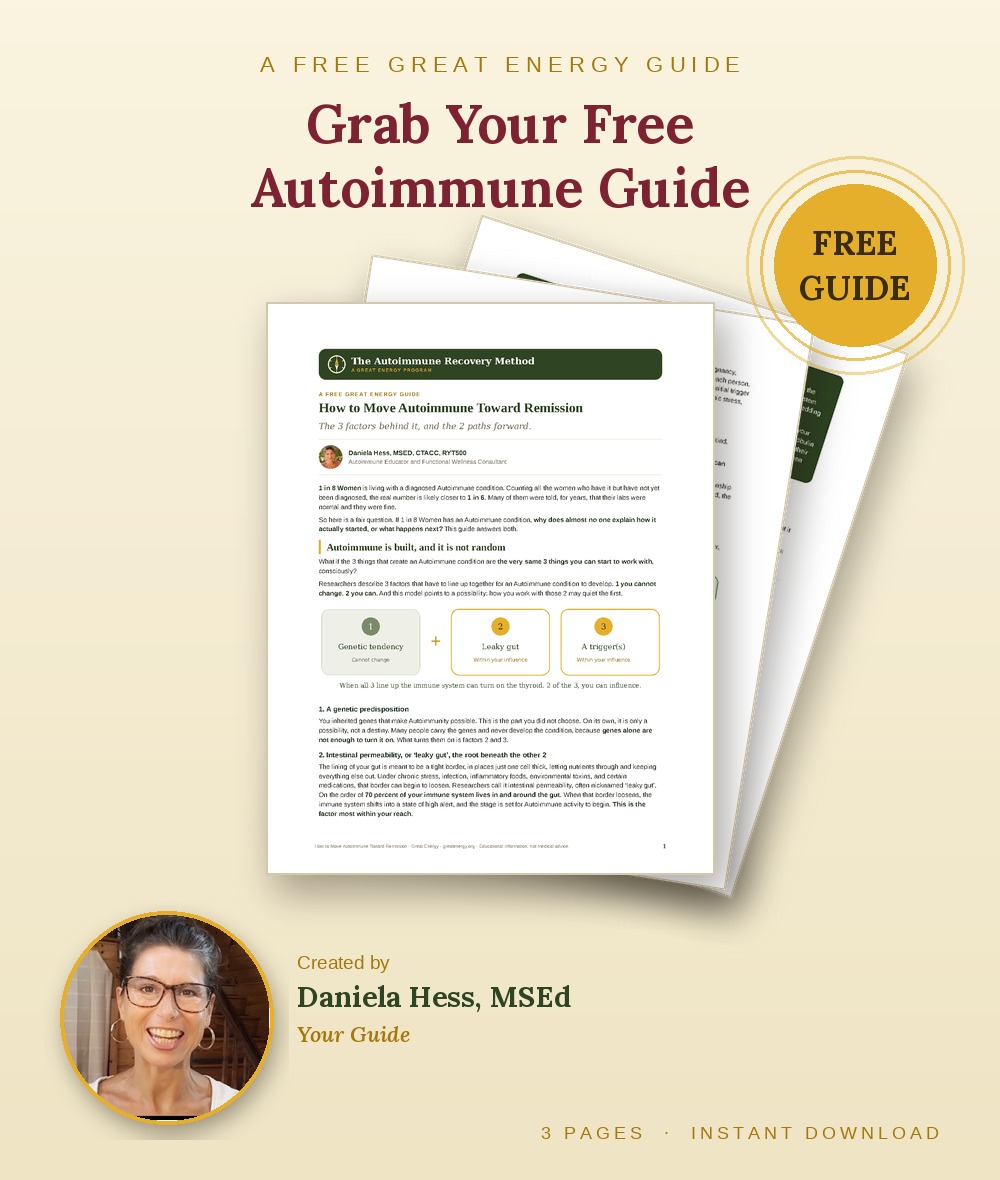
How to Move Autoimmune Toward Remission
The 3 factors behind an Autoimmune condition and the 2 paths forward, free, straight to your inbox.
No spam. Unsubscribe anytime.
Your guide is on its way. You can also open it now (PDF).

Articles from Daniela
Daniela Hess, MSEd, is a co-founder of Great Energy and an Autoimmune Educator and Functional Wellness Consultant who lives and thrives with Hashimoto’s. She is not a licensed medical provider.
AIP recipes to try
A place to start in the kitchen while you work on this with your own clinician: