Kidney and eye
Autoimmune Interstitial Nephritis
Autoimmune interstitial nephritis affects the interstitium, the tissue between the kidney's filtering tubules, where inflammatory immune cells gather and can reduce kidney function over time. Current understanding describes an immune reaction directed against the kidney's tubular tissue, and in some people this occurs together with inflammation in the eye, a pairing known as TINU syndrome (tubulointerstitial nephritis and uveitis). It can also appear alongside other autoimmune conditions such as lupus or Sjogren's.
TINU syndrome itself is considered rare and research describes it as accounting for a small share of all uveitis cases, roughly two percent, and solid population-wide prevalence figures for autoimmune interstitial nephritis as a whole are limited, since much of what is known comes from case series rather than large population studies. Corticosteroids are the usual first treatment, with other immune-modulating medications reserved for cases that do not respond.
Common signs
Reduced urine output, and sometimes fever, rash, and joint pain, though these classic signs are often absent. Tiredness and nausea can occur as kidney function drops.
This is a plain-language summary for orientation, not a diagnosis. Mechanisms are described as current understanding, not settled fact. Work with your own clinician for your care.
Questions people ask
What are the symptoms of autoimmune interstitial nephritis?+
What is TINU syndrome, and does it affect the eyes?+
How is autoimmune interstitial nephritis treated, and is it curable?+
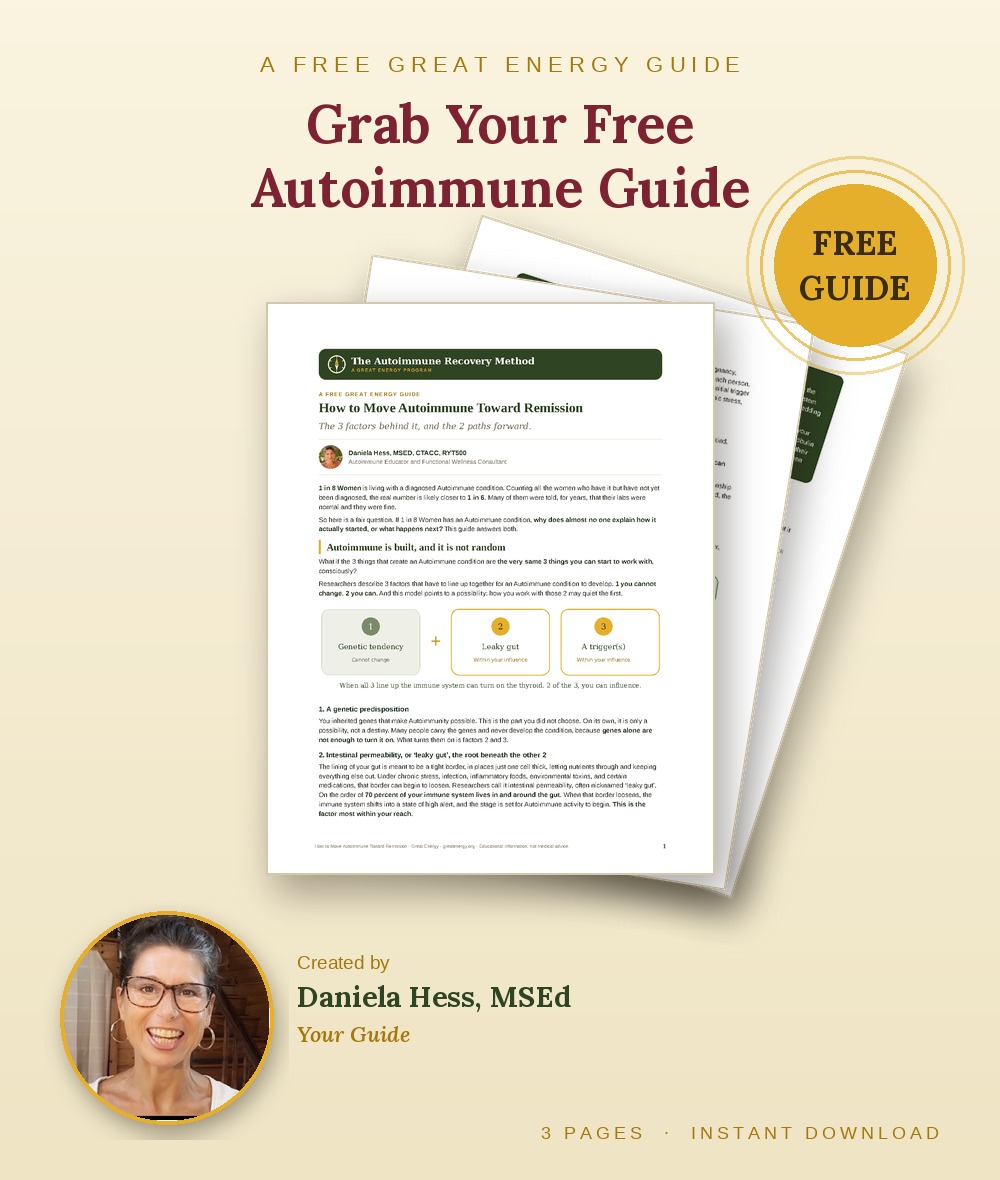
How to Move Autoimmune Toward Remission
The 3 factors behind an Autoimmune condition and the 2 paths forward, free, straight to your inbox.
No spam. Unsubscribe anytime.
Your guide is on its way. You can also open it now (PDF).

Articles from Daniela
Daniela Hess, MSEd, is a co-founder of Great Energy and an Autoimmune Educator and Functional Wellness Consultant who lives and thrives with Hashimoto’s. She is not a licensed medical provider.
AIP recipes to try
A place to start in the kitchen while you work on this with your own clinician: