Kidney and eye
Autoimmune Uveitis
Autoimmune uveitis affects the uvea, the middle layer of the eye that includes the iris and the tissue feeding the retina. Current understanding describes immune cells, including T-cells, breaking through the eye's normally protective blood-ocular barrier and mounting a local inflammatory response against eye tissue, sometimes in a recurring or remitting pattern. It can occur on its own or alongside a systemic autoimmune or inflammatory disease, and certain patterns link to specific conditions: uveitis at the front of the eye is associated with the HLA-B27 gene and conditions such as ankylosing spondylitis, and uveitis at the back of the eye is more associated with Behcet's disease.
Research describes spondyloarthritis, Behcet's disease, and sarcoidosis as having the largest impact on how common uveitis is overall, though a precise population-wide prevalence figure specific to the autoimmune forms is not well established. Because it can threaten vision, prompt care from an eye specialist is important.
Common signs
Eye redness, eye pain, light sensitivity, blurred vision, floating spots in the field of vision, and reduced vision.
This is a plain-language summary for orientation, not a diagnosis. Mechanisms are described as current understanding, not settled fact. Work with your own clinician for your care.
Questions people ask
Is uveitis an autoimmune condition?+
What are the symptoms of autoimmune uveitis?+
What other conditions are linked to autoimmune uveitis?+
In a doctor’s words
“There are many ways that inflammation can affect the eyes. It is our goal to figure out the right therapy for each individual, and to work to develop the precision diagnostics and therapies that will make treatment of uveitis better in the future.”
James Walsh, MD, PhD, Uveitis Specialist and Director of the Walsh Lab, WashU Medicine Department of Ophthalmology & Visual Sciences
Read more at WashU Medicine, Ophthalmology & Visual Sciences ↗
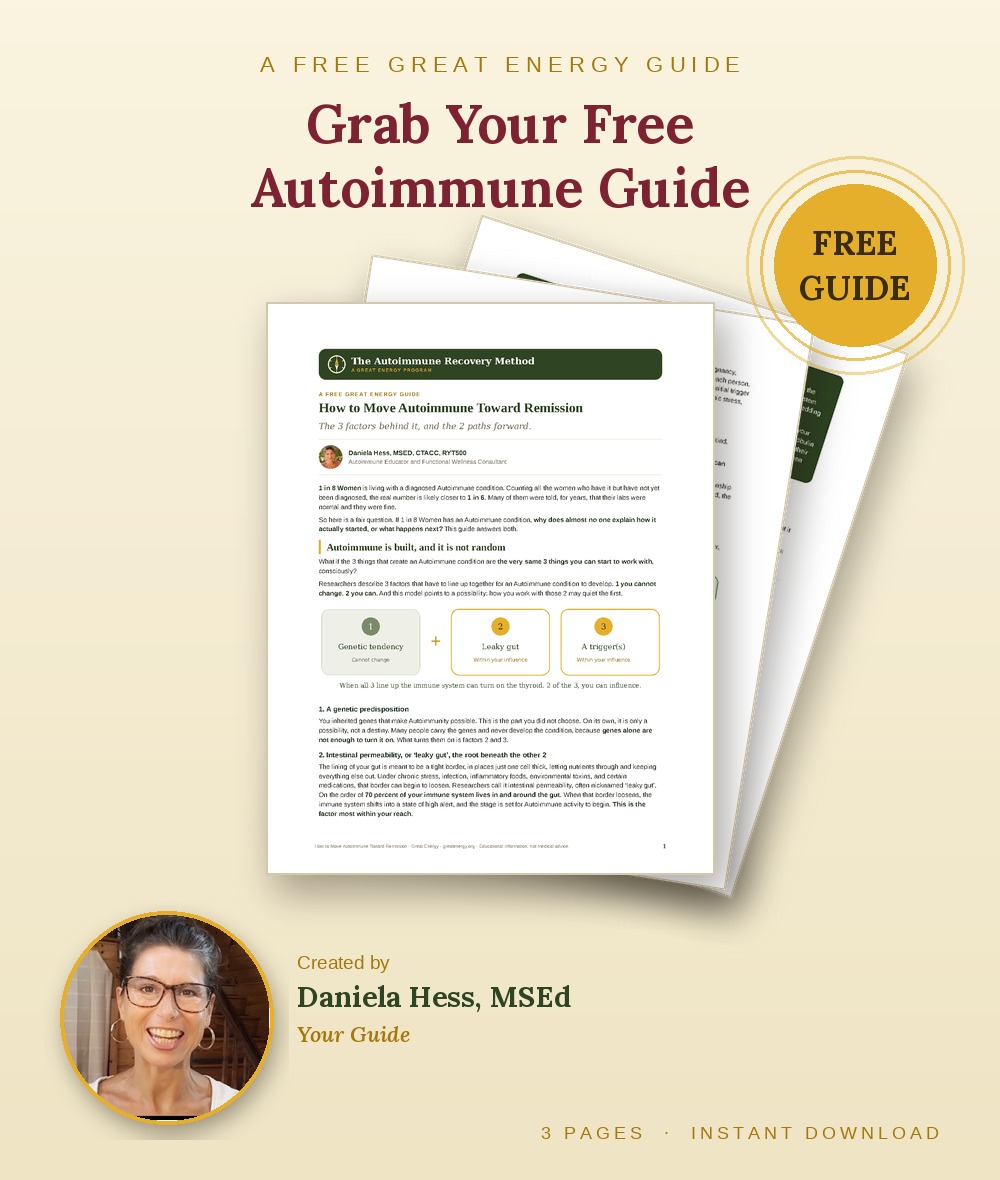
How to Move Autoimmune Toward Remission
The 3 factors behind an Autoimmune condition and the 2 paths forward, free, straight to your inbox.
No spam. Unsubscribe anytime.
Your guide is on its way. You can also open it now (PDF).

Articles from Daniela
Daniela Hess, MSEd, is a co-founder of Great Energy and an Autoimmune Educator and Functional Wellness Consultant who lives and thrives with Hashimoto’s. She is not a licensed medical provider.
AIP recipes to try
A place to start in the kitchen while you work on this with your own clinician: