Skin and hair
Chronic spontaneous urticaria (CSU)
Chronic spontaneous urticaria causes recurring hives and itching without an identifiable outside trigger, lasting more than six weeks. Mast cells sit at the center of the current understanding of this condition. When activated, they release histamine and other mediators that cause blood vessels to leak fluid into the skin, producing raised, itchy welts and sometimes the deeper swelling known as angioedema.
Research describes an autoimmune subset in which the body produces functional autoantibodies against IgE or its high-affinity receptor on mast cells, found in roughly 40 percent of patients studied, which helps explain resistance to standard antihistamine treatment in some cases. Other immune cells, including T cells and eosinophils, are also understood to help sustain the reaction. A precise general-population prevalence figure was not identified in this search, though the condition is understood to affect a meaningful minority of people who experience chronic hives.
Common signs
Recurring raised, itchy welts (hives or wheals) that can appear anywhere on the body, often coming and going within hours and shifting location. Some people also have deeper swelling (angioedema) of the lips, eyelids, hands, or feet. The intense itch can disturb sleep and daily life.
This is a plain-language summary for orientation, not a diagnosis. Mechanisms are described as current understanding, not settled fact. Work with your own clinician for your care.
Questions people ask
What causes chronic spontaneous urticaria?+
What are the symptoms of chronic spontaneous urticaria?+
Does chronic spontaneous urticaria go away on its own?+
In a doctor’s words
“I certainly think the drug will be distributed widely to dermatologists and to allergists. People who have chronic hives will now have something that works for the vast majority of patients and works quickly.”
Mark G. Lebwohl, MD, Dermatologist, Mount Sinai, New York City
Read more at WebMD ↗
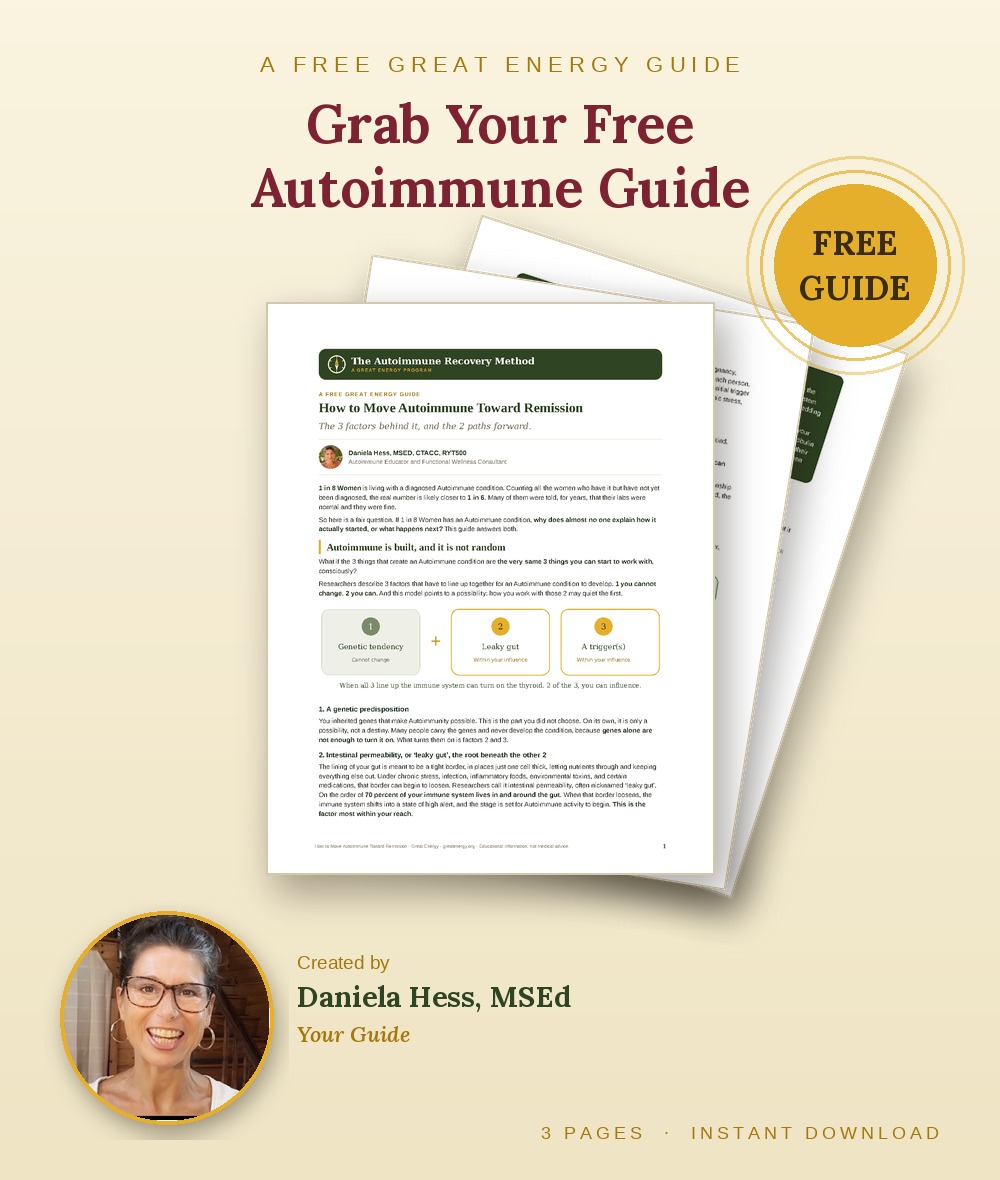
How to Move Autoimmune Toward Remission
The 3 factors behind an Autoimmune condition and the 2 paths forward, free, straight to your inbox.
No spam. Unsubscribe anytime.
Your guide is on its way. You can also open it now (PDF).
Articles from Daniela
Daniela Hess, MSEd, is a co-founder of Great Energy and an Autoimmune Educator and Functional Wellness Consultant who lives and thrives with Hashimoto’s. She is not a licensed medical provider.
AIP recipes to try
A place to start in the kitchen while you work on this with your own clinician: