Skin and hair
Dermatitis herpetiformis (DH)
Dermatitis herpetiformis is considered the skin manifestation of celiac disease. In people with a genetic susceptibility to gluten, eating gluten triggers autoantibodies against tissue transglutaminase, and in the skin specifically against a related enzyme, transglutaminase 3, now understood as the primary target driving the rash. These antibodies deposit in the skin and set off an intensely itchy, blistering reaction, most often on the elbows, knees, buttocks, and scalp.
Most people with dermatitis herpetiformis also have the intestinal changes of celiac disease, including inflammation and sometimes villous atrophy, even when they have few or no digestive symptoms. Research describes dermatitis herpetiformis as substantially less common than celiac disease itself, with studies from Finland and the United Kingdom estimating roughly one case of dermatitis herpetiformis for every eight cases of celiac disease.
Common signs
Intensely itchy, often burning clusters of small blisters and bumps, classically on the elbows, knees, buttocks, lower back, and scalp, frequently arranged symmetrically on both sides of the body. The itch can be so strong that the blisters are scratched away before they are seen.
This is a plain-language summary for orientation, not a diagnosis. Mechanisms are described as current understanding, not settled fact. Work with your own clinician for your care.
Questions people ask
Is dermatitis herpetiformis related to celiac disease?+
What does the dermatitis herpetiformis rash look like, and where does it appear?+
How common is dermatitis herpetiformis?+
In a doctor’s words
“When a person with celiac disease consumes gluten, the mucosal immune system in the intestine responds by producing a type of antibody called immunoglobulin A (IgA).”
John Zone, MD, Chief of Dermatology, University of Utah School of Medicine
Read more at Celiac Disease Foundation ↗
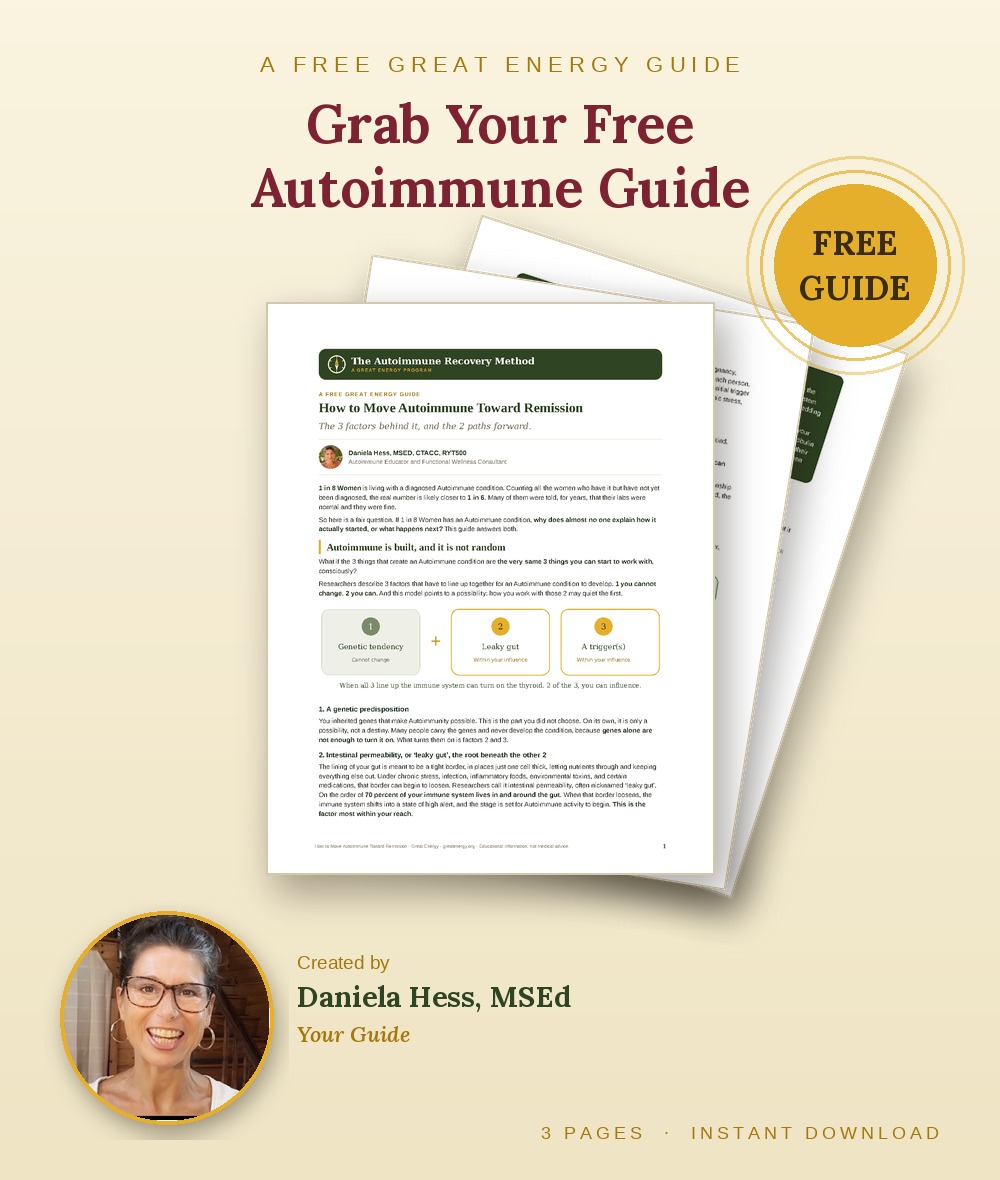
How to Move Autoimmune Toward Remission
The 3 factors behind an Autoimmune condition and the 2 paths forward, free, straight to your inbox.
No spam. Unsubscribe anytime.
Your guide is on its way. You can also open it now (PDF).

Articles from Daniela
Daniela Hess, MSEd, is a co-founder of Great Energy and an Autoimmune Educator and Functional Wellness Consultant who lives and thrives with Hashimoto’s. She is not a licensed medical provider.
AIP recipes to try
A place to start in the kitchen while you work on this with your own clinician: