Blood and blood vessels
Giant cell arteritis (temporal arteritis)
Giant cell arteritis is inflammation of medium and large arteries, often those around the head and scalp, in which immune cells including T-cells and macrophages gather in the artery wall and form clusters called granulomas that can narrow the vessel and reduce blood flow.
It mainly affects people over fifty, and a global meta-analysis estimated a pooled incidence of roughly 10 cases per 100,000 people over fifty and a pooled prevalence of roughly 52 per 100,000, with rates highest in Scandinavian countries at around 22 per 100,000. It is more common in women, with studies describing a female-to-male ratio near 1.7 to 1. It often overlaps with polymyalgia rheumatica, which brings shoulder and hip stiffness, and because it can threaten vision, it is treated as a medical emergency with urgent, specialist-led care.
Common signs
A new headache, often at the temples, scalp tenderness, jaw pain or fatigue when chewing, vision changes, fever, and unintended weight loss. It often overlaps with polymyalgia rheumatica, which brings shoulder and hip stiffness. Sudden vision loss is a warning sign that needs immediate care.
This is a plain-language summary for orientation, not a diagnosis. Mechanisms are described as current understanding, not settled fact. Work with your own clinician for your care.
Questions people ask
What is giant cell arteritis?+
What are the symptoms of giant cell arteritis, and why is vision loss an emergency?+
Is giant cell arteritis related to polymyalgia rheumatica?+
In a doctor’s words
“Having the option to use upadacitinib for this disease is a big win because it could help patients stop taking glucocorticoids, control their disease, and improve their quality of life.”
Peter A. Merkel, MD, MPH, Chief of Rheumatology, Professor of Rheumatology and Epidemiology, Director of the Penn Vasculitis Center, Perelman School of Medicine at the University of Pennsylvania
Read more at Penn Medicine News ↗
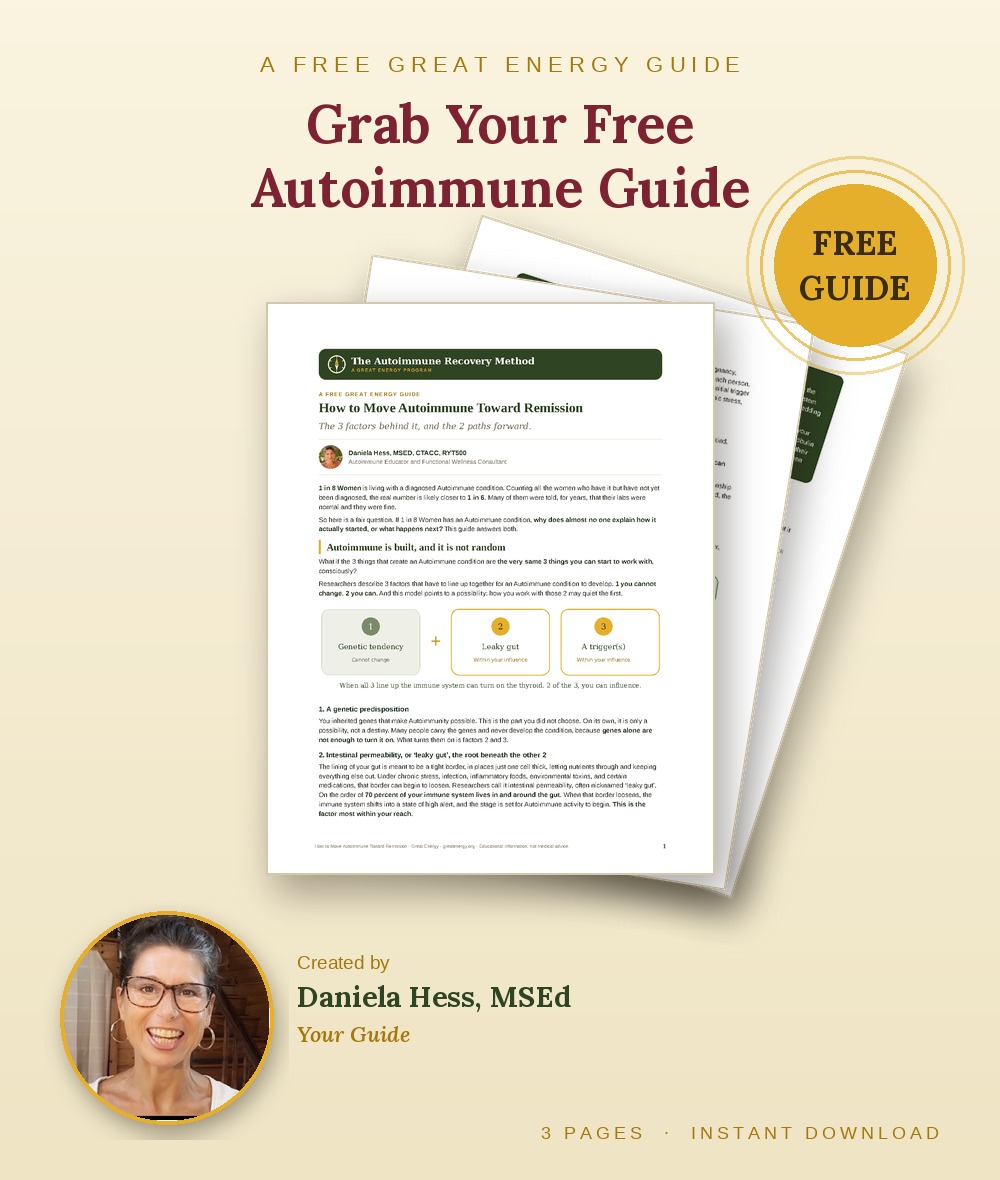
How to Move Autoimmune Toward Remission
The 3 factors behind an Autoimmune condition and the 2 paths forward, free, straight to your inbox.
No spam. Unsubscribe anytime.
Your guide is on its way. You can also open it now (PDF).

Articles from Daniela
Daniela Hess, MSEd, is a co-founder of Great Energy and an Autoimmune Educator and Functional Wellness Consultant who lives and thrives with Hashimoto’s. She is not a licensed medical provider.
AIP recipes to try
A place to start in the kitchen while you work on this with your own clinician: