Neuromuscular and nervous system
Guillain-Barre syndrome (GBS)
Guillain-Barre syndrome is an acute condition in which the immune system attacks the peripheral nerves, the nerves outside the brain and spinal cord. It's usually preceded by an infection, often by one to two weeks, and current understanding is that antibodies produced against the infectious trigger cross-react with components of the nerve, damaging the myelin coating or the nerve fibers themselves. The classic demyelinating form accounts for the large majority of cases in Western countries, while axonal forms are more common in parts of Asia and Central and South America.
GBS is described as a rare condition and the leading cause of acute paralytic neuropathy worldwide, with incidence varying by region and the infections circulating locally. Unlike most conditions here, it's usually a single, self-limited illness rather than a lifelong one.
Common signs
Weakness and tingling that usually begin in the feet and legs and move upward, often fairly symmetrically, with loss of reflexes. It can progress over hours to days to weakness of the arms, face, and the muscles used for breathing and swallowing. Because it can affect breathing and heart rate and blood pressure, it's treated as a medical emergency.
This is a plain-language summary for orientation, not a diagnosis. Mechanisms are described as current understanding, not settled fact. Work with your own clinician for your care.
Questions people ask
What causes Guillain-Barre syndrome?+
What are the symptoms of Guillain-Barre syndrome, and why is it treated as an emergency?+
Is Guillain-Barre syndrome the same as CIDP?+
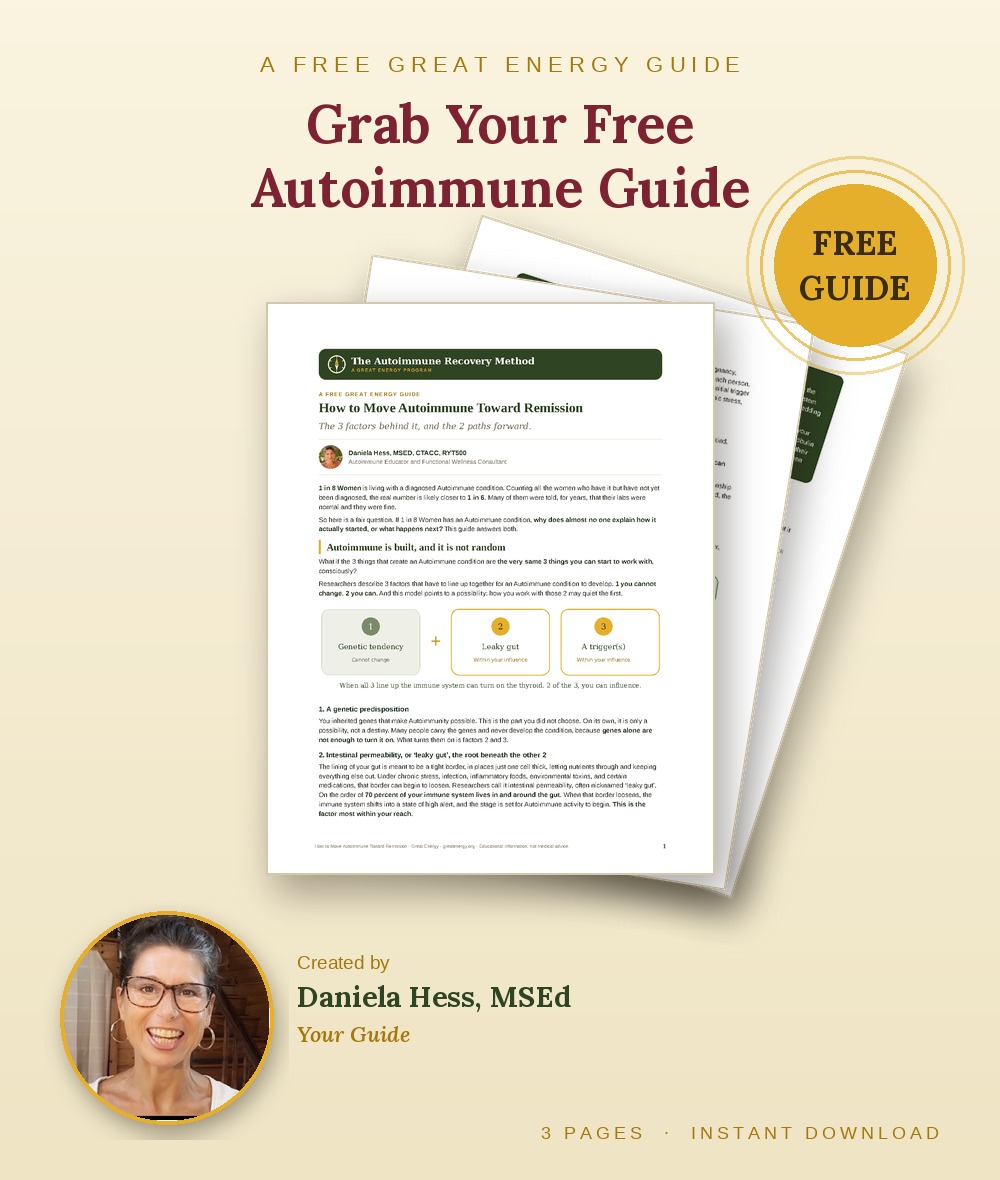
How to Move Autoimmune Toward Remission
The 3 factors behind an Autoimmune condition and the 2 paths forward, free, straight to your inbox.
No spam. Unsubscribe anytime.
Your guide is on its way. You can also open it now (PDF).

Articles from Daniela
Daniela Hess, MSEd, is a co-founder of Great Energy and an Autoimmune Educator and Functional Wellness Consultant who lives and thrives with Hashimoto’s. She is not a licensed medical provider.
AIP recipes to try
A place to start in the kitchen while you work on this with your own clinician: