Blood and blood vessels
Kawasaki disease
Kawasaki disease is inflammation of blood vessels that mainly affects young children, in which the immune system appears to mount an intense response, thought to be triggered by an as yet unidentified infectious agent, producing widespread vessel inflammation that can involve the arteries supplying the heart. It has been diagnosed in more than 60 countries across Asia, Europe, the Middle East, the Americas, and Africa, and research describes it as the leading cause of acquired heart disease in children in the United States and other developed countries.
Incidence is markedly higher in Japan and in children of Japanese and other East Asian ancestry, with rates reported around 200 to 300 per 100,000 children under five, compared with a lower incidence, generally under 25 per 100,000, in the United States and Europe. It is a medical emergency because of the risk of coronary artery damage, which research indicates can develop in untreated cases, so care is urgent and specialist-led.
Common signs
A fever lasting several days, red eyes, a rash, red and cracked lips with a strawberry-colored tongue, swollen and red hands and feet, and swollen lymph nodes in the neck.
This is a plain-language summary for orientation, not a diagnosis. Mechanisms are described as current understanding, not settled fact. Work with your own clinician for your care.
Questions people ask
What causes Kawasaki disease?+
Is Kawasaki disease contagious?+
Why is Kawasaki disease considered a medical emergency for a child?+
In a doctor’s words
“I derive the greatest joy from the work that I do in helping KD patients live healthy and fulfilling lives.”
Jane Newburger, MD, Associate Cardiologist-in-Chief, Academic Affairs; Director, Kawasaki Program; Commonwealth Professor of Pediatrics, Harvard Medical School (Boston Children's Hospital)
Read more at Kawasaki Disease Foundation ↗
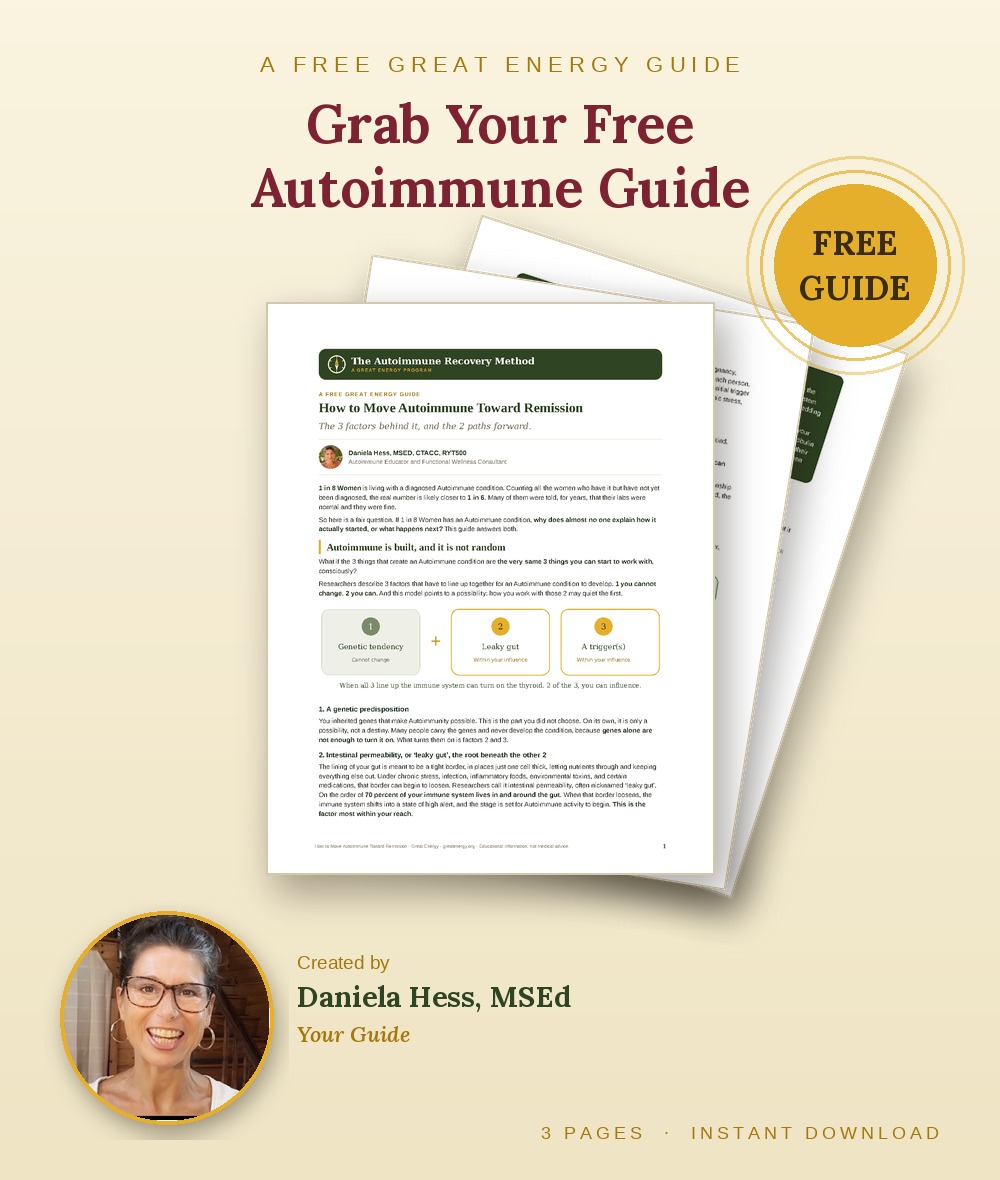
How to Move Autoimmune Toward Remission
The 3 factors behind an Autoimmune condition and the 2 paths forward, free, straight to your inbox.
No spam. Unsubscribe anytime.
Your guide is on its way. You can also open it now (PDF).

Articles from Daniela
Daniela Hess, MSEd, is a co-founder of Great Energy and an Autoimmune Educator and Functional Wellness Consultant who lives and thrives with Hashimoto’s. She is not a licensed medical provider.
AIP recipes to try
A place to start in the kitchen while you work on this with your own clinician: