Skin and hair
Lichen planus
Lichen planus is a T-cell-mediated condition that can affect the skin, mouth, genitals, scalp, and nails. Research describes cytotoxic CD8-positive T cells attacking keratinocytes, the main cells of the outer skin layer, in response to a self-antigen that has not been clearly identified, while CD4-positive T cells also contribute to the surrounding inflammation. The trigger appears to be multifactorial, with genetics, certain infections, medications, and immune dysregulation all playing a role, and lichen planus is sometimes seen alongside other autoimmune conditions. The oral form most often affects women between 30 and 60, and skin lesions frequently clear on their own within one to two years, though recurrences are common and can leave lasting discoloration.
A precise overall prevalence figure is not well established, though it is generally described as an uncommon condition affecting roughly 1 percent or less of the population.
Common signs
On the skin, itchy, flat-topped bumps that often look purple, reddish, or darker, commonly on the wrists, forearms, lower back, and ankles. In the mouth and other mucous membranes it can form lacy white patches, sometimes with painful sores. It may also cause scarring hair loss on the scalp, called lichen planopilaris, and nail ridging, thinning, or scarring.
This is a plain-language summary for orientation, not a diagnosis. Mechanisms are described as current understanding, not settled fact. Work with your own clinician for your care.
Questions people ask
Is lichen planus contagious?+
What causes lichen planus?+
Does lichen planus go away, or does it come back?+
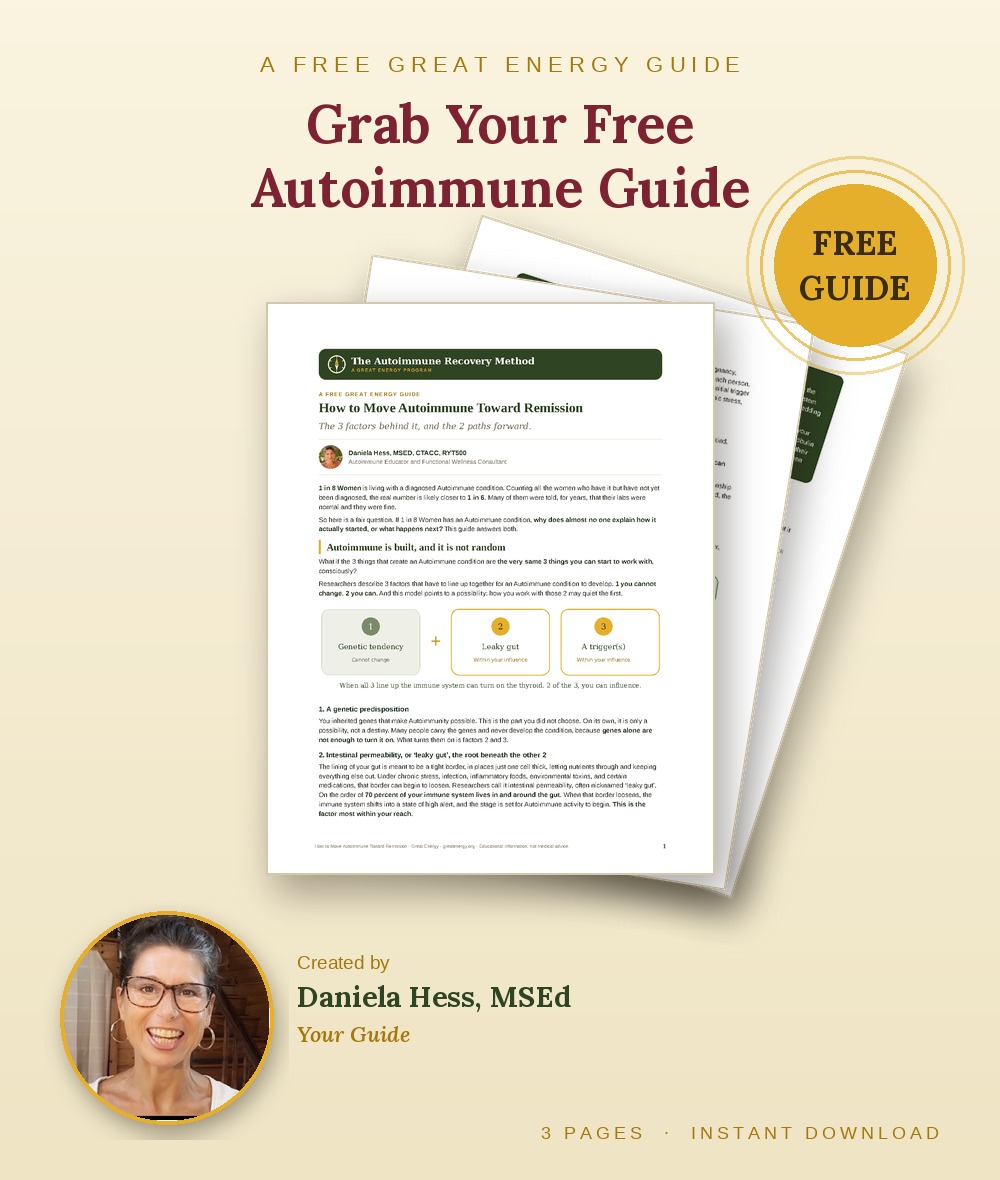
How to Move Autoimmune Toward Remission
The 3 factors behind an Autoimmune condition and the 2 paths forward, free, straight to your inbox.
No spam. Unsubscribe anytime.
Your guide is on its way. You can also open it now (PDF).
Articles from Daniela
Daniela Hess, MSEd, is a co-founder of Great Energy and an Autoimmune Educator and Functional Wellness Consultant who lives and thrives with Hashimoto’s. She is not a licensed medical provider.
AIP recipes to try
A place to start in the kitchen while you work on this with your own clinician: