Skin and hair
Lichen sclerosus
Lichen sclerosus is a chronic inflammatory condition that most often affects the genital and anal skin. Current research points to an immune-driven Th1 response, in which environmental factors acting on a genetically susceptible person set off a chronic inflammatory state that damages tissue and activates pathways involved in collagen buildup, ultimately leading to the thinned, fragile, whitened skin that characterizes the condition. Older hypotheses also considered infectious triggers and a reaction to prior skin trauma, and it is likely that more than one mechanism contributes across different people.
Lichen sclerosus most often develops in postmenopausal women, though it can affect men and children too, with children accounting for an estimated 7 to 15 percent of cases. Estimates of how common it is range from roughly 1 in 300 to 1 in 1,000 people, and because it is under-recognized, the true prevalence may be higher.
Common signs
Smooth white, often crinkly or shiny patches, most often around the vulva, penis, or anus, with itching, soreness, and sometimes pain. The thinned skin can crack, bruise, or tear easily, and discomfort with urination, bowel movements, or intimacy is common. Untreated disease can lead to scarring, narrowing of the affected opening, and a small increased skin cancer risk over time.
This is a plain-language summary for orientation, not a diagnosis. Mechanisms are described as current understanding, not settled fact. Work with your own clinician for your care.
Questions people ask
What causes lichen sclerosus?+
What does lichen sclerosus look like, and where does it appear?+
Can lichen sclerosus turn into skin cancer?+
In a doctor’s words
“When caught early, prompt treatment can prevent a lifetime of debilitating itch and painful genital scarring.”
Amanda Zubek, MD, PhD, Dermatologist, Yale Medicine
Read more at Yale Medicine ↗
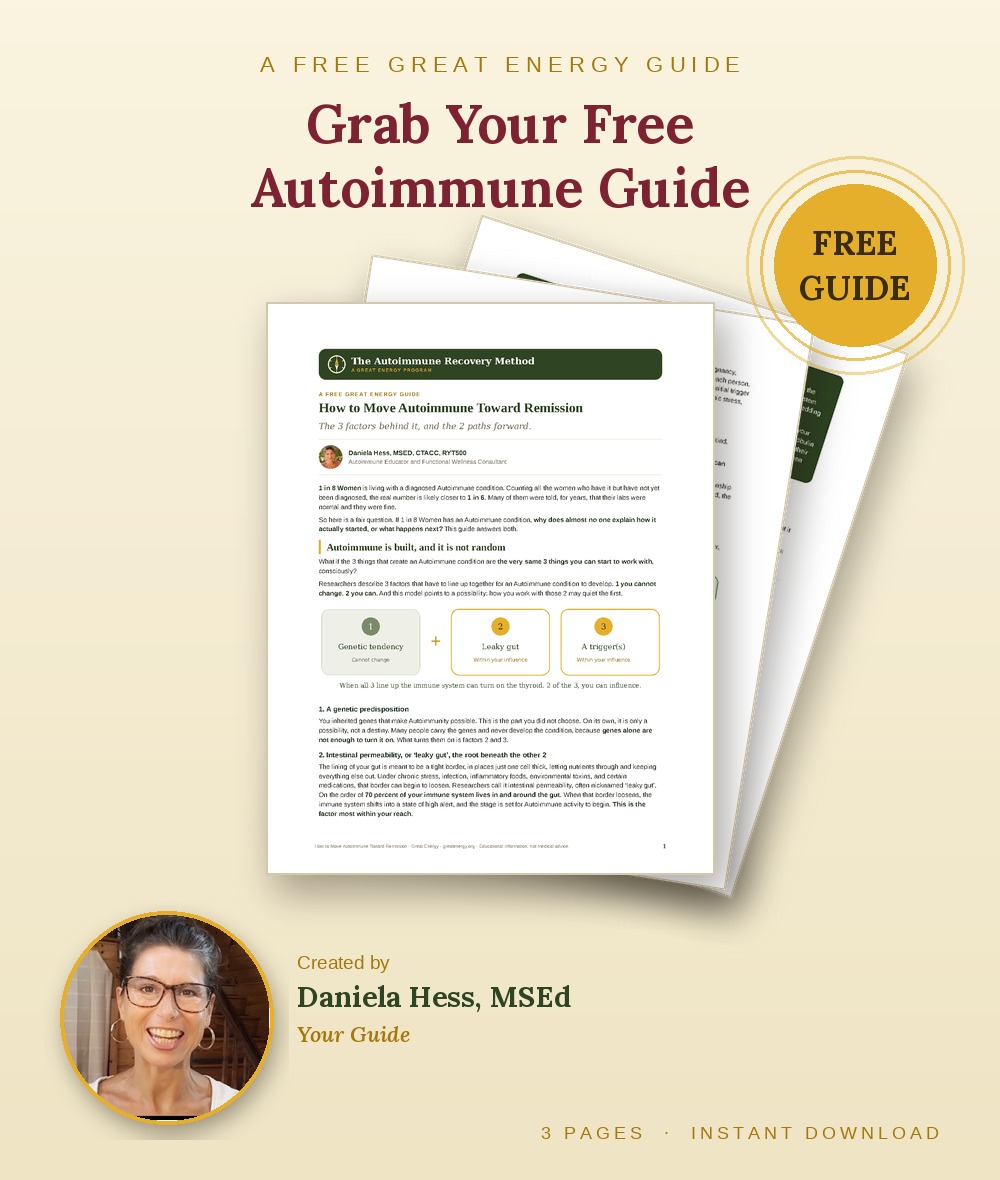
How to Move Autoimmune Toward Remission
The 3 factors behind an Autoimmune condition and the 2 paths forward, free, straight to your inbox.
No spam. Unsubscribe anytime.
Your guide is on its way. You can also open it now (PDF).
Articles from Daniela
Daniela Hess, MSEd, is a co-founder of Great Energy and an Autoimmune Educator and Functional Wellness Consultant who lives and thrives with Hashimoto’s. She is not a licensed medical provider.
AIP recipes to try
A place to start in the kitchen while you work on this with your own clinician: