Blood and blood vessels
Microscopic polyangiitis (MPA)
Microscopic polyangiitis is inflammation of small blood vessels, in which the immune system appears to attack vessel walls with little or no immune complex deposition, a pattern researchers call pauci-immune vasculitis. It is one of the ANCA-associated vasculitides, and the antibodies involved are most often directed against an enzyme called myeloperoxidase, though a smaller share of people test positive for a different target, proteinase 3, and not everyone with MPA has detectable ANCA.
Research describes the ANCA-associated vasculitides as a group having a pooled global incidence of roughly 17 cases per million people per year and a pooled prevalence near 198 cases per million, and within that group MPA tends to affect men somewhat more than women and typically appears after age fifty. The kidneys and lungs are most often involved and tend to drive the course of the condition.
Common signs
Fatigue, fever, weight loss, and joint and muscle aches, along with kidney involvement (blood or protein in the urine), coughing or shortness of breath that can include coughing up blood, skin rashes, and numbness or weakness from nerve involvement.
This is a plain-language summary for orientation, not a diagnosis. Mechanisms are described as current understanding, not settled fact. Work with your own clinician for your care.
Questions people ask
What is microscopic polyangiitis?+
What causes MPA and is it linked to ANCA antibodies?+
What is the difference between MPA and GPA?+
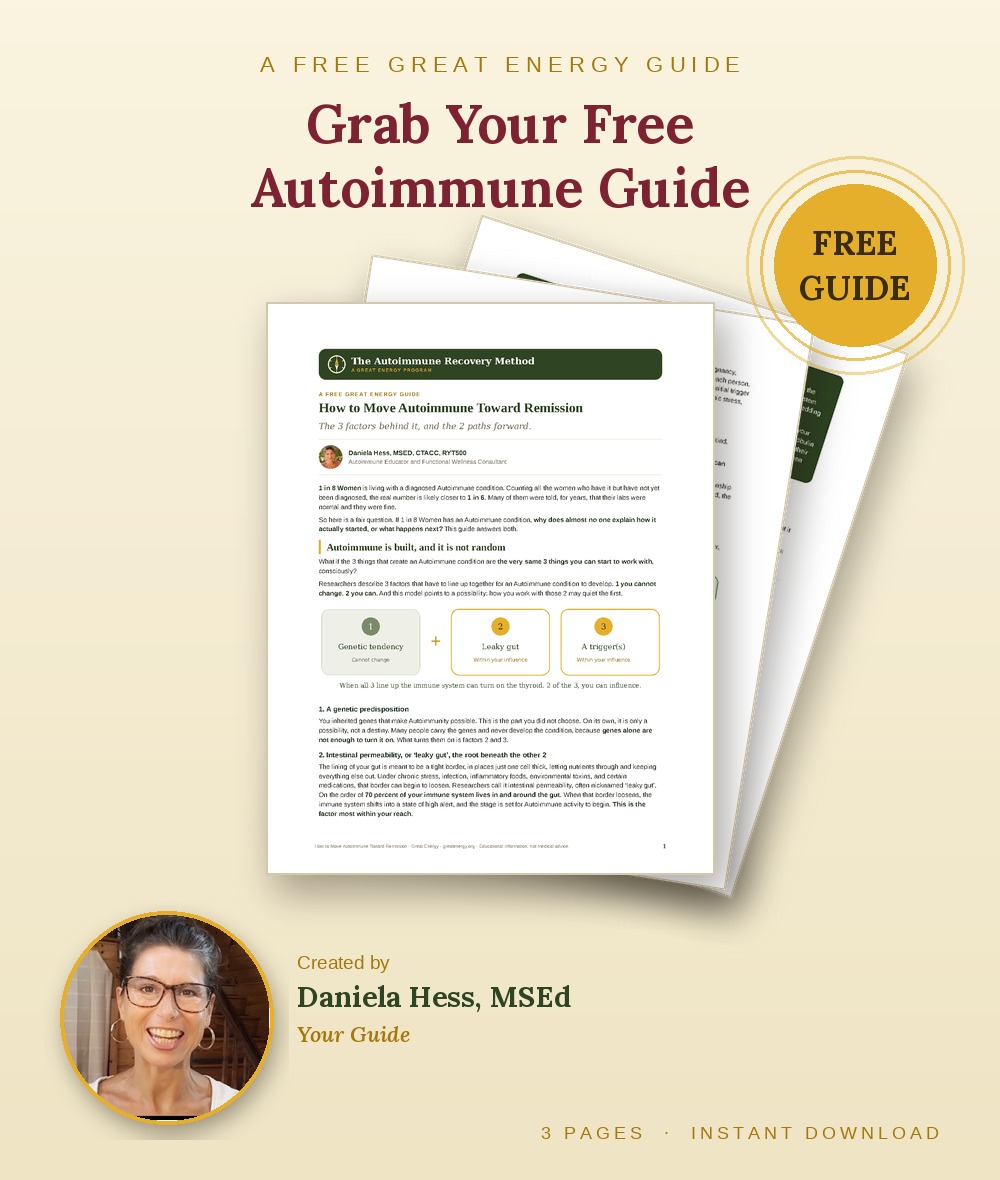
How to Move Autoimmune Toward Remission
The 3 factors behind an Autoimmune condition and the 2 paths forward, free, straight to your inbox.
No spam. Unsubscribe anytime.
Your guide is on its way. You can also open it now (PDF).

Articles from Daniela
Daniela Hess, MSEd, is a co-founder of Great Energy and an Autoimmune Educator and Functional Wellness Consultant who lives and thrives with Hashimoto’s. She is not a licensed medical provider.
AIP recipes to try
A place to start in the kitchen while you work on this with your own clinician: