Joints, muscles, and connective tissue
Mixed connective tissue disease (MCTD)
Mixed connective tissue disease combines features of more than one connective tissue disease, often lupus, scleroderma, and inflammatory muscle disease, in the same person, and is distinguished from these separate conditions by a particular antibody pattern directed against U1-RNP. The immune system is thought to drive this overlapping process, and the clinical picture commonly includes Raynaud's phenomenon, swollen or puffy hands, joint pain, and swallowing difficulty, though the exact combination varies.
A Norwegian national multicentre survey, one of the few population-based studies of this condition, estimated the point prevalence of adult-onset MCTD at about 3.8 per 100,000 people and the annual incidence at roughly 2.1 per million, figures that support its reputation as the least common of the connective tissue diseases. Estimates vary across populations and diagnostic criteria.
Common signs
A mix that commonly includes Raynaud's, swollen or puffy hands, joint pain, muscle weakness, fatigue, and swallowing difficulty. Because it overlaps several conditions, the exact picture varies, and lung involvement can develop in some people.
This is a plain-language summary for orientation, not a diagnosis. Mechanisms are described as current understanding, not settled fact. Work with your own clinician for your care.
Questions people ask
What is mixed connective tissue disease?+
What are the symptoms of MCTD?+
Is there a cure for MCTD, or does it go into remission?+
In a doctor’s words
“I will help you. We'll get through it.”
Oliver Lawless, MD, Rheumatologist who diagnosed and managed the patient's MCTD care for 35 years
Read more at AiArthritis (International Foundation for Autoimmune & Autoinflammatory Arthritis), "An Unexpected Detour: Life With Mixed Connective Tissue Disease" by Carol Kaminski ↗
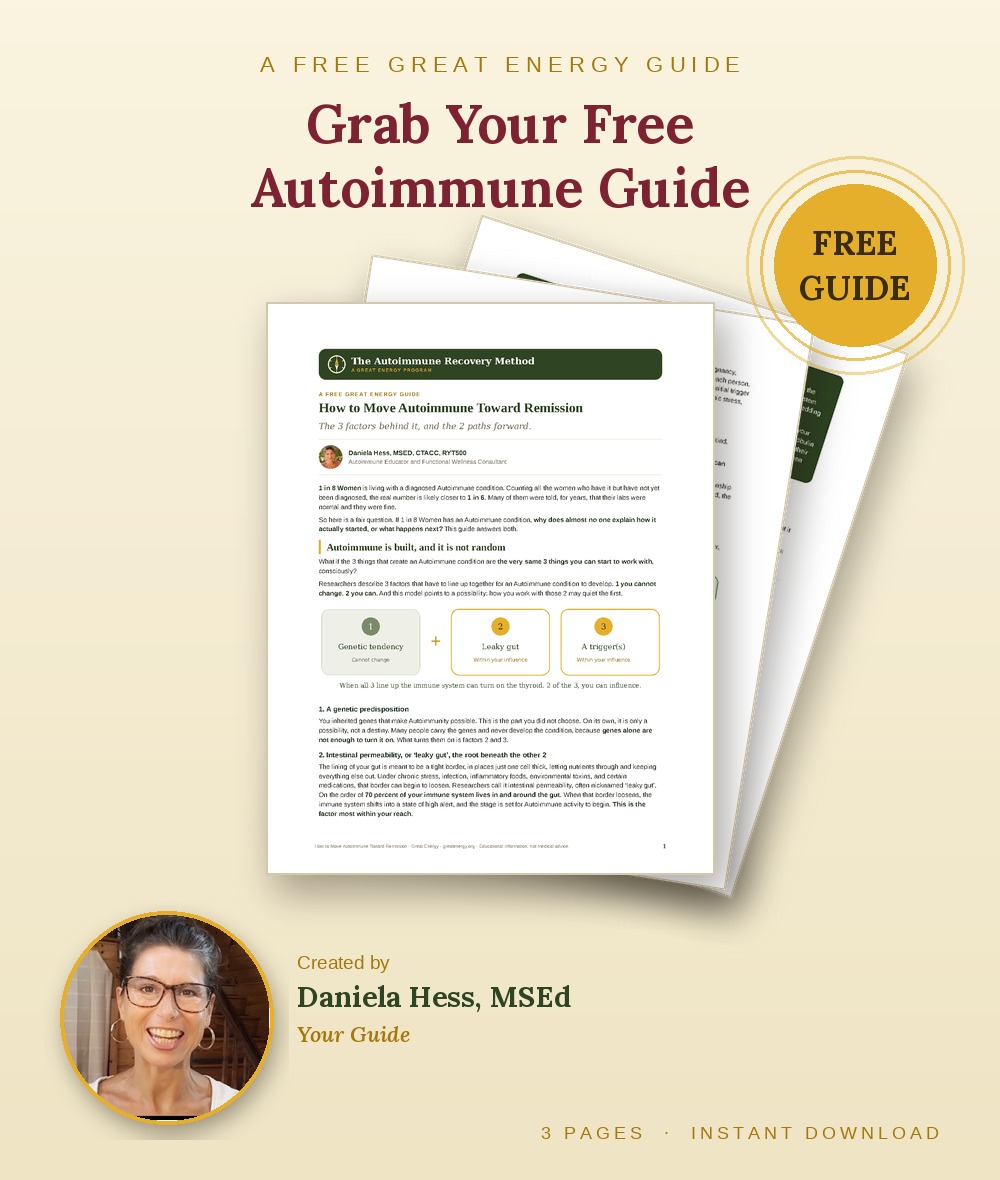
How to Move Autoimmune Toward Remission
The 3 factors behind an Autoimmune condition and the 2 paths forward, free, straight to your inbox.
No spam. Unsubscribe anytime.
Your guide is on its way. You can also open it now (PDF).

Articles from Daniela
Daniela Hess, MSEd, is a co-founder of Great Energy and an Autoimmune Educator and Functional Wellness Consultant who lives and thrives with Hashimoto’s. She is not a licensed medical provider.
AIP recipes to try
A place to start in the kitchen while you work on this with your own clinician: