Neuromuscular and nervous system
Neuromyelitis optica spectrum disorder (NMOSD, Devic's disease)
Neuromyelitis optica spectrum disorder, historically called Devic's disease, is an autoimmune condition of the central nervous system that most often targets the optic nerves and spinal cord. In many people it's linked to antibodies against aquaporin-4, a water channel found on support cells called astrocytes, and the resulting injury leads to inflammation and demyelination distinct from multiple sclerosis.
NMOSD is considered a rare condition whose prevalence varies notably by ancestry. Research describes prevalence at roughly 1 per 100,000 in people of European descent, higher, around 3.5 per 100,000, in East Asian populations, and higher still, up to around 10 per 100,000, in some Black populations. It carries a strong female predominance, with a female-to-male ratio reported as high as 9 to 1, and a typical age of onset around 40.
Common signs
Optic neuritis, with vision loss and pain on eye movement, often in one or both eyes, and transverse myelitis, with weakness, numbness, and bladder or bowel problems below the level of spinal cord involvement. Some people also have bouts of stubborn hiccups, nausea, or vomiting from a brainstem area called the area postrema.
This is a plain-language summary for orientation, not a diagnosis. Mechanisms are described as current understanding, not settled fact. Work with your own clinician for your care.
Questions people ask
What causes NMOSD?+
What are the symptoms of NMOSD?+
Is NMOSD the same as multiple sclerosis?+
In a doctor’s words
“The fact that we now have three medications that target the specific disease pathways in patients with the aquaporin-4 antibody is a game changer.”
Alfonso (Sebastian) S. Lopez Chiriboga, MD, autoimmune neurologist, Mayo Clinic, Jacksonville, Florida
Read more at Mayo Clinic (Medical Professionals News) ↗
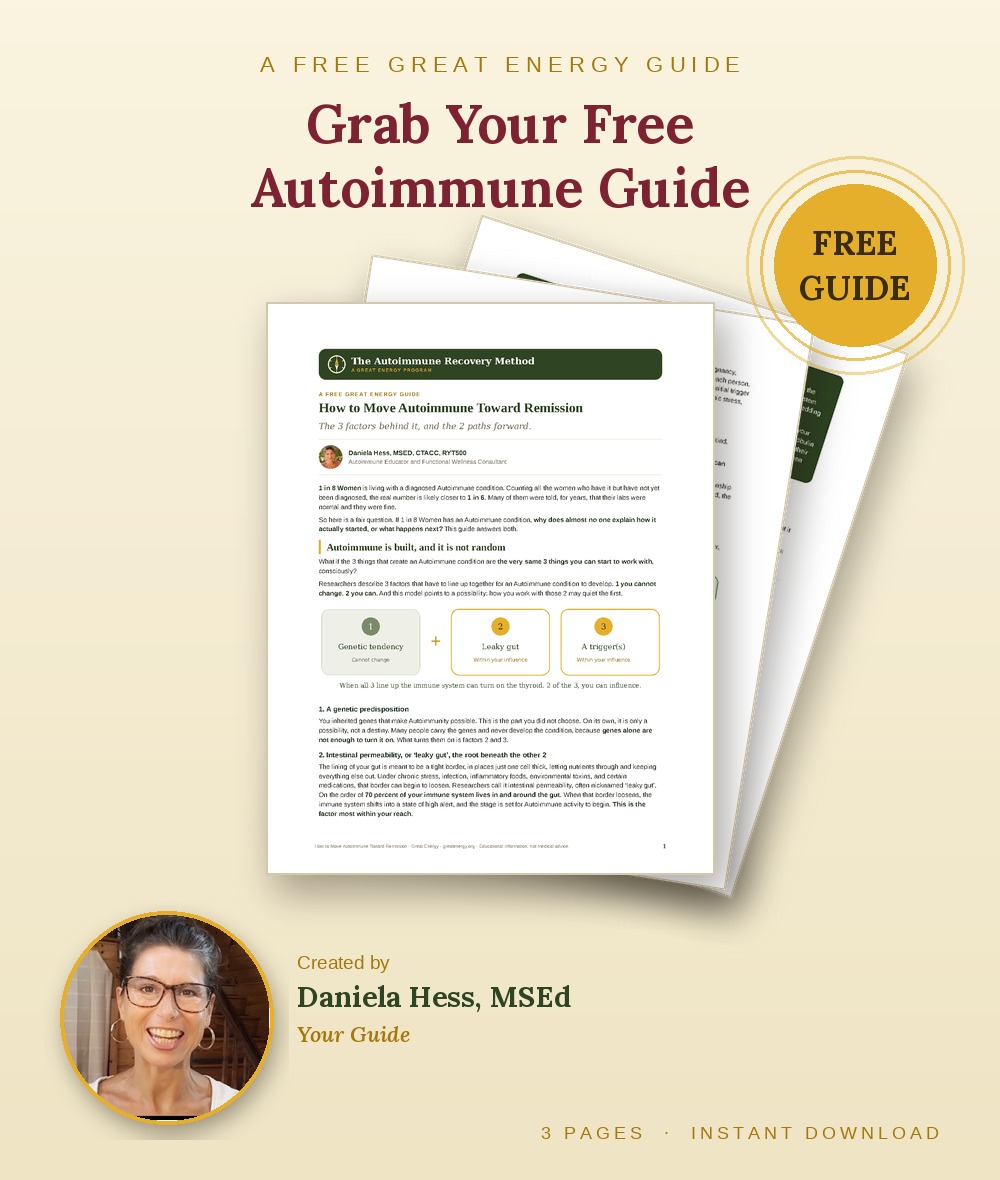
How to Move Autoimmune Toward Remission
The 3 factors behind an Autoimmune condition and the 2 paths forward, free, straight to your inbox.
No spam. Unsubscribe anytime.
Your guide is on its way. You can also open it now (PDF).
Articles from Daniela
Daniela Hess, MSEd, is a co-founder of Great Energy and an Autoimmune Educator and Functional Wellness Consultant who lives and thrives with Hashimoto’s. She is not a licensed medical provider.
AIP recipes to try
A place to start in the kitchen while you work on this with your own clinician: