Joints, muscles, and connective tissue
Polymyalgia rheumatica (PMR)
Polymyalgia rheumatica affects the muscles and connective tissue around the shoulders, neck, and hips, mainly in older adults. Research describes inflammation of the synovium and periarticular structures, with systemic IL-6 signaling thought to drive much of the aching, stiffness, and fatigue that mark the condition, though the exact trigger is not fully understood.
It is considered the most common inflammatory rheumatic disease in people over 50, and studies describe incidence estimates that vary widely by region, from roughly 13 per 100,000 in southern Europe to well over 100 per 100,000 in parts of Scandinavia. It is two to three times more common in women, and it sometimes occurs alongside a related blood-vessel inflammation called giant cell arteritis, which is why the two conditions are often studied and monitored together.
Common signs
Aching and marked stiffness in the shoulders, neck, upper arms, hips, and thighs, usually on both sides and typically worst in the morning. The stiffness can make it hard to rise from a chair or lift the arms, and fatigue and a general unwell feeling are common.
This is a plain-language summary for orientation, not a diagnosis. Mechanisms are described as current understanding, not settled fact. Work with your own clinician for your care.
Where this comes from
Questions people ask
What are the symptoms of polymyalgia rheumatica?+
Is polymyalgia rheumatica related to giant cell arteritis?+
Does polymyalgia rheumatica go away on its own, or how long does it last?+
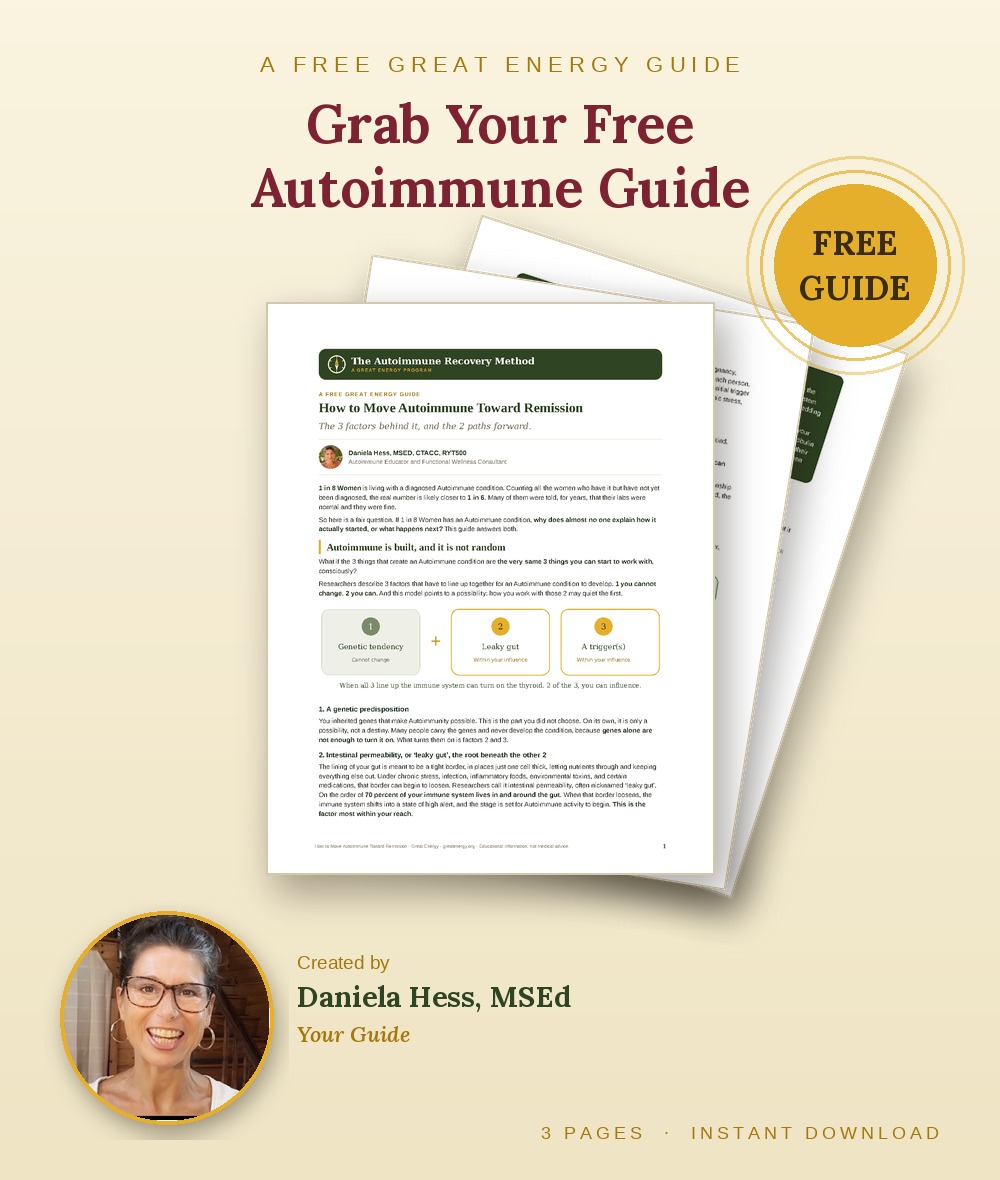
How to Move Autoimmune Toward Remission
The 3 factors behind an Autoimmune condition and the 2 paths forward, free, straight to your inbox.
No spam. Unsubscribe anytime.
Your guide is on its way. You can also open it now (PDF).

Articles from Daniela
Daniela Hess, MSEd, is a co-founder of Great Energy and an Autoimmune Educator and Functional Wellness Consultant who lives and thrives with Hashimoto’s. She is not a licensed medical provider.
AIP recipes to try
A place to start in the kitchen while you work on this with your own clinician: