Joints, muscles, and connective tissue
Psoriatic arthritis (PsA)
Psoriatic arthritis is a form of inflammatory arthritis that develops in a meaningful share of people who have psoriasis, most often appearing after skin symptoms but occasionally before them. It causes joint pain, stiffness, and swelling, along with characteristic features like sausage-like swelling of entire fingers or toes (dactylitis) and inflammation where tendons attach to bone (enthesitis).
Research estimates it complicates psoriasis in roughly 6 to 41 percent of cases depending on the population studied, and left untreated it can cause irreversible joint damage.
Common signs
Joint pain, swelling, and stiffness, sometimes with a whole finger or toe swelling like a sausage (dactylitis), along with psoriasis skin patches and nail changes (pitting or lifting). Morning stiffness, fatigue, and heel or other attachment-point pain (enthesitis) are common.
This is a plain-language summary for orientation, not a diagnosis. Mechanisms are described as current understanding, not settled fact. Work with your own clinician for your care.
Questions people ask
What are the symptoms of psoriatic arthritis?+
Does psoriasis always show up before the joint symptoms of psoriatic arthritis?+
Is there a cure for psoriatic arthritis?+
In a doctor’s words
“The goal of getting to a target of treatment of either low disease activity or remission, so that they can, when they go out into the day, leave the disease behind them and try to return to a more normal life. That's really a goal that we have, and we can achieve it, at least for a period of time with many of our drugs now.”
Philip Mease, MD, Director of Rheumatology, Swedish Medical Center / Providence St. Joseph Health; Clinical Professor, University of Washington
Read more at Rheumatology Live ↗
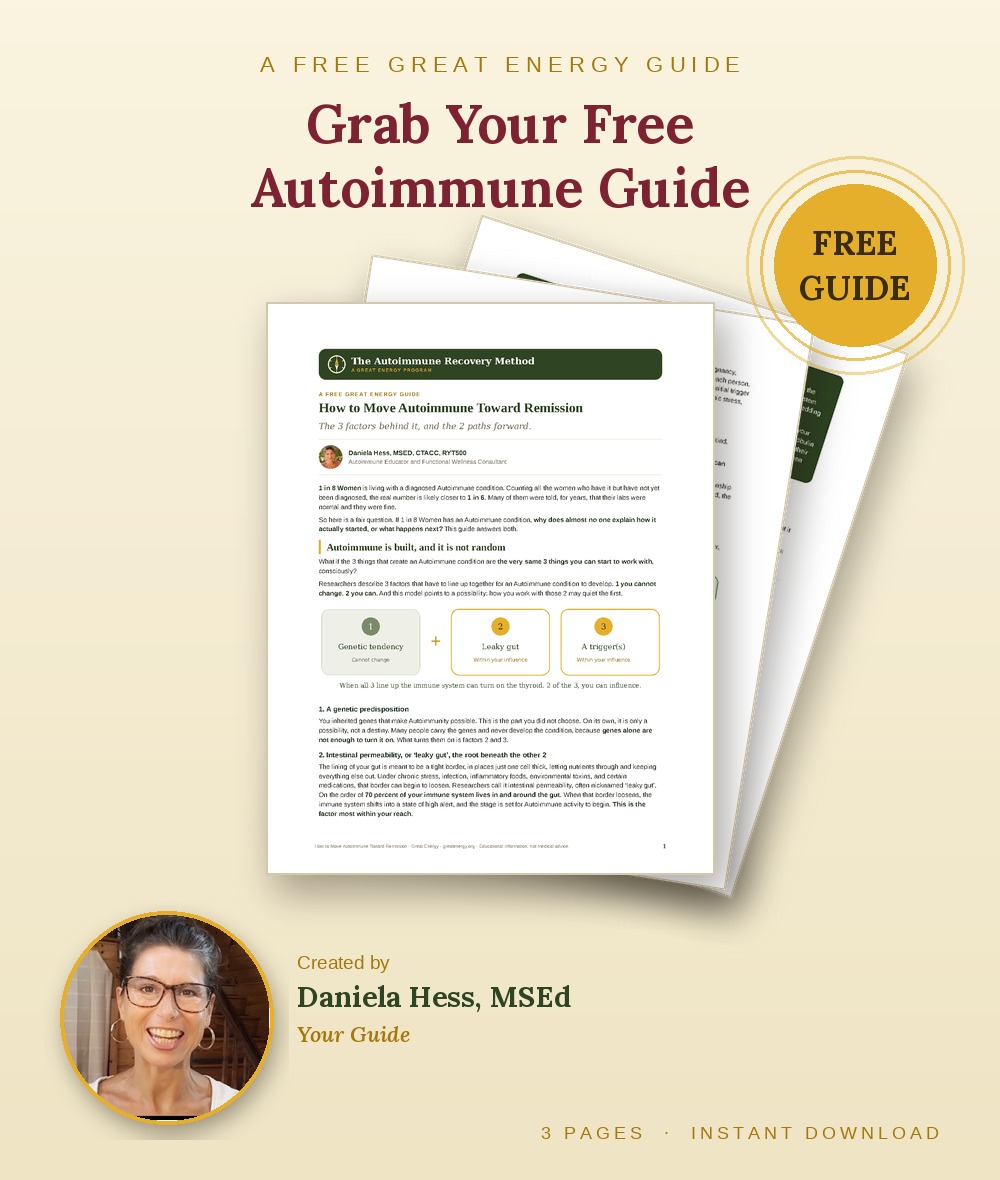
How to Move Autoimmune Toward Remission
The 3 factors behind an Autoimmune condition and the 2 paths forward, free, straight to your inbox.
No spam. Unsubscribe anytime.
Your guide is on its way. You can also open it now (PDF).

Articles from Daniela
Daniela Hess, MSEd, is a co-founder of Great Energy and an Autoimmune Educator and Functional Wellness Consultant who lives and thrives with Hashimoto’s. She is not a licensed medical provider.
AIP recipes to try
A place to start in the kitchen while you work on this with your own clinician: