Blood and blood vessels
Raynaud's phenomenon (related)
Raynaud's phenomenon is an exaggerated narrowing of small blood vessels in the fingers and toes in response to cold or stress, which briefly limits blood flow. The primary form occurs on its own and research describes its underlying mechanism as still not fully understood despite more than a century of study, involving some combination of changes in blood vessel lining, nerve signaling, and locally produced substances that affect how vessels constrict and relax.
Research estimates the pooled prevalence of primary Raynaud's phenomenon at roughly 5 percent of the general population, with figures in individual studies ranging from about 3 to 9 percent depending on how the condition is defined and diagnosed. The secondary form is autoimmune-related and can accompany conditions such as scleroderma or lupus, so it is marked here as related rather than as a primary autoimmune condition in its own right, and it tends to be more severe than the primary form.
Common signs
Fingers or toes that turn white, then blue, then red as blood flow returns, often with numbness, tingling, coldness, or pain during an episode, usually triggered by cold or stress.
This is a plain-language summary for orientation, not a diagnosis. Mechanisms are described as current understanding, not settled fact. Work with your own clinician for your care.
Questions people ask
Is Raynaud's phenomenon an autoimmune disease?+
What triggers a Raynaud's episode, and what does it look like?+
How common is Raynaud's phenomenon?+
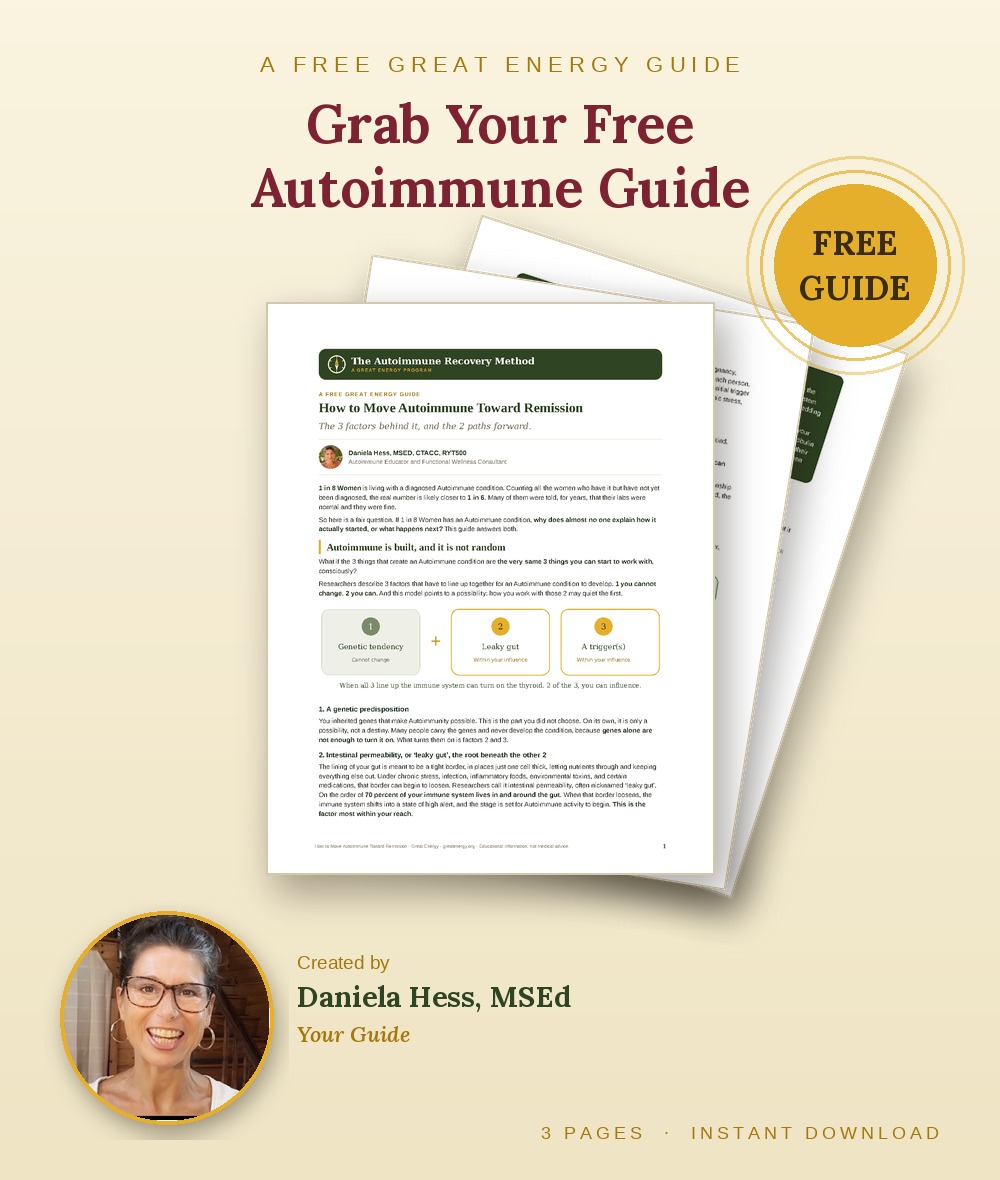
How to Move Autoimmune Toward Remission
The 3 factors behind an Autoimmune condition and the 2 paths forward, free, straight to your inbox.
No spam. Unsubscribe anytime.
Your guide is on its way. You can also open it now (PDF).

Articles from Daniela
Daniela Hess, MSEd, is a co-founder of Great Energy and an Autoimmune Educator and Functional Wellness Consultant who lives and thrives with Hashimoto’s. She is not a licensed medical provider.
AIP recipes to try
A place to start in the kitchen while you work on this with your own clinician: