Joints, muscles, and connective tissue
Sjogren's syndrome (Sjogren's)
Sjogren's syndrome is an autoimmune condition in which lymphocytes, a type of immune cell, infiltrate the exocrine glands that produce tears and saliva, and this infiltration together with polyclonal B-cell activation and autoantibody production against Ro and La antigens is thought to drive the resulting glandular dysfunction. Over time this reduces the glands' ability to keep the eyes and mouth moist, and the same immune activity can extend to other tissues in some people. Sjogren's can occur alone or alongside another autoimmune condition such as rheumatoid arthritis or lupus.
A systematic review and meta-analysis estimated that primary Sjogren's affects roughly 0.2 to 3.0 percent of the population, with a pooled incidence around 7 per 100,000 person-years, and research consistently finds it affects women far more often than men, at a ratio near 9 to 1.
Common signs
Persistent dry eyes (gritty or burning) and dry mouth, along with difficulty swallowing dry foods, dental problems, and dryness elsewhere. Many people also have fatigue and joint pain, and some experience dryness of the skin or other glands.
This is a plain-language summary for orientation, not a diagnosis. Mechanisms are described as current understanding, not settled fact. Work with your own clinician for your care.
Questions people ask
What is Sjogren's syndrome?+
What are the symptoms of Sjogren's syndrome?+
Can Sjogren's syndrome occur with other autoimmune diseases?+
In a doctor’s words
“For the first time, multiple clinical trials to evaluate new treatment options are meeting their Phase II endpoints, providing hope that in the near future, we might identify therapies for subsets of Sjogren's patients that could address the root cause of their symptoms.”
Sara McCoy, MD, PhD, rheumatologist, director of the UW Health Sjogren's clinic
Read more at University of Wisconsin School of Medicine and Public Health ↗
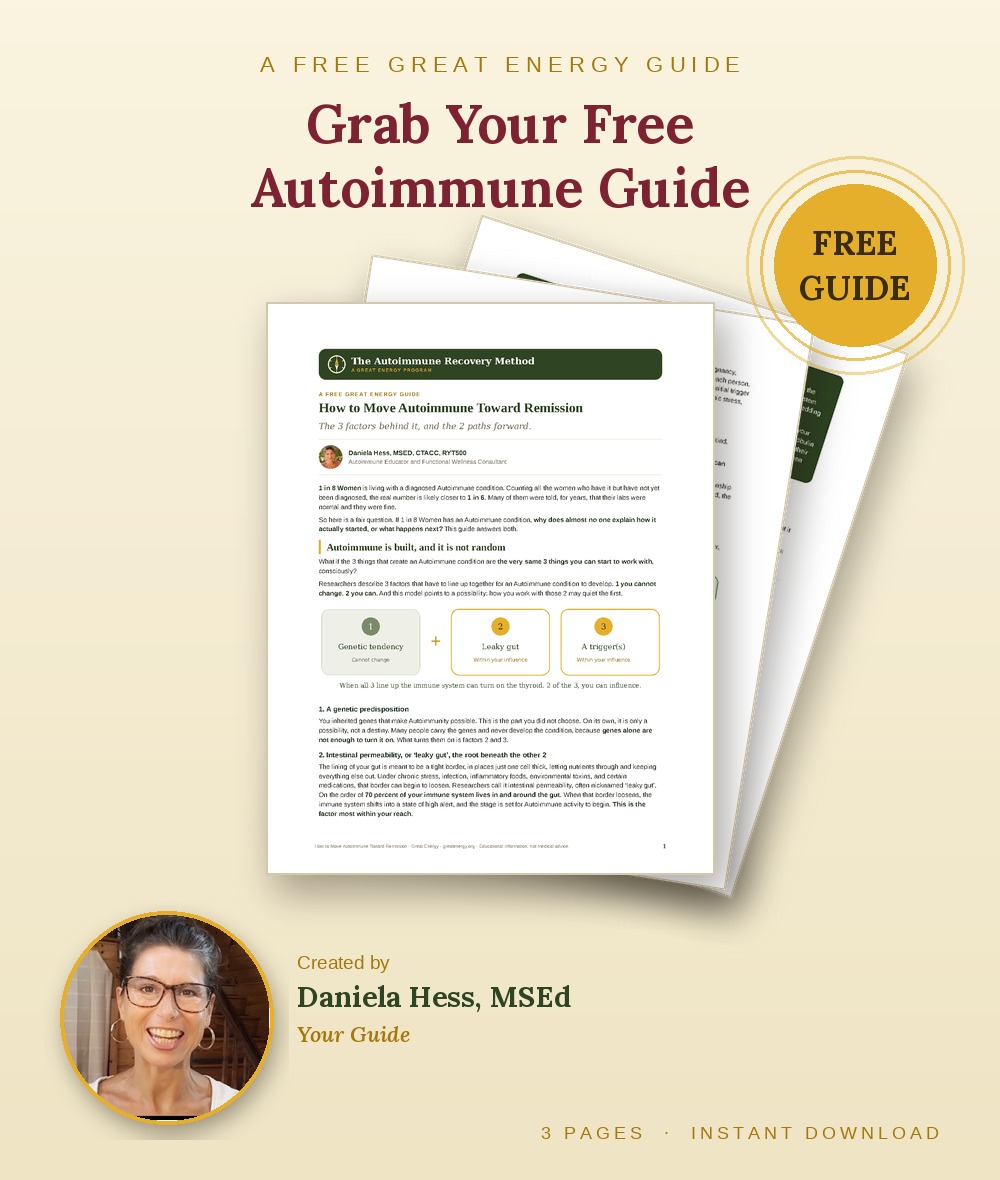
How to Move Autoimmune Toward Remission
The 3 factors behind an Autoimmune condition and the 2 paths forward, free, straight to your inbox.
No spam. Unsubscribe anytime.
Your guide is on its way. You can also open it now (PDF).

Articles from Daniela
Daniela Hess, MSEd, is a co-founder of Great Energy and an Autoimmune Educator and Functional Wellness Consultant who lives and thrives with Hashimoto’s. She is not a licensed medical provider.
AIP recipes to try
A place to start in the kitchen while you work on this with your own clinician: