Blood and blood vessels
Takayasu arteritis
Takayasu arteritis is a chronic, granulomatous inflammation of the aorta and its major branches, in which immune cells infiltrate and damage the vessel wall over time, which can narrow, weaken, or scar these large arteries.
It is considered a rare condition, with research describing an incidence of roughly 1 to 2 cases per million people and a prevalence that varies notably by region, from about 5 to 33 cases per million in Western Europe to a higher 30 to 40 cases per million in parts of Asia. It tends to affect younger adults, especially women of childbearing age, and most often begins during the second or third decade of life. Early symptoms are often vague, such as fatigue and low-grade fever, before more specific vascular symptoms appear as blood flow through affected arteries becomes restricted.
Common signs
Fatigue, fever, and aching joints early on, then later a weak or absent pulse in an arm, differences in blood pressure between the arms, arm or leg pain with use, dizziness, and headaches as blood flow is affected.
This is a plain-language summary for orientation, not a diagnosis. Mechanisms are described as current understanding, not settled fact. Work with your own clinician for your care.
Questions people ask
What is Takayasu arteritis?+
What are the symptoms of Takayasu arteritis?+
How is Takayasu arteritis different from giant cell arteritis?+
In a doctor’s words
“Her spirit amazes me daily. I am so impressed by her resilience in the face of this illness and her ability to find the positives. I feel lucky to be a part of her care team.”
Ginger Janow, M.D., Pediatric Rheumatologist, Joseph M. Sanzari Children's Hospital, Hackensack University Medical Center
Read more at Hackensack Meridian Health, Healthier You (Patient Perspectives) ↗
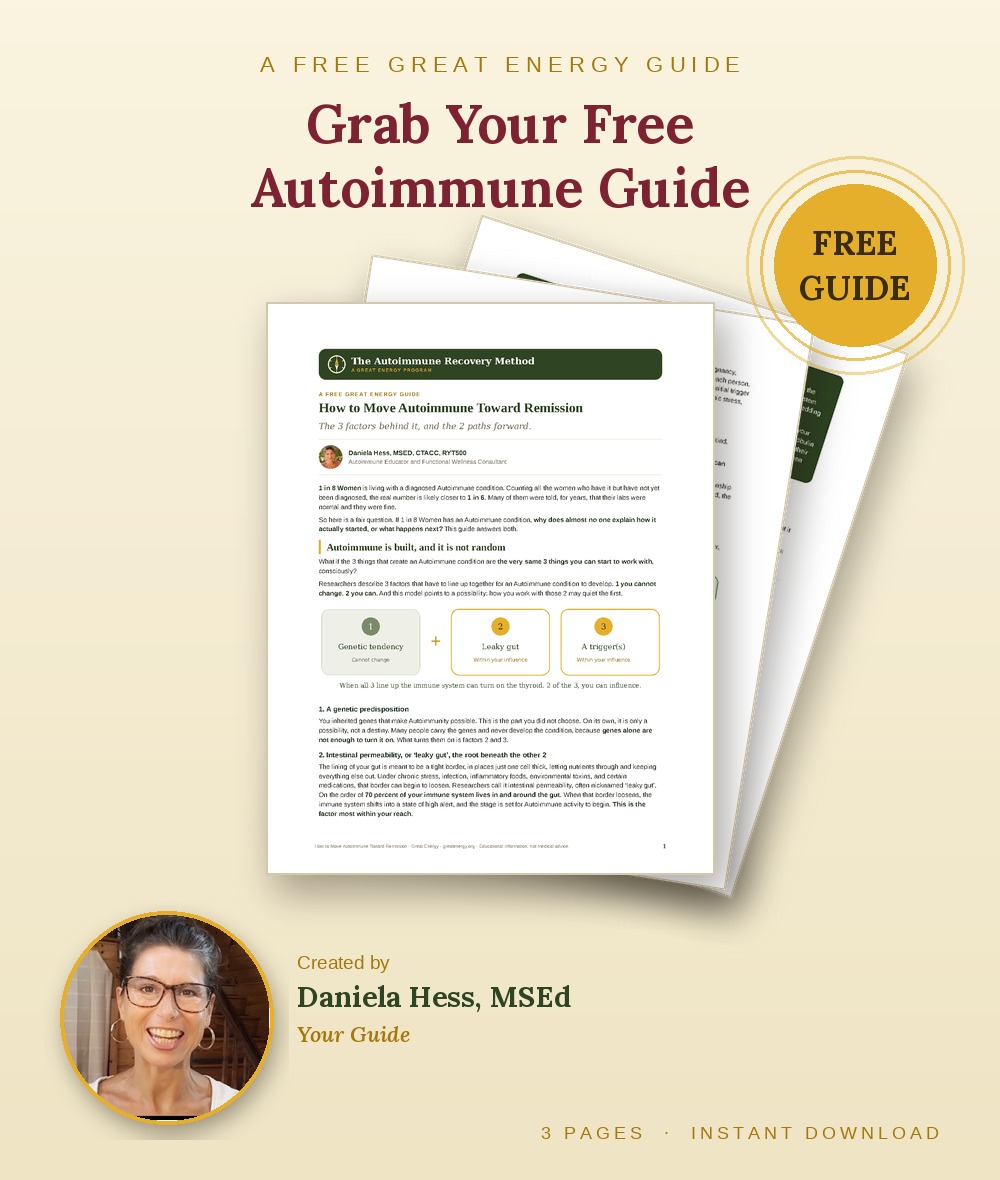
How to Move Autoimmune Toward Remission
The 3 factors behind an Autoimmune condition and the 2 paths forward, free, straight to your inbox.
No spam. Unsubscribe anytime.
Your guide is on its way. You can also open it now (PDF).

Articles from Daniela
Daniela Hess, MSEd, is a co-founder of Great Energy and an Autoimmune Educator and Functional Wellness Consultant who lives and thrives with Hashimoto’s. She is not a licensed medical provider.
AIP recipes to try
A place to start in the kitchen while you work on this with your own clinician: