Gastrointestinal and liver
Ulcerative colitis (UC)
Ulcerative colitis is a form of inflammatory bowel disease affecting the colon and rectum. It is understood to arise from an interaction between genetics, environmental factors, gut microbiota, and an immune system that mounts a sustained inflammatory response against the colon's lining, producing continuous inflammation that begins at the rectum and extends upward in an unbroken stretch. Unlike Crohn's disease, it usually stays confined to the colon and affects the surface lining rather than the full thickness of the bowel wall.
Research describes global incidence estimated at roughly 1 to 20 cases per 100,000 people yearly, with rates rising in newly industrialized regions. Ulcerative colitis tends to follow a bimodal age pattern, with one diagnosis peak in the second and third decades of life and a second later between ages 50 and 80.
Common signs
Loose stools often mixed with blood or mucus, urgency, a feeling of incomplete emptying, abdominal cramping, fatigue, and at times fever or weight loss. Symptoms tend to flare and then settle, and some people also have joint, skin, or eye involvement.
This is a plain-language summary for orientation, not a diagnosis. Mechanisms are described as current understanding, not settled fact. Work with your own clinician for your care.
Questions people ask
What is the life expectancy of someone with ulcerative colitis?+
Can ulcerative colitis be cured?+
What foods should I avoid with ulcerative colitis?+
In a doctor’s words
“We started a treatment that she takes just once a month and it immediately induced, and now has maintained, remission. She has been stable without symptoms since we started and for the first time since she had been diagnosed.”
David T. Rubin, MD, Section Chief of Gastroenterology, Hepatology and Nutrition, University of Chicago Medicine
Read more at UChicago Medicine ↗
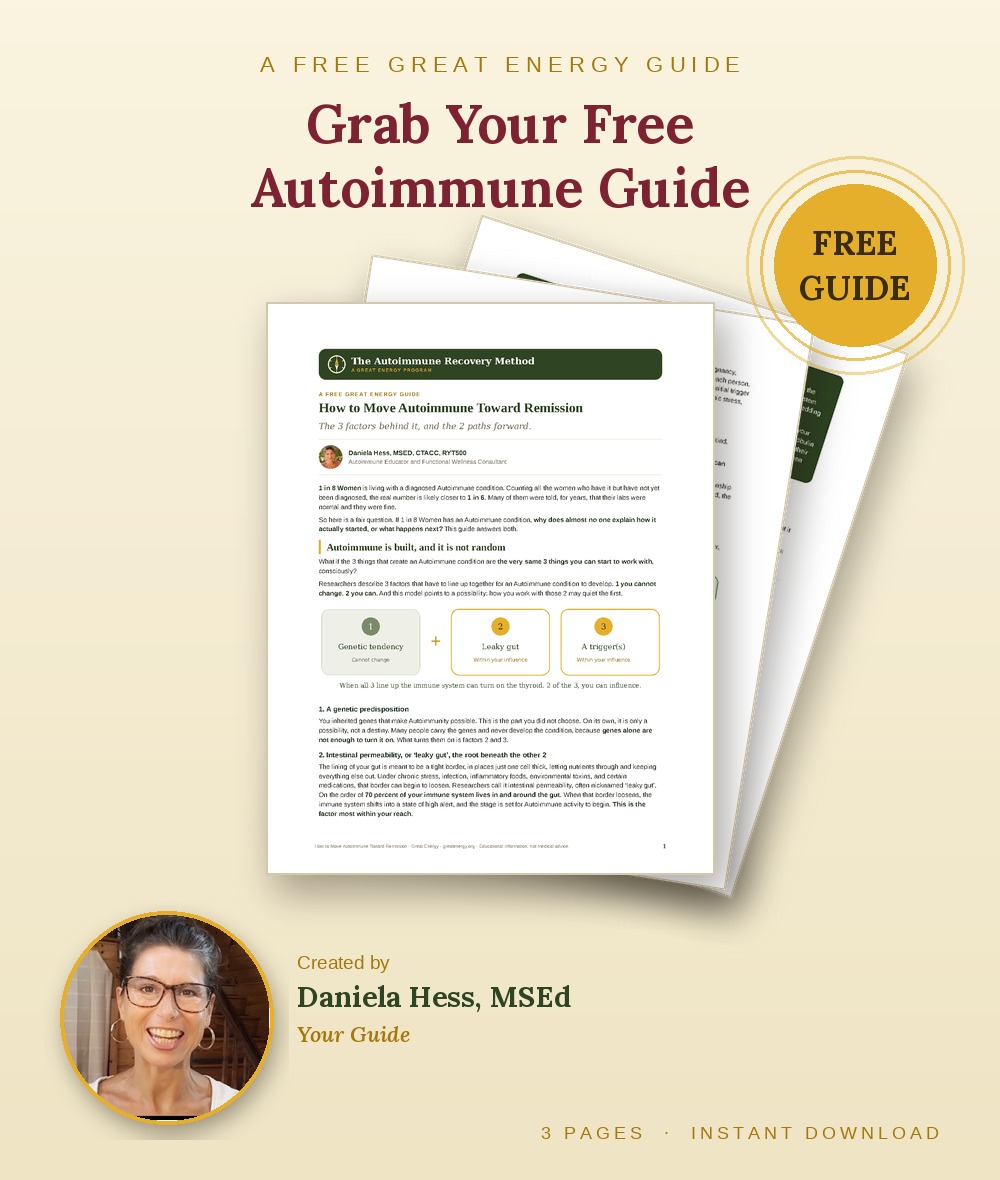
How to Move Autoimmune Toward Remission
The 3 factors behind an Autoimmune condition and the 2 paths forward, free, straight to your inbox.
No spam. Unsubscribe anytime.
Your guide is on its way. You can also open it now (PDF).

Articles from Daniela
Daniela Hess, MSEd, is a co-founder of Great Energy and an Autoimmune Educator and Functional Wellness Consultant who lives and thrives with Hashimoto’s. She is not a licensed medical provider.
AIP recipes to try
A place to start in the kitchen while you work on this with your own clinician: