The AIP Diet
The AIP pantry: what to stock before you start
By Daniela Hess · Great Energy · June 27, 2026
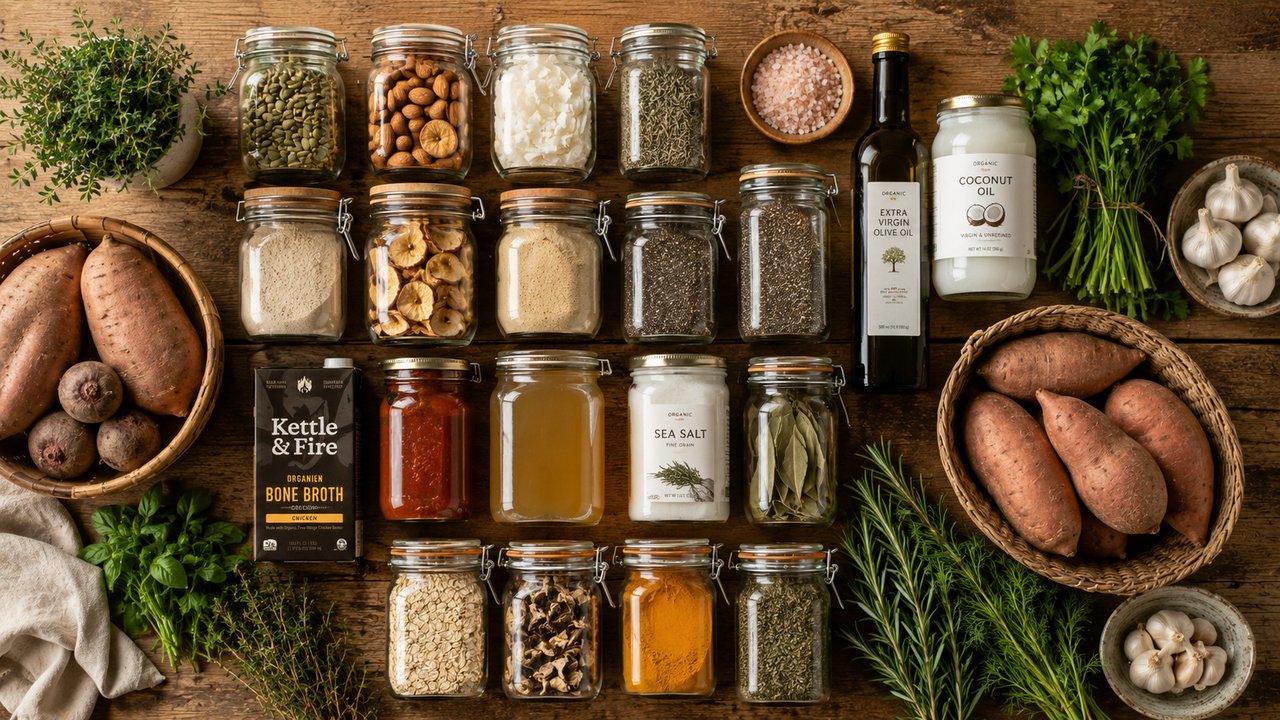
There is a moment when you open your kitchen, the cupboards in your kitchen, and you see that it is finally stocked for this protocol. The thought shifts from 'what am I giving up' to 'I actually have everything I need.' Take a moment to really be with that. It matters.
The whole goal of this pantry setup is to get you there as readily as possible, so that your kitchen becomes a place of abundance and nourishment rather than scarcity.
Stocking the pantry is one of the most practical steps inside the Autoimmune Recovery Method (ARM), a complete approach to moving an Autoimmune condition 'Toward Remission'. A kitchen set up this way is what makes the food piece of the Autoimmune Recovery Method livable day after day.
If you are new here and want to understand the food approach itself before you stock for it, that is laid out in 'What AIP Is, and Why It Works'.
The single most important practical step before you begin AIP is preparing your kitchen.
There is a name for what happens when you are already running on empty and still have to decide what to eat: decision fatigue. Every choice you make in a day draws down the same small reserve, so by evening, when a depleted body and a tired mind reach for food, there is almost nothing left to decide with.
This is biology, and the environment around you can make it easier or harder to work with. When eliminated foods are in easy reach, compliance gets significantly harder, because at 9 PM, a depleted body reaches for whatever is closest, not always whatever is wisest or most nourishing for your healing gut.
When you do not have AIP-compatible staples on hand, every meal becomes a negotiation.
Take the time you need to set up your pantry. When you take the time to set it up, it does most of its work quietly for weeks, without you having to think about it. What you are doing is arranging your kitchen so that the easiest reach is the healing one, and so the tired version of you is taken care of.
Step 1: clear the kitchen
Go through your pantry, refrigerator, and freezer and remove the eliminated categories. Not move aside. Remove. This includes:
- Grains: flour, pasta, rice, oats, cornmeal, bread, crackers.
- Dairy: milk, butter, ghee, cheese, yogurt, cream, whey protein.
- Eggs.
- Legumes and beans.
- Nightshades: tomato products, peppers, eggplant, potatoes, paprika, cayenne, chili powder, most curry blends.
- Seed oils: canola, vegetable, soybean, sunflower, safflower, corn oil.
- Soy in all forms: tofu, edamame, miso, soy sauce, and soy lecithin hiding in packaged products.
- Nuts and seeds and nut-based products.
- Sugar and sweetened products, except small quantities of honey and maple syrup.
- All processed and packaged foods containing eliminated ingredients.
Why remove rather than just relocate. Because a craving does not negotiate with a high shelf. The thing pushed to the back of the cupboard is still the thing your hand finds on a hard day, and a hard day is precisely when your defenses are lowest.
Clear it fully, and the decision is made once, in a calm moment, instead of fifty times in weak ones.
If clearing food out feels wasteful, donate the unopened items to a food bank or hand them to a neighbor, and let that be its own small mercy.
However, if there are others in your home who still eat these foods, give the eliminated items their own shelf or cupboard, out of your direct sightline, so that your reaching space is clear even if the whole house is not. The goal is a kitchen where compliance is the path of least resistance, where reaching for what is in front of you is automatically the right thing.
The spice drawer
This is where people stumble most, because nightshade-derived spices hide everywhere: in curry blends, in seasoning mixes, in things that do not look spicy at all. Replace your spice rack with AIP-compliant herbs and spices.
In: Turmeric, ginger, garlic powder, onion powder, cinnamon, cloves, allspice, mace, saffron, basil, bay leaf, cilantro, dill, oregano, rosemary, thyme, sage, mint, lemon balm, marjoram, chives, tarragon. Salt and black truffle salt. Horseradish and wasabi, for heat without nightshades.
Out: Paprika, cayenne, chili powder, red pepper flakes, and any curry blend or spice mix containing them. Mustard, which is a seed and comes back in stage 1 reintroduction. Mixed seasoning blends from the grocery store are high-risk and worth avoiding during elimination unless you have verified every ingredient.
When in doubt, read the label. Then read it again. I show you how in 'Reading a Label Like a Detective'.
Pantry staples to stock
Fats and oils: Coconut oil, avocado oil, cold-pressed olive oil, lard or tallow if you cook with them.
Canned and jarred goods: Wild-caught canned salmon, sardines, mackerel, and anchovies. Full-fat coconut milk with no added gums or sweeteners (check every brand, because many coconut milks contain carrageenan or soy emulsifiers).
Bone broth, or the bones and equipment to make it yourself. Coconut aminos, which is the soy sauce replacement you will reach for constantly. Apple cider vinegar with the mother.
Grain-free flours and starches: Cassava flour is the most versatile AIP baking flour, and the closest in texture to wheat flour. Tigernut flour works well in baked goods (a tigernut is a tuber, not a nut, and is AIP-compliant). Coconut flour is another good option, more absorbent than the others, so a little goes further. Arrowroot starch and tapioca starch, also called tapioca flour, are your thickeners for sauces and soups.
Whole-food carbs without grains: I want to stop you here, because this is where a lot of people quietly panic. Carbs are not the enemy. Your gut actually needs carbohydrate, especially resistant starch, to feed the good bacteria that keep you well.
Those bacteria ferment that starch into short-chain fatty acids, butyrate chief among them, which is one of the main fuels the cells of your gut lining run on. Starve the bacteria and you partly starve the very lining you are here to repair.
And going too low on carbs can slow your body's conversion of T4, the storage form of thyroid hormone, into T3, the active form your cells actually use, while leaning harder on your stress hormones to keep your blood sugar up. This matters doubly in Hashimoto's, where the thyroid is already laboring and that conversion is already fragile.
AIP is not keto and it is not low-carb. So stock the whole-food carbs that come without grains: sweet potato, plantain, cassava, winter squash and pumpkin, taro, lotus root, and fruit.
We often think we need grains when really we are just used to them. Your body needs the carbohydrate. It does not need the wheat.
This is really the whole pantry in miniature. Every swap on this list, whole-food starch for a box of pasta, real spices for a packaged blend, is the same shift from processed to real, which I make the case for in 'For the Love of Whole Foods: The Shift from Processed to Real'.
Fresh and frozen produce: Vegetables are the heart of this way of eating, and the thing to aim for is variety, the widest variety you can manage.
Try to rotate through around 30 different vegetables across a week, all the colors you can find, rather than the same 3 on repeat. Each color is a different family of plant compounds, and each plant feeds a different population of the bacteria living in you.
The greens carry one set of compounds, the deep oranges and reds another, the purples another still, and the bacteria that thrive on one are not the same ones that thrive on the next. A monotonous plate grows a monotonous gut. A varied plate grows a varied one, and diversity down there is one of the most consistent markers of a resilient gut.
Variety is what prevents new nutrient gaps and keeps that inner garden diverse, which is the whole point. I go further into this in 'Vegetables on AIP: Variety, Rotation, and Why It Matters'.
Stock with whatever is in season and will rotate through the week, and keep frozen cauliflower, broccoli, and mixed vegetables on hand as practical backups for the days when fresh is not there.
Frozen vegetables are picked and flash-frozen at their peak, so they often hold their nutrients as well as fresh, sometimes better than the fresh that has been riding a truck for a week. Reaching for frozen is plain wisdom for the week you do not see coming, something to feel good about.
The batch-cooking setup
AIP eating is easiest when you have ready food. I want you to think of Sunday as an investment in the rest of your week, an hour or two that makes Tuesday evening possible. Here is the equipment that makes batch cooking practical:
- A large pot for bone broth and soups.
- A slow cooker or Instant Pot for hands-off cooking of meats and stews.
- Sheet pans for roasting large quantities of vegetables.
- Glass storage containers in a range of sizes for refrigerating batch-cooked food.
- A good sharp knife.
Stock the pantry once, batch cook on Sunday, and the week becomes manageable. Meals turn into assemblies from cooked components rather than complex daily events, which is exactly what you need on the evenings when there is nothing left in the tank.
I lay out the whole rhythm in 'Batch Cooking and the AIP Mash'. Your kitchen, stocked like this, is one of the most direct acts of care you can offer your healing body.
Stand in it for a moment when it is ready. Breathe in slow, down past the chest into the solar plexus and belly, and feel what it is to be held by your own kitchen. Long exhale. That low belly breath signals safety to your nervous system, and it begins to settle. This is what enough looks like.
And notice, while you are standing there, the quiet, steady voice in you that decided to set all of this up in the first place. Call it the Wisdom Voice. It is the kind voice, the one always guiding you toward harmony and balance, the part of you that keeps championing for you, even on the days you cannot quite champion for yourself.
Trust it. I say more about working with it in 'The Inner Work Is Not Soft: Why Mindset and Connection Are Part of Recovery'.
One last thing as you set this up, because it changes how the whole pantry feels. The point of all of this is nutrient density and variety, the foods that actually feed your gut and rebuild your body. Narrowing what is on your plate was never the aim in itself.
The eliminations are temporary, a season of a few months. The way of eating, nutrient-dense and wide and full of color, is what continues. That is why I always say: 'It is a protocol, not a diet.'
You are stocking this pantry to feed yourself well, for the long run, with depriving yourself nowhere in the picture.
---
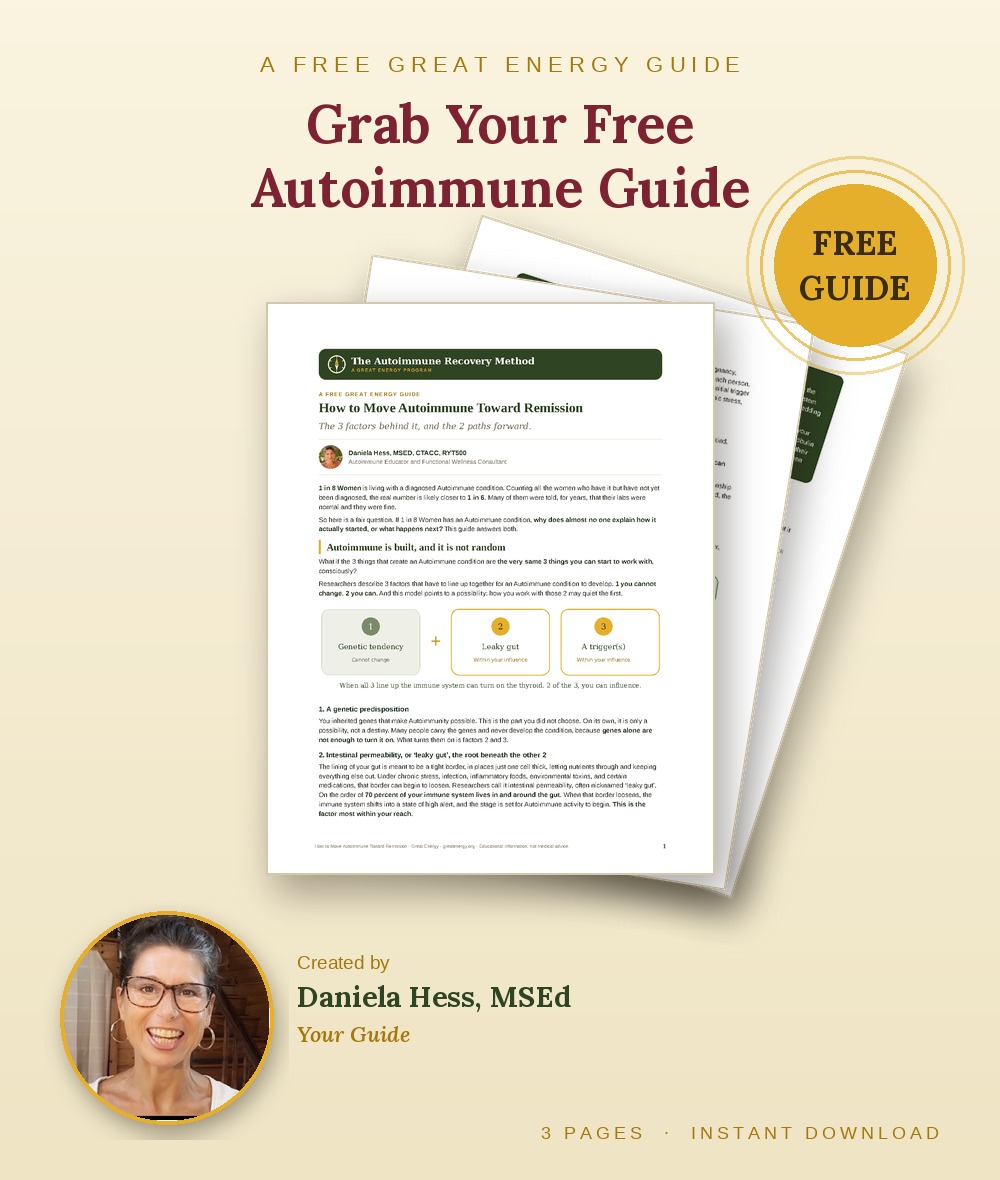
How to Move Autoimmune Toward Remission
The 3 factors behind an Autoimmune condition and the 2 paths forward, free, straight to your inbox.
No spam. Unsubscribe anytime.
Your guide is on its way. You can also open it now (PDF).
Prefer to work together directly? Daniela offers a 1-on-1 labs review and functional wellness session for women with an Autoimmune diagnosis.
See how to work with Daniela
About the author
Daniela Hess, MSEd, is the co-founder of Great Energy and the founder of the Autoimmune Recovery Method. She is an Autoimmune Educator and Coach, a Functional Wellness Consultant, and a certified AIP coach. She lives and thrives with Hashimoto’s and hypothyroidism, and she teaches the science and the Soul of moving an autoimmune condition toward Remission. She is not a licensed medical provider and does not diagnose, treat, or prescribe. Everything here is for education, not medical advice.
With Great Energy & Great Love,
Daniela
From the glossary
Words in this article you can look up. Tap or click a term to learn what it means.
Batch cookingBlood sugarCassava flourCoconut aminosCoconut flourHorseradishInstant PotNutrient densityReintroductionResistant starchShort-chain fatty acidsSlow cookerSoy lecithinTigernut flour