The AIP Diet
Preparing to start
By Daniela Hess · Great Energy · June 27, 2026

If you are getting ready to change something central to daily life, you may be doing it while already managing a body that asks a great deal of you.
This is a path of devotion to your well-being. AIP asks you to stay present to your 'Why', and to what this preparation is affording you. Much of it comes down to a simple test: if your great-grandmother would eat it, then it is, for the most part, AIP compliant. This takes devotion, and if you are reading this and considering it, I know you are coming to this path without a lot of energy to spare.
This preparing-to-start step is part of the Autoimmune Recovery Method (ARM), a complete approach to moving an Autoimmune condition toward Remission. The food elimination you are getting ready for is the heart of it, and good preparation is what lets the Autoimmune Recovery Method actually do its work. There is a saying in AIP that the key to succeeding is always knowing what your next 2 meals are, and having the ease of already having them ready. You stay a couple of meals ahead of yourself. If you are new here and want the basics first, the whole path you are stepping into is mapped in 'The AIP Journey, Start to Finish: A Map of the Phases'.
Here is what I have watched happen, again and again, in the women I work with. The ones who move through the first 2 weeks the most smoothly are almost always the ones who prepared before day one, in whatever practical way they had the capacity for.
Preparation is the difference between a week that builds a groove and a week spent in damage control. Here is what that preparation actually looks like.
Clear and restock before you start
Pick a date, an actual date, not 'soon'. A few days before that date, go through your kitchen with clear eyes.
You do not have to throw everything out, and you do not have to make it dramatic. Box it up, or move it to a shelf that is not yours for now.
What you are after is simple and powerful: a kitchen where every single time you open the refrigerator, the first thing you see is food you can actually eat. You are removing dozens of small daily decisions before they ever reach you tired.
The restock list has 3 categories.
- Protein: good quality meat, poultry, and fish. Organ meats if you are ready for them, even if that just means a small jar of grass-fed beef liver pâté.
- Starchy vegetables: sweet potatoes, winter squash, taro, plantain. Anything that gives you the steady energy your body is used to getting from grains.
- Vegetables in as many colors as you can find: leafy greens, root vegetables, brassicas, alliums, sea vegetables.
Round it out with fats: olive oil, coconut oil, avocados, lard or tallow if you use them, and coconut milk. Then check your herbs and spices against the AIP-compliant list. For the full stocking guide, including the spice drawer and the staples that make this easier, see 'The AIP Pantry: What to Stock Before You Start'.
Bone broth is worth making or buying before you start, and I mean before, not the first time you are standing in the kitchen at 6pm with nothing ready. It is settling, it is deeply nourishing, and it carries the glycine and collagen that the cells of the gut lining use as raw material to repair themselves, one of the building blocks of the very single-cell wall you are trying to seal, which I explain in 'Bone Broth: The Gut-Healing Food of Hashimoto's Recovery'.
More than that, it gives you something warm and satisfying to reach for on the days when you genuinely do not know what to eat. There will be days like that. It helps so much to have the answer already waiting in the fridge.
It is also worth setting up a simple food and symptom journal before day one, even just a notebook by the kettle. Write down what you ate at each meal and how you felt: your energy, your sleep, your digestion, your mood. Track any supplements or medications you take too.
In these first weeks it gives you a place to put the noise, and later, in reintroduction, it becomes the most useful tool you have, because a food's effect often shows up a day or two after you eat it, and the page remembers what a tired week forgets. It also becomes invaluable to look back on with your own practitioner, when the two of you are trying to understand what is going on in your body. We have one ready for you to use.
Tell the key people in your life
This is not about asking permission. You are giving them context for your devotion to your own well-being, so they are not confused when you decline what they cook, and so they do not hand you something that sets you back.
A brief explanation is enough for most people: 'I am doing a focused elimination period for my health, and I have to be pretty careful about it.' The longer conversation can wait for when you have the energy for it.
Choose a starting week with some room
If your next 3 weeks are full of mandatory dinners at restaurants you have not researched, and family events where the food is not in your control, that is not the week to start. This is not about waiting for a perfect time. That never comes.
But giving yourself a window with a little less friction in the first 2 weeks is what makes the difference between building a groove and spending those weeks in recovery from accidental exposures.
What to expect in the first 2 weeks
For some people the first days are genuinely fine. Energy holds steady, the food feels satisfying, and they are surprised by how much they get to eat. For others, the first week is rough: tired, headachy, foggy, sometimes a little short-tempered.
Before you panic, understand: the 'rough patch' is most often a carbohydrate issue or caffeine withdrawal, and it is temporary. It is not your body rejecting the path.
If you feel off, check your carbohydrates first. When grains and sugar come out, your body suddenly has far fewer of the quick carbohydrates it was used to, and it needs a beat to adjust to steadier fuel.
It can often help to add sweet potato or squash to at least one meal, sometimes two. It is not unusual for the headachy, foggy feeling to lift within a day or two.
If you were a serious coffee drinker, some of what you feel is plain caffeine withdrawal, which peaks around day 2 to 3 and typically clears by the end of the week. Knowing both of these in advance keeps a normal dip from feeling like a verdict.
The first 30 days are not the time to judge what AIP is doing, and 30 days is only the floor. The gold standard for the elimination phase is 90 days. The immune system takes time to quiet, and it will not be rushed.
An immune system that has been on high alert for years does not stand down in a week, and the gut lining it sits behind, though it is one of the most renewing surfaces in your whole body, still needs a real stretch of calmer conditions before it can settle and strengthen.
This is true across Autoimmune conditions, whether it is Hashimoto's, rheumatoid arthritis, lupus, or psoriasis, and the same patience applies to all of them.
You are changing the conditions, meal by meal, and the body responds on biological time, not on the schedule you wish it kept. Many people do not feel the lift they came here for until week 3 or 4.
So the question in these early weeks is not 'did I feel better every single day.' It is 'has my overall picture changed from where I started.'
The choice between easing in and starting all at once, and the factors that decide how long your transition takes, are covered in 'Gradual or Rapid, Choosing Your Transition'. This whole transition is one step of the Autoimmune Recovery Method, and if it helps to see the rest, every phase from here to the end is mapped in 'The AIP Journey, Start to Finish: A Map of the Phases'.
This is exactly where the journal helps, because it shows you the slow trend that any single hard day can hide. You are working to give your gut the conditions it needs to heal, and that kind of healing moves on its own schedule, not yours. Your job is to keep sending the signal.
One more thing
This is a lot of change at once, and some of it will be harder than it looks on paper. It is simply the nature of changing something essential to daily life. You do not have to like every part of it to do it well.
So before you begin, get quiet for one breath. Inhale deep, exhale long. And make this promise to yourself: be as kind to yourself in this process as you would be to someone you love who was trying with everything they had to heal. That kindness is part of the work, every bit as much as the food and the timing.
And you do not have to figure this out alone. There is a quiet, steady voice in you that has been with you the whole way, sometimes felt in the head, sometimes in the heart, sometimes in the space between your thoughts. It is the part of you that keeps championing for you, even on the days you cannot quite champion for yourself.
The Sufi poets Rumi and Hafiz called it the Friend. It is always the kind voice, the one guiding you toward harmony and balance. Begin to notice it, and trust it. Tending it is part of the work itself, which I make the case for in 'The Inner Work Is Not Soft: Why Mindset and Connection Are Part of Recovery'.
---
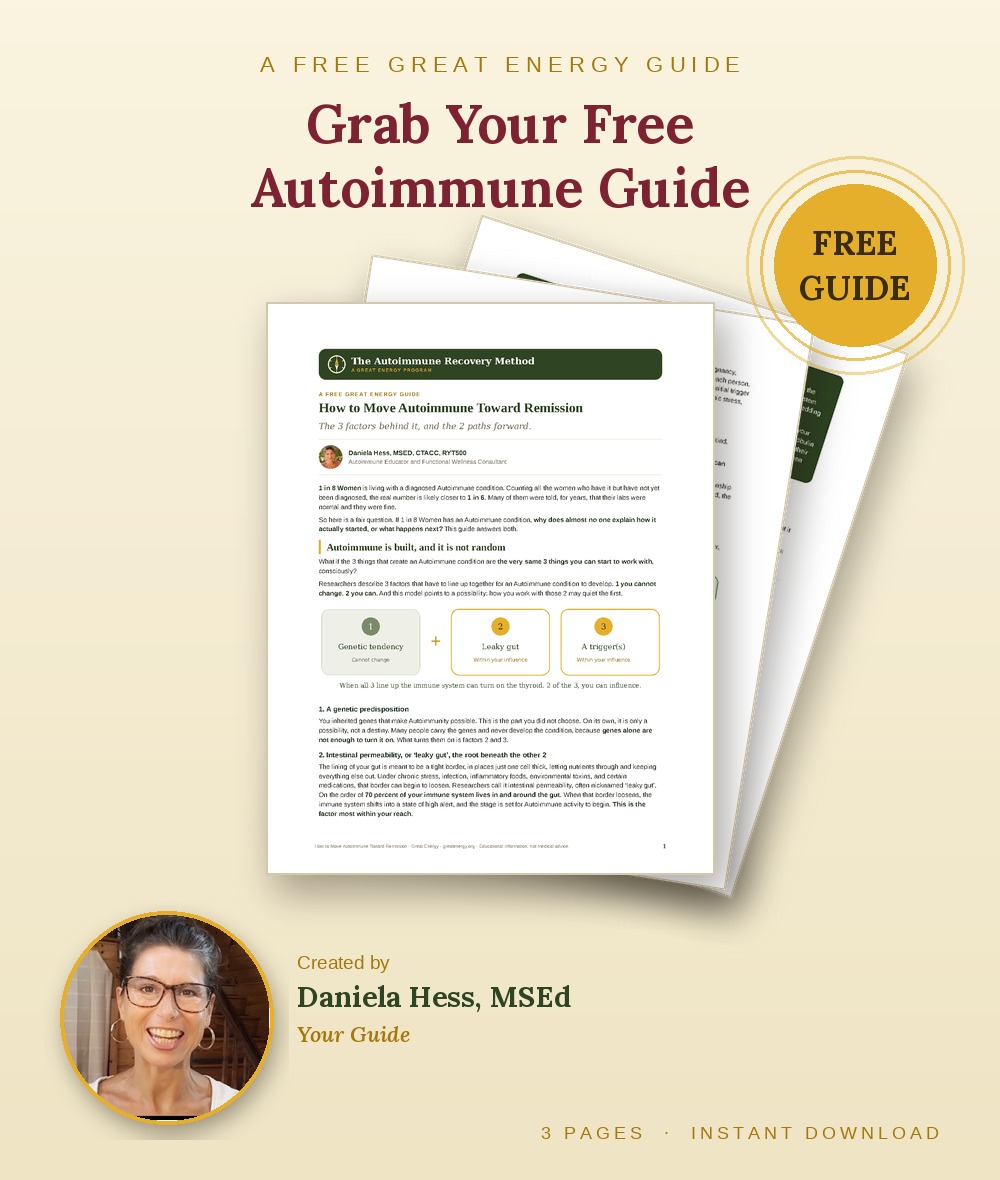
How to Move Autoimmune Toward Remission
The 3 factors behind an Autoimmune condition and the 2 paths forward, free, straight to your inbox.
No spam. Unsubscribe anytime.
Your guide is on its way. You can also open it now (PDF).
Prefer to work together directly? Daniela offers a 1-on-1 labs review and functional wellness session for women with an Autoimmune diagnosis.
See how to work with Daniela
About the author
Daniela Hess, MSEd, is the co-founder of Great Energy and the founder of the Autoimmune Recovery Method. She is an Autoimmune Educator and Coach, a Functional Wellness Consultant, and a certified AIP coach. She lives and thrives with Hashimoto’s and hypothyroidism, and she teaches the science and the Soul of moving an autoimmune condition toward Remission. She is not a licensed medical provider and does not diagnose, treat, or prescribe. Everything here is for education, not medical advice.
With Great Energy & Great Love,
Daniela
From the glossary
Words in this article you can look up. Tap or click a term to learn what it means.
Bone brothCollagenGlycineImmune systemLardPlantainPsoriasisReintroductionRemissionRheumatoid arthritisSea vegetablesTallowTaro