The AIP Diet
How AIP actually works
By Daniela Hess · Great Energy · July 3, 2026

AIP is a tool for discovering which foods are driving your immune system to attack your own tissue, and for giving your gut the conditions it needs to stop that from happening. There is so much more to it than what comes off your plate.
We are not sorting foods into good or bad here. We are working with inflammatory and anti-inflammatory, foods that keep the fire lit, and foods that help it settle.
Here is the mechanism in plain terms. The lining of your gut is a single cell thick. Inflammatory foods irritate that lining and help create what is often called leaky gut. The more inflamed that lining becomes, the more it leaks, and the more gets into your bloodstream that was never meant to be there. That is a piece of how Autoimmunity happens: what leaks out gets met by your immune system, and in some cases, that immune system mistakes it for your own tissue.
The whole thing rests on 2 precise moves that happen simultaneously: we remove inflammatory foods, and we give back what rebuilds, in the form of anti-inflammatory foods. Hold these side by side, because most people only ever hear about the first one and miss half the medicine. Understanding the mechanism is what helps you trust the protocol when the first 2 weeks are hard, and they can be hard.
AIP is the food foundation of the Autoimmune Recovery Method (ARM), a complete approach to moving an Autoimmune condition 'Toward Remission'. This article is the why underneath the how, the mechanism that makes the rest of ARM make sense. If you are new here and want the practical overview of the food work first, it is laid out in 'What AIP Is, and Why It Works'.
The gut is the center of it
Many Autoimmune conditions share a common upstream factor: something has compromised the lining of the small intestine. This is true across the family, from Hashimoto's and hypothyroidism to celiac, type 1 diabetes, and inflammatory bowel disease. That lining is a single cell thick, one cell standing between everything you eat and your bloodstream, and it is supposed to be selectively permeable, a careful gatekeeper.
The cells are held together by tight junctions, seams meant to stay closed, that let nutrients through and keep everything else in the gut where it belongs. When those seams loosen, larger molecules slip through into the bloodstream where they were never meant to be. Food proteins, bacterial fragments, microbes. The immune system finds them there, reads them as invaders, and mounts an attack.
This is what people mean by 'leaky gut', and it is one of the common contributing mechanisms behind Autoimmunity, a piece of biology and not a flaw in you, not a verdict on your character. There is even a known trigger for that loosening: gluten's gliadin protein signals the gut to release zonulin, a molecule that pries the tight junctions open in susceptible people.
The gut is often described as housing on the order of 70 percent of the immune system, packed right behind that single-cell wall, which is part of why so much of this work begins right there.
Molecular mimicry: mistaken identity in the body
The harder piece, and the one that explains so much, is that some of those food proteins look very similar to your own tissue. Gluten, the protein in wheat, has a molecular structure that evidence suggests may resemble thyroid tissue in people with Hashimoto's. So when the immune system learns to attack gluten loose in the bloodstream, it can begin attacking thyroid cells by mistake, friendly fire on your own body.
This is called molecular mimicry, and I trace it in full in 'Molecular Mimicry: How One Protein Teaches the Immune System to Attack Another'. The plainest way to say it is this: it is a case of mistaken identity, not malice. Your immune system is a devoted, exhausted protector, doing exactly the job it was built for, working from confused information it never chose. It cannot tell the gluten from the thyroid that resembles it, so it moves against both.
Dairy proteins can play the same trick. So do egg proteins, for some people. The foods that come out during AIP are, collectively, the ones most commonly driving this kind of immune confusion. They are not coming out at random.
How other Autoimmune conditions tell this story
Is this the mechanism behind every Autoimmune condition? Not always in exactly the same way. Molecular mimicry is best documented in conditions like rheumatic fever, where a strep infection can trigger an immune response that also attacks heart tissue, and it is a proposed mechanism in Hashimoto's, tied to gluten. In rheumatoid arthritis, the leading mechanism looks a little different: certain proteins in the joints get chemically altered, through a process called citrullination, often set off by things like smoking or gum disease, and the immune system no longer recognizes them as your own.
A few more examples show how varied this can look. In celiac disease, the immune system does not mistake gluten for a distant tissue. It builds a response against an enzyme in the gut lining itself, called tissue transglutaminase, which modifies gluten as it is digested, and the resulting immune attack damages the gut lining directly, right at the site of contact.
In psoriasis, the driving force is less about mistaken identity and more about a subset of immune cells, T cells, becoming chronically overactive and signaling the skin to grow and shed far faster than it should. One form, guttate psoriasis, is well documented to follow a strep throat infection, and a piece of that bacteria may resemble a protein in skin tissue closely enough to set this off, a mimicry story much like the one with rheumatic fever.
In multiple sclerosis, the target is myelin, the protective sheath around nerve fibers. A growing body of research points to the Epstein-Barr virus, the virus behind mono, as a near-universal precursor, and a piece of that virus is now understood to resemble a protein on the cells that make myelin closely enough to plausibly explain the crossfire.
Different Autoimmune conditions can have different specific triggers for this kind of confusion, and mimicry is one of several ways it happens, not the single explanation for all of them. What they share is the same underlying pattern: a devoted immune system, doing its job, responding to something it has been given real reason to treat as a threat.
Different conditions, different specific stories, and yet they all trace back to the same 3 things: a genetic predisposition that made this possible, a gut lining that became permeable enough to let something through it should never have met, and a trigger, an infection, a stress, an exposure, that set the whole thing in motion. Change the story and you are still looking at the same 3 factors underneath it.
Now, this is where AIP comes back in.
What AIP does
AIP works by removing the most common immune-reactive, inflammatory foods so your immune system has less to fight. That is the taking away. But removing foods is not enough, and this is the part I never want you to miss. What we DO eat is what feeds the microbiome and rebuilds the body.
So at the same time, AIP floods the body with the nutrients that intestinal cells need to rebuild the gut lining: glycine from bone broth and collagen-rich meats, short-chain fatty acids from the fiber in vegetables, zinc and vitamin A from organ meats, omega-3s from fish.
The wide variety of plants on the plate is not decoration. It is the bulk of your meal, and it is food for the good bacteria in your gut, the bacteria that do so much of the quiet work of keeping the immune system calm. Datis Kharrazian recommends 6 to 14 servings of vegetables a day, and the goal is variety, not quantity. This is not incidental. It is the reason the AIP plate looks the way it does.
The 4 things AIP addresses together
The 4 things AIP addresses at the same time, in Kharrazian's framing, are gut integrity, nutrient density, blood sugar regulation, and immune modulation. Here is what each one means plainly.
Gut integrity is the sealing of that single-cell wall so it stops leaking. Nutrient density is supplying the raw materials the body has been short on, so it can actually repair. Blood sugar regulation is keeping your energy steady instead of spiking and crashing, which is why the protocol leans on protein and starchy vegetables at real meals rather than grazing. Immune modulation is helping that overactive protector settle back toward calm.
They are addressed together because they feed each other in a chain. Stable blood sugar supports adrenal function, adrenal function supports immune regulation, immune regulation reduces gut inflammation, and reduced gut inflammation lets the lining finally heal. Pull one link and the others sag. Strengthen one and the others lift.
More energy, fewer flares, a gut that can actually absorb what you give it. These are the downstream possibilities when that whole cycle stabilizes, not promises, but real possibilities you are working toward.
What it cannot do
AIP cannot do this work alone when there is an active infection, significant mold exposure, a toxin burden, or an unaddressed blood sugar problem. The diet is a powerful foundation, but it is a foundation. That is why ARM works through the 6 Keys of Action Toward Remission rather than treating food as the complete solution: Community & Foundations, Gut & Nourishment, Environment & Rhythms, Love & Healthy Relationships, Calm & Resilience, and Purpose & Aliveness.
If you do 30 to 90 days of compliant AIP and your symptoms do not move, the answer is finding what else needs tending, never simply doing more with food. That is not your fault, and it is not a sign you did it wrong.
Why some foods that look healthy come out
This is the question people ask most often. Why nightshades? Why eggs? Why nuts and seeds?
None of these foods are bad in an absolute sense. They come out because they contain compounds that can irritate an already-compromised gut lining or provoke immune responses in a body that is already in an inflammatory state.
These are simply the plant's own quiet defenses, nothing exotic or poisonous: lectins, sticky proteins that can bind to and irritate the gut wall; saponins, found in nightshades and legumes, which can loosen the very junctions you are trying to seal; alkaloids in nightshades; and enzyme inhibitors in nuts, seeds, and grains that make them harder to digest.
In a healthy gut these mostly pass without trouble. In a gut that is already leaking and inflamed, they can keep the irritation going.
The goal is to quiet the immune system enough, and heal the gut enough, that you can test them back in one by one and find out which ones are actually a problem for YOUR body, specifically, not the average body in a study. We are never trying to avoid them forever.
The answer to every elimination is reintroduction. Temporary removal is the method, never the destination. I walk through this whole process in 'Reintroduction, Where You Learn Your Own Map'. A simple food and symptom journal is what turns reintroduction from guesswork into real knowledge, because the reaction to a food often shows up a day or two later, in your energy, your sleep, your digestion, your mood, and the page remembers what the day forgets.
Give yourself permission to be curious about what you discover here, almost like a researcher studying your own life. Get quiet, breathe into your belly, in deep and a long exhale. That slow diaphragmatic breath is a signal of safety to your nervous system, and it helps the whole system settle. Let this be true: your immune system is not the enemy here. It is a devoted, exhausted protector, working with the only information it has, and this whole process is about clearing the confusion so it can finally tell friend from foe and stand down.
We are learning to work with it, not against it. And as you learn to trust your body again, notice the quiet, steady voice in you that has been championing for you the whole way, even on the days you could not quite champion for yourself. You might call it the Wisdom Voice, and it is the kind voice, the one always guiding you toward harmony and balance. Trust it, and know that tending it is part of the healing, not a soft extra alongside it, which I make the case for in 'The Inner Work Is Not Soft: Why Mindset and Connection Are Part of Recovery'.
Questions people ask
How does leaky gut lead to Autoimmune disease?+
What is molecular mimicry in Autoimmune disease?+
Why do healthy foods like nightshades and eggs get removed on AIP?+
What does AIP actually do to the body?+
Can AIP fix Autoimmune symptoms on its own?+
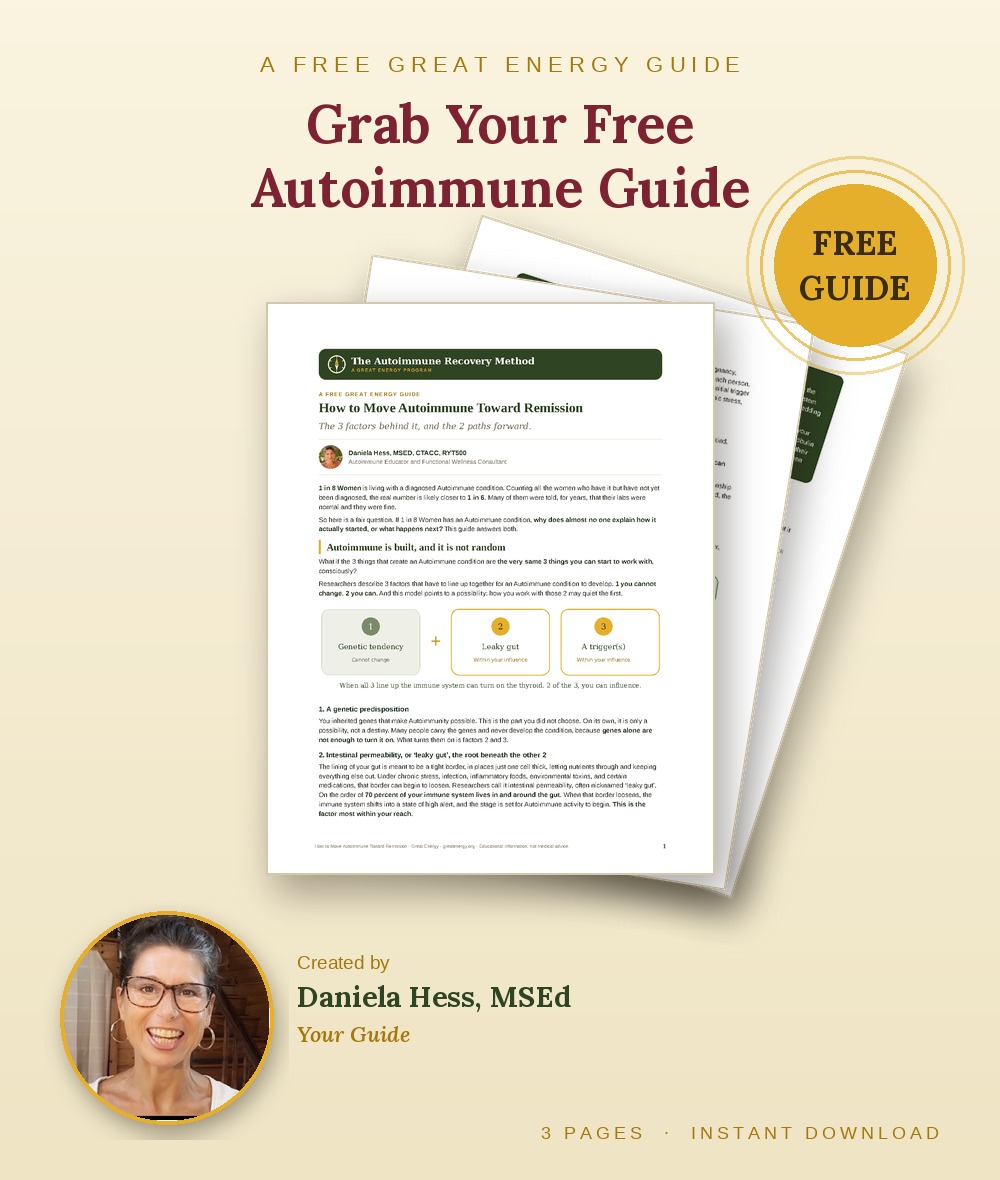
How to Move Autoimmune Toward Remission
The 3 factors behind an Autoimmune condition and the 2 paths forward, free, straight to your inbox.
No spam. Unsubscribe anytime.
Your guide is on its way. You can also open it now (PDF).
Prefer to work together directly? Daniela offers a 1-on-1 labs review and functional wellness session for women with an Autoimmune diagnosis.
See how to work with Daniela
About the author
Daniela Hess, MSEd, is the co-founder of Great Energy and the founder of the Autoimmune Recovery Method. She is an Autoimmune Educator and Coach, a Functional Wellness Consultant, and a certified AIP coach. She lives and thrives with Hashimoto’s and hypothyroidism, and she teaches the science and the Soul of moving an autoimmune condition toward Remission. She is not a licensed medical provider and does not diagnose, treat, or prescribe. Everything here is for education, not medical advice.
With Great Energy & Great Love,
Daniela
From the glossary
Words in this article you can look up. Tap or click a term to learn what it means.
Blood sugarBone brothCeliac diseaseHypothyroidismImmune systemInflammationMolecular mimicryMultiple sclerosisNutrient densityReintroductionRheumatoid arthritisShort-chain fatty acidsTight junctionsType 1 diabetes