The AIP Diet
What a proper meal looks like
By Daniela Hess · Great Energy · June 27, 2026
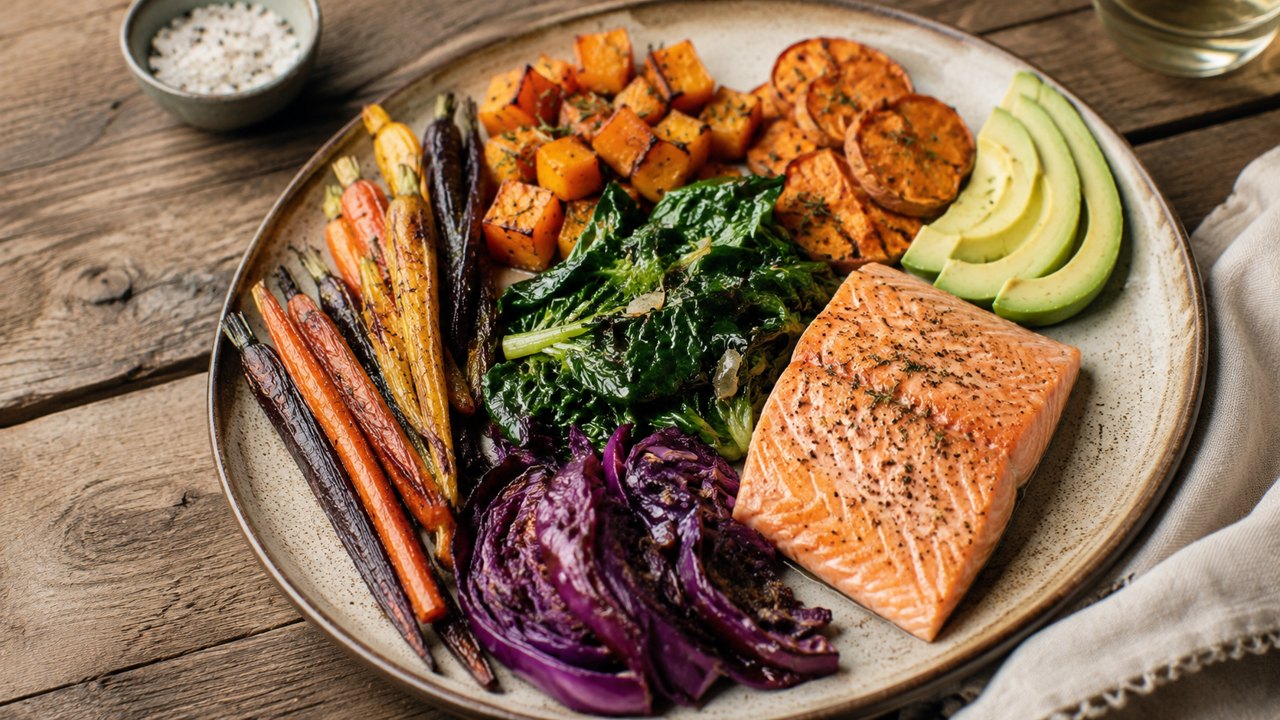
Let's talk about what a proper AIP meal actually looks like and how to build your plate well.
Building the plate well is the ground floor of the second key, gut and nourishment, in the Autoimmune Recovery Method (ARM), a complete approach to moving your Autoimmune condition toward Remission. If you are new here and want the basics of why we eat this way, start with 'What AIP Is, and Why It Works'.
Here is a gentle reminder that is important to hold close to you through your AIP journey. What we eliminate on this protocol stops the damage, but removing foods is not the whole picture. 'What we DO eat is what feeds the microbiome and fuels the body.' Elimination is only half the work. The food you add back in, in real abundance, is what actually heals the gut lining.
So a proper plate is a plate of nourishment, not a list of rules, and it has a shape. Hold the shape like a guide, not a rulebook.
Vegetables first, and most of the plate
This is the part most people get backwards, so I will say it plainly: aim for vegetables at about 75 percent of your plate. Not a side. Not a garnish. The majority.
Vegetables bring the vitamins, the minerals, and the plant compounds that feed your gut and support the whole terrain, and they are the single biggest thing most of us are not eating enough of.
The other half of this teaching is variety. Reach for the widest range you can manage, all the colors of the rainbow, leafy greens, roots, squashes, cruciferous vegetables, whatever is in season and agrees with you.
Dr. Datis Kharrazian recommends 6 to 14 servings of vegetables a day. That is not the insane amount it might sound like at first, it is simply what actually does the healing.
Different colors and different plants do different jobs and feed different bacteria, so the goal across a week is range, not the same two vegetables on repeat.
Variety is also how you prevent new nutrient gaps and new intolerances. If you take one thing from this whole page, let it be more vegetables, and more kinds of them.
Protein, and vary it
A real serving, roughly 4 to 6 ounces of well-sourced meat, poultry, or fish, about the size of your palm or a little more. Protein is what your body uses to rebuild the gut lining, make immune cells, and repair tissue, which is the whole project right now.
Animal protein carries complete essential amino acids in the exact ratios your body uses, along with nutrients that are difficult to get anywhere else in the same bioavailable form, vitamin B12, heme iron, zinc, choline, and taurine among them. This is also why AIP is not compatible with a vegan or vegetarian way of eating, which I explain in 'Why AIP Cannot Be Vegan or Vegetarian'.
Every amino acid is a brick, and the gut barrier you are trying to settle is rebuilt brick by brick from what you actually put on the plate.
Your body cannot stockpile protein the way it stockpiles fat, so it needs a real delivery at each meal to keep the repair work supplied. Skimp on it and the body still finds the amino acids it needs, but it takes them by breaking down your own muscle, which is the opposite of what a depleted woman can afford.
Protein is also a big part of why a meal holds you, because it is the most satiating thing on the plate, the one that tells your appetite the meal was real.
A few things I want you to know here, because they matter more than most people realize. Vary your proteins rather than living on chicken. Reach for pork, beef, lamb, bison, and game too, and go easy on poultry as a category, since its fat runs higher in omega-6 relative to omega-3 than ruminant meats like beef and lamb.
Make fish and seafood a staple of your week, not an occasional treat, and know that a fish-oil capsule does not replace eating the fish, because a capsule does not give you the whole-food matrix and full range of nutrients whole fish provides.
I cover how to source it well in 'Seafood and Fish on AIP: Importance and How to Source Well'.
And aim to work organ meats in at least once a week. I know that lands hard for some of you. But organ meats are nutrient powerhouses, liver especially, and you can hide them in a meatball or a chili if you need to.
Oysters and mussels are an easy starting point if organ meats feel like a big ask. I make the full case in 'Organ Meats: The Most Nutrient-Dense Foods on AIP'.
Good fats and whole-food carbs
Fat is not the enemy and it never was. Olive oil, avocado and avocado oil, coconut, the natural fat on well-raised meat, a little duck fat or tallow.
Fat carries flavor, and it is also the vehicle for the fat-soluble vitamins, A, D, E, and K, which simply cannot be absorbed without it. This is not a small detail in Hashimoto's, where vitamin A and vitamin D both matter to immune regulation.
Eat your colorful vegetables with no fat, and you absorb only a fraction of what they offered you. The carotenoids in carrots, sweet potatoes, and leafy greens, the compounds that give them their color and much of their benefit, are fat-soluble, so without fat on the plate alongside them, your body cannot actually take them up. Fat also burns slow and steady, which is a large part of why a real meal keeps you full for hours rather than spiking and crashing your blood sugar.
A meal with enough fat feels like a meal. A meal without it feels like a snack you are supposed to pretend was dinner.
And here is the one that surprises people: carbs are not the enemy either. AIP is not keto and it is not low-carb.
Your gut actually needs carbohydrate, especially resistant starch, to feed your good bacteria and make the short-chain fatty acids that keep the gut lining healthy. Cut carbs too low and you can slow the conversion of thyroid hormone and lean harder on your stress hormones, which is the last thing we want.
So include whole-food carbs without grains: sweet potato, plantain, cassava, winter squash, pumpkin, a little fruit. We often think we need grains when really we are just used to them. Whole-food carbs give your body what the grain was standing in for, without the trigger.
Plantain, especially when it is still a little green, and tiger nut are particularly rich in resistant starch, a type of carbohydrate that resists digestion until it reaches your large intestine, where it becomes food for the very bacteria you are trying to nourish.
This is the shape of the plate itself making the same argument the whole protocol makes: real, whole food in place of processed food, the move I write about at length in 'For the Love of Whole Foods: The Shift from Processed to Real'.
Three real meals, not constant grazing
Build the plate this way and you will not need to nibble all day. I want you eating 3 real meals, not grazing every couple of hours, because constant snacking does not give your gut the gap it needs to fully digest and run its between-meal cleaning wave.
That cleaning wave has a name, the migrating motor complex, or MMC, and it only switches on once your gut has been empty of food for a real stretch, roughly 4 to 5 hours. Every time you snack, even a small one, the clock resets and the wave never gets to finish its job. Over time, a gut that never gets this gap becomes its own source of trouble.
There is a whole piece that goes deeper into this, 'Why the Space Between Meals Matters', and it is the natural companion to this one. (If your blood sugar is unstable early on, eating a little more often for a short stretch can steady you. That is a temporary bridge, not the goal.) A well-built plate is what makes 3 meals possible, because it actually holds you.
The quiet test of a good plate
Put all of this together and here is what changes. A proper meal often keeps you satisfied for 4 to 5 hours. That is the quiet test of whether the plate was built well, and it is a test you run with your own body, not with a scale or an app.
'I ate a full meal and I am hungry an hour later' is one of the most common things I hear, and it is almost never about your discipline. It usually means the plate was short on protein or fat, or short on the volume of vegetables that could be filling it.
The hunger is a measurement, plain and simple, and there is no blame in it. Adjust the plate, not your self-judgment.
I want to say something about the word 'should', because it does real damage in eating. I am not going to tell you what to eat and what to avoid at every turn, and I would gently invite you to drop that word from how you talk to yourself about food. 'Should' turns a meal into a test you are scored on, a way to be right or wrong about dinner.
It is far more useful, and far kinder, to ask a different question: did this plate give my body what it needs, and did it actually hold me. That is information you can use. Shame is not.
A few honest, practical notes
You do not need to weigh and measure forever. We are not weighing and measuring anything here, as you can see: the big colorful pile of vegetables, the palm-sized protein, the generous pour of good fat, a whole-food carb, eyeballed, will serve you well most days.
Build your plates around what is genuinely satisfying to you within the protocol, because a meal you enjoy is a meal you will actually eat, and consistency is what heals, not perfection. Always knowing what your next meal or two will be, and having it ready to put together, takes so much of the stress out of doing this well.
And if a meal leaves you hungry, take it as feedback rather than a verdict on you. Add more protein, more fat, or more vegetables next time and notice the difference.
This matters more than it might seem, because the plate is the foundation everything else sits on. When your meals truly satisfy you, the cravings quiet, the between-meal grazing eases, and the whole protocol gets dramatically more livable. You stop fighting your hunger and start working with it.
And remember, we eat this way for life. The eliminations are temporary, a few months of giving your gut a clean slate, but eating for nutrient density is not a phase you finish. This is a lifestyle.
So before you eat, glance at the plate and check the shape. Vegetables filling most of it, in as many colors as you can manage. Protein the size of your palm. Real fat. A whole-food carb.
Then, before the first bite, take one slow breath down into the belly and let the body know food is coming. That low belly breath signals safety to your nervous system, and it settles. Take a moment, too, for real gratitude: for the animal, the plants, and the earth that gave you this food, and for every person whose effort brought it to your plate. Food is medicine, and every meal you eat is medicine you are taking in. That small pause does real work. It shifts you out of the hurried, braced state and into the one where you actually digest.
In that pause, you might also notice the quiet, steady voice in you that wanted to feed you well in the first place. It is the kind voice, the one guiding you toward harmony and balance. The Sufi poets Rumi and Hafiz called it the Friend. It is the part of you that keeps championing for you, even on the days you cannot quite champion for yourself.
Trust it, and let 'The Inner Work Is Not Soft: Why Mindset and Connection Are Part of Recovery' show you how to listen for it. Get the shape right, eat it like it matters, and most of the rest gets easier.
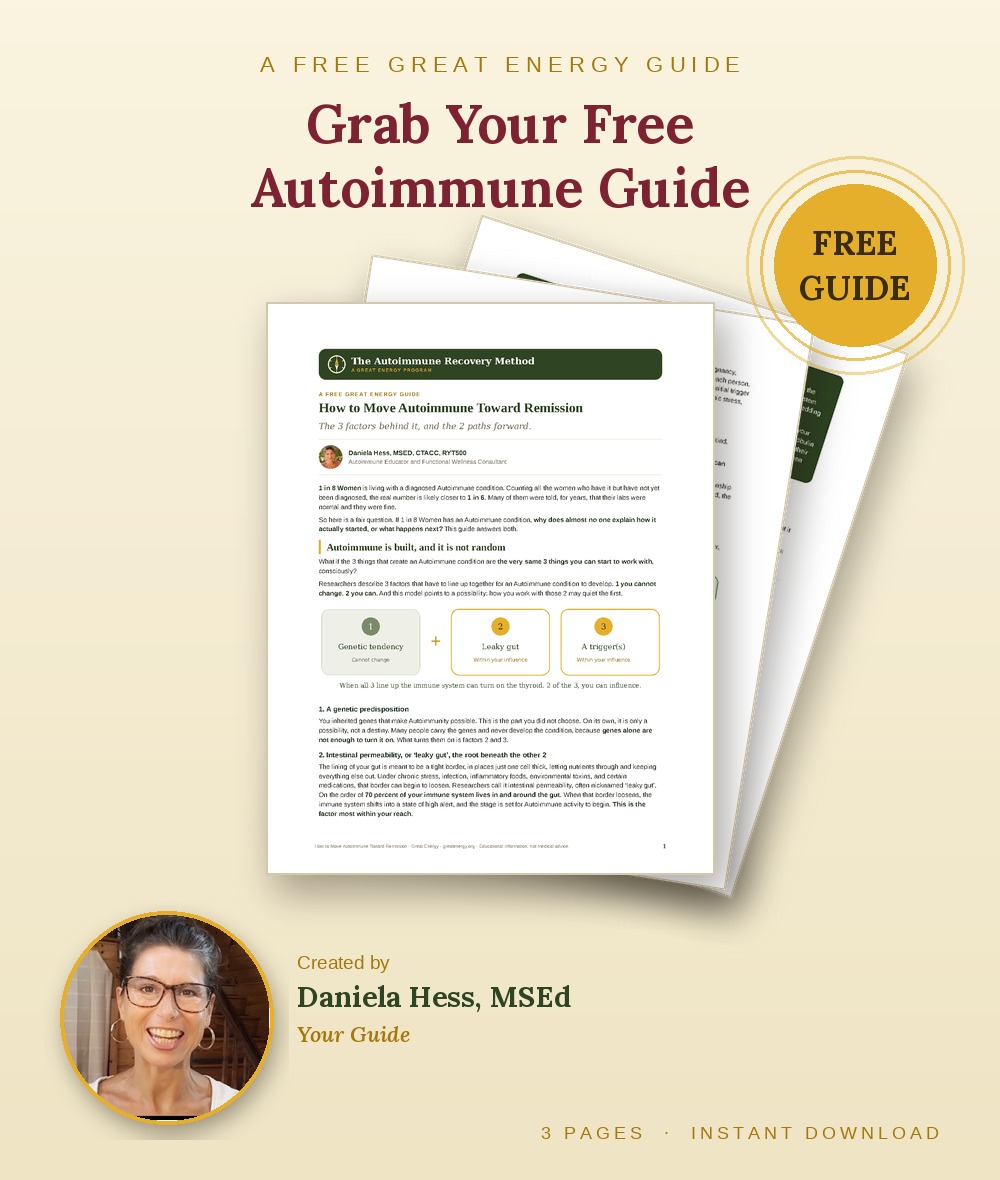
How to Move Autoimmune Toward Remission
The 3 factors behind an Autoimmune condition and the 2 paths forward, free, straight to your inbox.
No spam. Unsubscribe anytime.
Your guide is on its way. You can also open it now (PDF).
Prefer to work together directly? Daniela offers a 1-on-1 labs review and functional wellness session for women with an Autoimmune diagnosis.
See how to work with Daniela
About the author
Daniela Hess, MSEd, is the co-founder of Great Energy and the founder of the Autoimmune Recovery Method. She is an Autoimmune Educator and Coach, a Functional Wellness Consultant, and a certified AIP coach. She lives and thrives with Hashimoto’s and hypothyroidism, and she teaches the science and the Soul of moving an autoimmune condition toward Remission. She is not a licensed medical provider and does not diagnose, treat, or prescribe. Everything here is for education, not medical advice.
With Great Energy & Great Love,
Daniela
From the glossary
Words in this article you can look up. Tap or click a term to learn what it means.
Blood sugarCassavaCholineHeme ironMicrobiomeMigrating motor complexNutrient densityPlantainRemissionResistant starchShort-chain fatty acidsVitamin AVitamin B12Vitamin D