Sauces, condiments & dressings
Creamy turmeric dressing: the anti-inflammatory pour-over for salads and roasted vegetables
Sauces, condiments & dressings · serves 8 · under-15 min
Core AIP · Elimination phase compliant
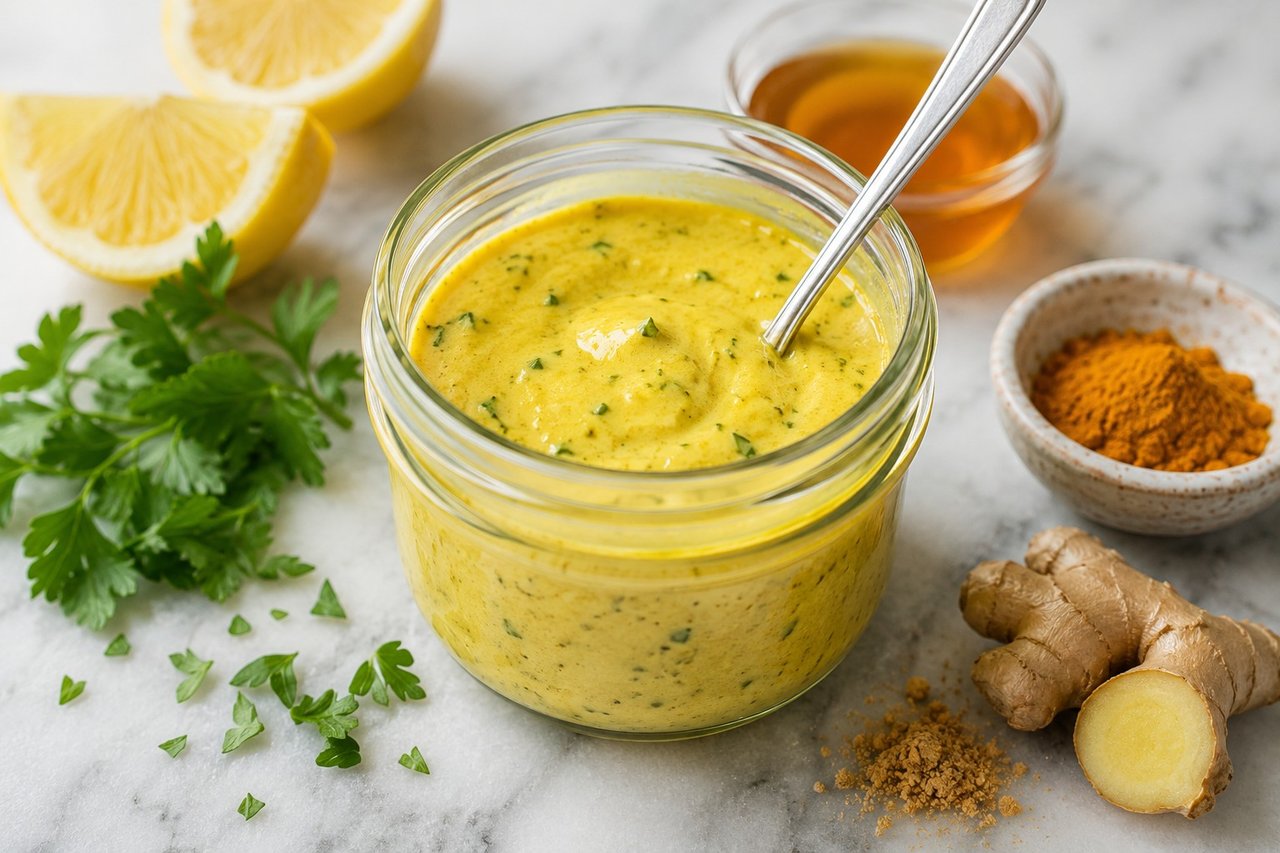
Most creamy dressings in conventional cooking use tahini or sunflower oil as their fat base. Both are excluded on AIP elimination. This dressing uses coconut cream and olive oil instead, emulsified with an immersion blender into something smooth and pourable that does not taste like coconut or announce its substitution.
Turmeric is the dominant flavor note and the anti-inflammatory anchor. Ground ginger adds warmth and its own separate anti-inflammatory contribution. Fresh parsley adds a small amount of greenery and brightness. The whole thing takes two minutes and produces about a cup and a half of dressing - enough for four to six large salads or a week of roasted vegetable finishing.
A note on curcumin bioavailability: black pepper (piperine) increases curcumin absorption by roughly 20-fold and is often combined with turmeric for this reason. Black pepper is excluded on AIP elimination. Fat is the other bioavailability amplifier for curcumin, and this dressing provides plenty of it through the coconut cream and olive oil. Even without piperine, the fat co-ingestion helps. For people on reintroduction who can tolerate pepper, adding 1/8 teaspoon here is worth it.
Ingredients
- 1/3 cup full-fat coconut cream (the solid cream from a chilled can; spoon it off the top)
- 1/2 cup extra-virgin olive oil
- 1 tbsp fresh lemon juice (or apple cider vinegar for a citrus-free version)
- 1 tsp ground turmeric
- 1/2 tsp ground ginger
- 2 tsp fresh flat-leaf parsley, finely chopped
- 1/2 tsp fine sea salt
- 1 tsp raw honey (optional; omit for strict Whole30)
AIP note: Black pepper is omitted. For those on reintroduction, 1/8 tsp black pepper significantly improves curcumin absorption.
Yield: About 1 to 1.5 cups - enough for 6 to 8 salad portions.
Method
Combine the coconut cream, olive oil, lemon juice, turmeric, ginger, parsley, salt, and honey (if using) in a tall glass or a wide-mouth jar.
Blend with an immersion blender until smooth and creamy, about 30 seconds. The dressing should be a uniform pale orange color with no visible separation.
Alternatively, whisk vigorously in a small bowl until the coconut cream is fully incorporated. The result will be slightly less smooth than the blended version but will work as a dressing.
Taste and adjust. The dressing should taste warm from the turmeric and ginger, tart from the lemon, and well-seasoned. Add a small additional pinch of salt if it tastes flat.
Note on storage: The coconut cream and olive oil will separate in the refrigerator. Run the sealed jar under warm water for 30 seconds and re-whisk or re-blend before using.
Note on color: Turmeric stains. Clean your immersion blender and any cloth immediately.
How to use it
- Dress any salad in place of a tahini-based dressing
- Drizzle over roasted asparagus spears (the original pairing on the source site)
- Pour over a warm cauliflower and beet salad as a plate sauce
- Use as a dipping sauce for roasted sweet potato wedges
- Toss with cold slaw-cut cabbage and carrots as a quick side
- Drizzle over baked salmon fillets at plating
Storage
Refrigerator: up to 1 week in a sealed glass jar. Reheat and re-emulsify before each use.
*Adapted from unboundwellness.com/anti-inflammatory-turmeric-dressing/ by Michelle Hoover*
Nutrition
Estimated per serving (serves 8), calculated from the ingredients. Actual values vary with brands, sizes, and how much sauce or dressing you use.
How to Move Autoimmune Toward Remission
The 3 factors behind an Autoimmune condition and the 2 paths forward, free, straight to your inbox.
No spam. Unsubscribe anytime.
Your guide is on its way. You can also open it now (PDF).

Further reading
Daniela Hess, MSEd, is a co-founder of Great Energy and an Autoimmune Educator and Functional Wellness Consultant who lives and thrives with Hashimoto’s. She is not a licensed medical provider.
More recipes with Coconut cream, Lemon, or Turmeric
A reworked AIP tikka masala, warm and creamy, built without the nightshades and seedsA Creamy Ranch That Skips the Dairy and Keeps the ComfortA Make-Ahead Meal for the Days You Cannot CookA bright raw slaw of shredded carrot and radish tossed in a no-cook mint and turmeric pestoAIP Gyro Wrap with Coconut TzatzikiAIP colorful cauliflower salad - blanched cauliflower, dried fruit, turmeric-anchovy dressingAIP egg-free mayonnaise: a coconut cream and avocado oil emulsion in 5 minutesAIP harvest vegetable soup - root vegetables, squash and ground beef in broth, AIP Core seed-freeFrom the glossary
Words in this recipe you can look up. Tap or click a term to learn what it means.
BioavailabilityCoconut creamCurcuminEmulsifyReintroductionEvery ingredient in this recipe is on the Core Autoimmune Protocol food list.
Download the Core Food List (PDF) Explore the food list