Sauces, condiments & dressings
AIP nomato marinara: the herb-forward pasta sauce built from beets, carrots, and olives
Sauces, condiments & dressings · serves 8 · 30-60 min
Core AIP · Elimination phase compliant
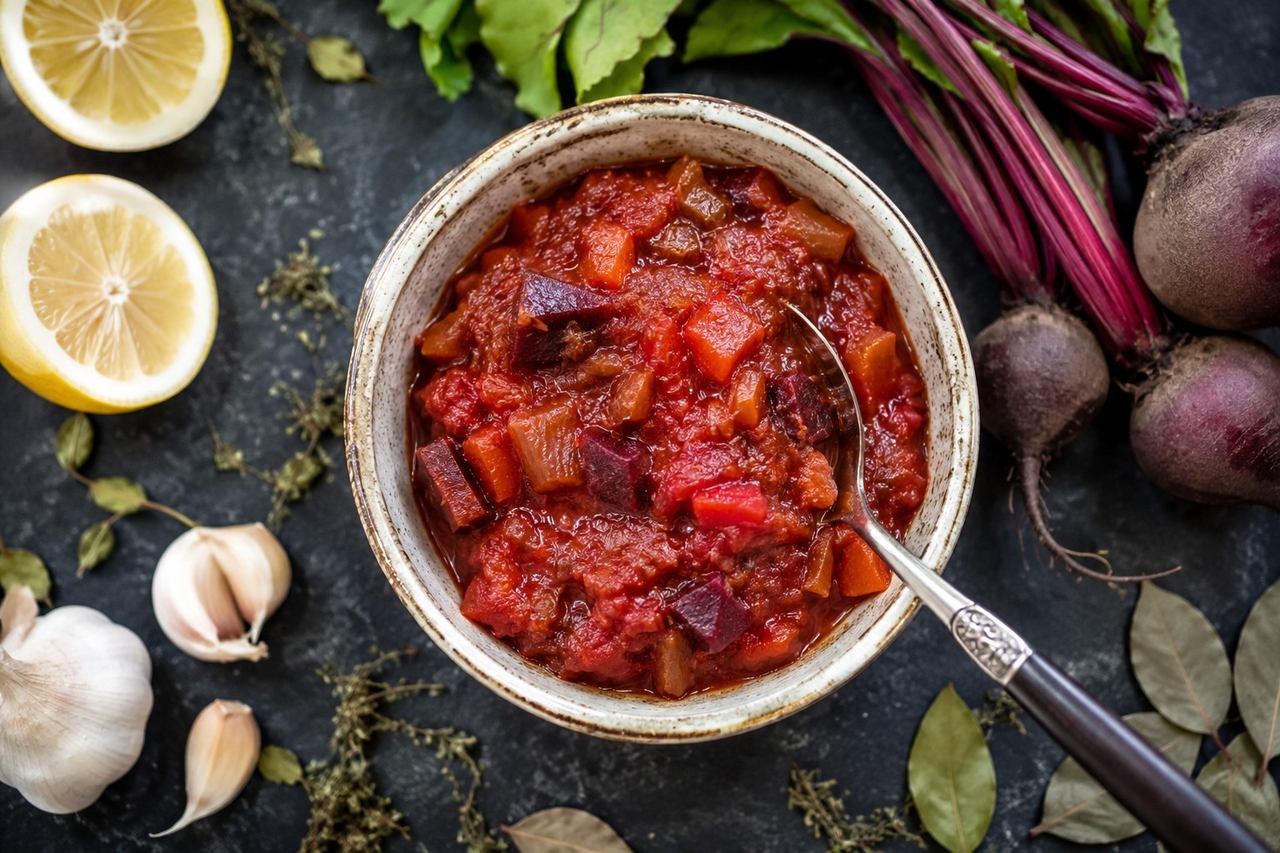
The other nomato sauces are a blended root-vegetable base (see the classic nomato at Classic Nomato Sauce, built on carrot, beet, and butternut squash, or the BBQ version at Nomato BBQ sauce). This is a different thing: a true marinara equivalent, herb-forward and cooked long enough to develop the kind of depth that comes from time and aromatics rather than nightshade acidity.
The technique secret is the kalamata olives, which go in at the blending stage rather than during cooking. Olives bring glutamate compounds - the same family of savory molecules found in tomatoes, Parmesan, and anchovies. They are the closest AIP-compliant substitute for the umami backbone that makes tomato sauce taste like more than its components. You do not taste olive in the finished sauce; you taste savory depth and something that reads as complex.
The herb combination - basil, oregano, thyme, marjoram - is the Italian canon. Lemon juice, added after blending, provides the acid brightness that would normally come from the tomatoes themselves. The sauce is not trying to be tomato sauce; it is trying to be something that functions the way tomato sauce does in a dish, and it succeeds at that.
Beets contribute betalains, a group of plant pigments with antioxidant properties distinct from the anthocyanins in berries. They are also responsible for the sauce's deep red color - convincing enough that it requires a moment of attention before you register that nothing is wrong with your AIP protocol.
Ingredients
- 2 to 4 tbsp cooking fat (bacon fat, lard, or coconut oil)
- 1 large onion, roughly chopped (about 3 cups)
- 4 ribs celery, roughly chopped (about 2 cups)
- 1 lb carrots, roughly chopped (about 2 cups)
- 3 medium beets, peeled and roughly chopped (about 3 cups)
- 4 to 8 cloves garlic, pressed or minced
- Juice of 2 lemons (about 1/4 cup)
- 1/2 tsp dried basil
- 1/2 tsp dried oregano
- 1/2 tsp dried thyme
- 1/4 tsp dried marjoram
- 2 dried bay leaves
- Fine sea salt, to taste
- Bone broth and water, enough to barely cover the vegetables (about 2 to 3 cups)
- 15 to 20 kalamata olives, drained and pitted
Yield: About 4 to 5 cups of sauce - enough for 8 servings.
Method
Heat the cooking fat in a large, heavy pot over medium heat. Add the onion and cook, stirring occasionally, until softened and starting to turn golden, about 8 minutes. Add the garlic and cook 2 minutes more.
Add the celery, carrots, beets, bay leaves, dried herbs, and lemon juice. Stir to combine. Pour in enough bone broth and water to barely cover the vegetables. Bring to a boil, then reduce to a low simmer.
Cook, partially covered, until all the vegetables are very tender - the beets in particular should be completely soft when pierced with a fork, about 25 to 35 minutes.
Remove the bay leaves. Add the olives. Transfer the entire contents of the pot to a blender (in batches if needed) and blend until completely smooth. Season with salt.
Return to the pot and simmer for a further 5 to 10 minutes to reduce to a sauce consistency. If it is already the consistency you want, it is ready.
Taste again and adjust the salt and lemon.
Note on blending hot liquids: Fill the blender no more than halfway and hold the lid firmly with a towel. Hot liquid expands when blended. Work in batches.
How to use it
- Toss with spaghetti squash or sweet potato noodles as an AIP bolognese base (add browned ground beef or pork)
- Use as a sauce for AIP meatballs over zucchini noodles
- Spread on cassava tortillas as an AIP pizza-style base
- Serve as a dipping sauce for roasted cauliflower florets
- Use as the sauce layer in an AIP lasagna-style dish with thinly sliced zucchini
- Stir into soups as a flavor base - 1/2 cup per quart of broth adds significant depth
See also: classic nomato sauce, nomato BBQ sauce
Storage
Refrigerator: up to 5 days in a sealed glass jar.
Freezer: up to 3 months. Freeze in 1-cup portions for easy meal use.
*Adapted from thecuriouscoconut.com/blog/the-best-no-mato-sauce-autoimmune-paleo-marinara/ by Amanda Torres*
Nutrition
Estimated per serving (serves 8), calculated from the ingredients. Actual values vary with brands, sizes, and how much sauce or dressing you use.
How to Move Autoimmune Toward Remission
The 3 factors behind an Autoimmune condition and the 2 paths forward, free, straight to your inbox.
No spam. Unsubscribe anytime.
Your guide is on its way. You can also open it now (PDF).

Further reading
Daniela Hess, MSEd, is a co-founder of Great Energy and an Autoimmune Educator and Functional Wellness Consultant who lives and thrives with Hashimoto’s. She is not a licensed medical provider.
More recipes with Bacon fat, Onion, or Celery
A Make-Ahead Meal for the Days You Cannot CookA hearty Irish lamb stew braised low with turnips, riced celeriac, and thymeA slow-braised beef stew built on bone broth, anchovy depth, and a last-minute lift of kaleA slow-cooked beef stew with whole vegetables and broth, thickened by pureeing the softened onion and garlic back in, then finished with cranberriesA warming AIP chicken pho built in the Instant Pot with sweet potato noodles and fresh herbsAIP Instant Pot pumpkin coconut soup with turmeric, ginger, curry leaves, and cranberries - seed-spice-free, veganAIP Minestrone SoupAIP Paleo ChiliFrom the glossary
Words in this recipe you can look up. Tap or click a term to learn what it means.
AntioxidantBacon fatBone brothCassavaLardMarjoramNightshadeNomatoReduceSpaghetti squashUmamiEvery ingredient in this recipe is on the Core Autoimmune Protocol food list.
Download the Core Food List (PDF) Explore the food list